
A six-digit counter with paired signed readout gives ranks 1, 1, 2, 2, 3, 3 exactly. Its binary version compresses 64 addresses into 27 sites, exposing both the value of the construction and the memory carried beyond a spatial image.
What nesting means
A nested level completes work that depends on organized activity at lower levels. It is not an extra independent clock that an observer can set separately. A familiar counter captures this distinction: one elementary advance drives all digits, but higher digits change only when lower digits complete their cycles.
In DTT, the six inner roles describe this generative organization. Outer completion is the seventh role: it makes the outcome available as a record. The distinction is between constructing a configuration and certifying its availability, rather than between seven mutually independent temporal coordinates. A concrete model must state what each level retains and what qualifies its completion.
Open the full-size diagram →
One update, six carry periods
Take a radix q≥2 and six digits d₁,…,d₆, each between zero and q−1. The source address is the integer represented by those digits, with d₁ changing fastest. One update increments the address, including the usual carries.
0 ≤ n < q⁶.
Digit a changes after groups of qa−1 elementary updates, and the first a digits complete a cycle after qa updates. Higher roles therefore depend on completed lower-level cycles. The six digits are internal state variables of one update, not six separately evolving laboratory times.
Deriving the paired rank sequence
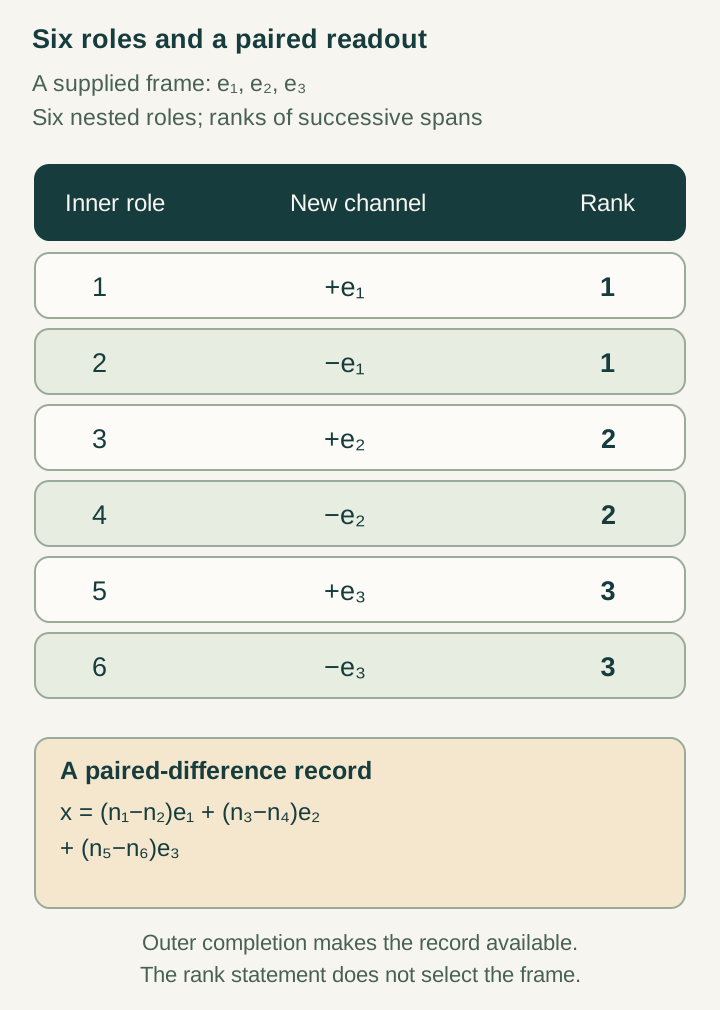
Supply three independent readout directions e₁,e₂,e₃ and a length scale ℓ. Pair adjacent digits with opposite signs:
During the first qa addresses, only the first a digits vary. The first digit opens e₁; its partner changes values along the same direction. The third digit opens e₂, and the fifth opens e₃. Because the listed directions are independent, the affine span has rank ⌈a/2⌉. The sequence is therefore 1,1,2,2,3,3. The supplied pairing explains this rank law; proving that nature selects the pairing is a further source-dynamics question.
Worked example: 64 addresses, 27 sites
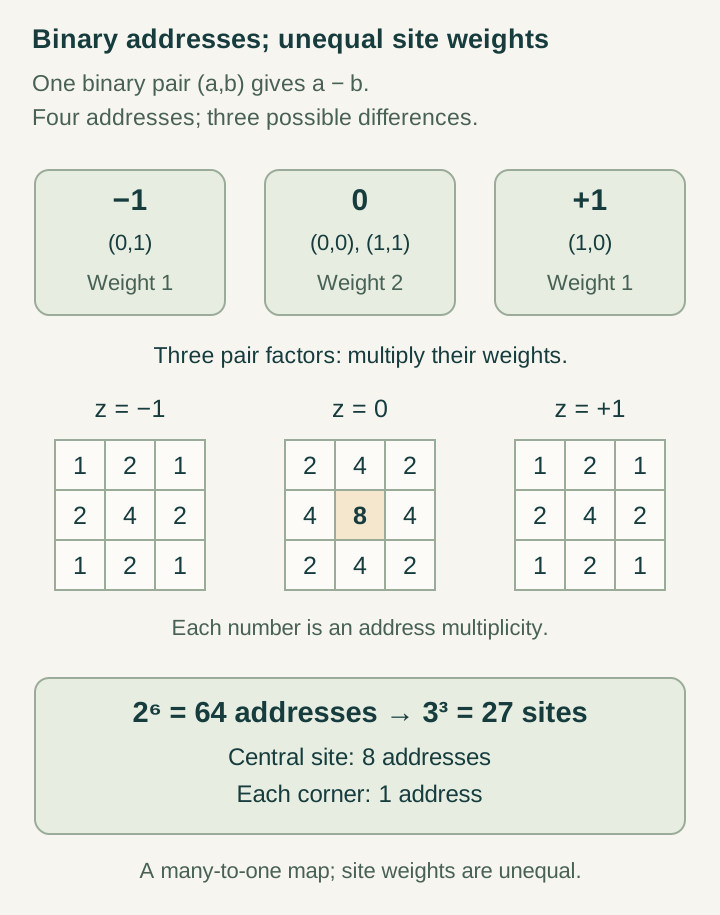
For q=2 there are 2⁶=64 addresses. Each paired difference can equal −1,0 or +1, giving 3³=27 distinct spatial sites. For one pair, the difference zero has two representatives, (0,0) and (1,1), while each nonzero difference has one.
Central-site multiplicity = 2³ = 8; corner multiplicity = 1.
Uniform address visitation consequently gives probability 8/64=1/8 to the centre and 1/64 to each corner. Uniform sampling of sites would instead give 1/27 to every site. Completion must specify whether it retains this multiplicity, compensates it or exposes a different measure. Geometric shape alone does not determine statistics.
Open the full-size diagram →
What the seventh role publishes
A completed episode can collect the full set of visited sites, the relations between them and any retained amplitudes or correlations. The publication interface certifies that this archive is ready for subsequent use. It is not a seventh digit, an additional spatial axis or merely a decorative phase marker.
The counter's private scan order must also be distinguished from observable transport. Carries reset several digits and can produce projected jumps. A particle cannot be assumed to follow that scan. Local motion needs a separate rule acting on completed records, together with a proof that its support grows only through the retained neighbourhood relations.
When six channels are minimal
A precise restricted lower bound accompanies the construction. Suppose primitive channels are nonnegative and an involution exchanges each channel with its opposite. Require the readout to be odd under this exchange. Each exchanged pair contributes at most one independent odd direction. Rank three then requires at least three pairs, hence six primitive channels.
Turning this into a six-level result additionally requires one primitive channel per level. Three coordinates that are signed from the beginning evade the nonnegative-channel assumption. Other generating arrangements can also evade the paired involution. The theorem establishes minimality within a declared architecture, which is exactly where a physical selection principle must act.
A productive physical question
The finite hierarchy gives DTT a clear computational realization: nested work, paired spatial readout and completed availability can coexist under one elementary update. Its most useful next development is to connect those roles to measurable resources. How much memory must remain available, how long does publication take, and what rule protects local transport?
A strong extension would vary q while keeping the source interaction and calibration fixed. It would track archive multiplicities, completion duration and propagation together. Agreement across that family would support a common physical mechanism; changing each interface independently would only produce another collection of compatible examples.
Continue with the articles
- One action, two temporal roles
Explain the draft’s same-cycle foundation: inner action is primitive, while outer record order comes from completed observable returns. Neither role automatically supplies a second readable laboratory clock.
- Six inner stages and one publication interface
Explain the hierarchy of readout ranks 1, 1, 2, 2, 3, 3 followed by completion. These are nested functional roles rather than six independently readable temporal coordinates.
- Generating a neighborhood and preserving local transport
Separate reconstruction of spatial adjacency from the requirement that subsequent dynamics remain local. Explain the guarded transport rules used to preserve the generated metric.
- What spatial readout forgets
Investigate information lost when a full generative state is reduced to spatial records. Explain why an apparently complete geometry may still be insufficient for autonomous prediction.