
For a radix-q counter with paired signed columns, the prefix image has affine rank ceiling(a/2). A separate involution argument shows why three odd directions need six primitive channels within the stated architecture.
Inputs: one update, six digits and a readout
Choose an integer radix q≥2, a positive length scale ℓ and three linearly independent vectors e1, e2, e3. Let the internal address have six digits da∈{0,…,q−1}, with the first digit least significant. The address and elementary update are:
Define a completed-coordinate candidate by Q(d)=ℓ[(d1−d2)e1+(d3−d4)e2+(d5−d6)e3]. The frame, length and pairing are declared interface data. The theorem concerns the image of this map; it does not derive the frame from a structureless source. Its SMM/DTT relevance is that one evolving address can organize several dependent inner roles without introducing independently adjustable clocks.
Step 1: identify the nested carry structure
Digit d1 changes at every update. Digit d2 changes when a full q-step cycle of the first digit completes. In general, da changes after groups of qa−1 elementary advances. The first a digits jointly return after qa advances.
Define the a-stage prefix as the addresses 0≤n<qa, beginning at the all-zero address. Exactly the first a digits vary freely over their q values, while all higher digits remain zero. This follows directly from uniqueness of the base-q expansion. The prefix contains qa internal states. Higher stages include every lower-stage configuration and additional combinations, making their dependence nested rather than parallel.
A different starting address need not have this simple prefix form because a carry can already be pending. The specified initialization is therefore part of the calculation, not an irrelevant notation choice.
Step 2: prove both bounds on the prefix rank
Write the readout as a matrix whose columns are ℓe1, −ℓe1, ℓe2, −ℓe2, ℓe3, −ℓe3. When only the first a digits vary, every output lies in the span of the first a columns. That span contains at most ceiling(a/2) frame directions, giving the upper bound.
For the reverse bound, the prefix contains the zero address and the address with a single digit equal to one in each available odd position. Their outputs are ℓe1, then ℓe2, then ℓe3 as those positions become available. They are independent because the frame is independent and ℓ>0. Since zero belongs to the image, its affine span equals its linear span.
a=1,…,6 ⇒ 1,1,2,2,3,3
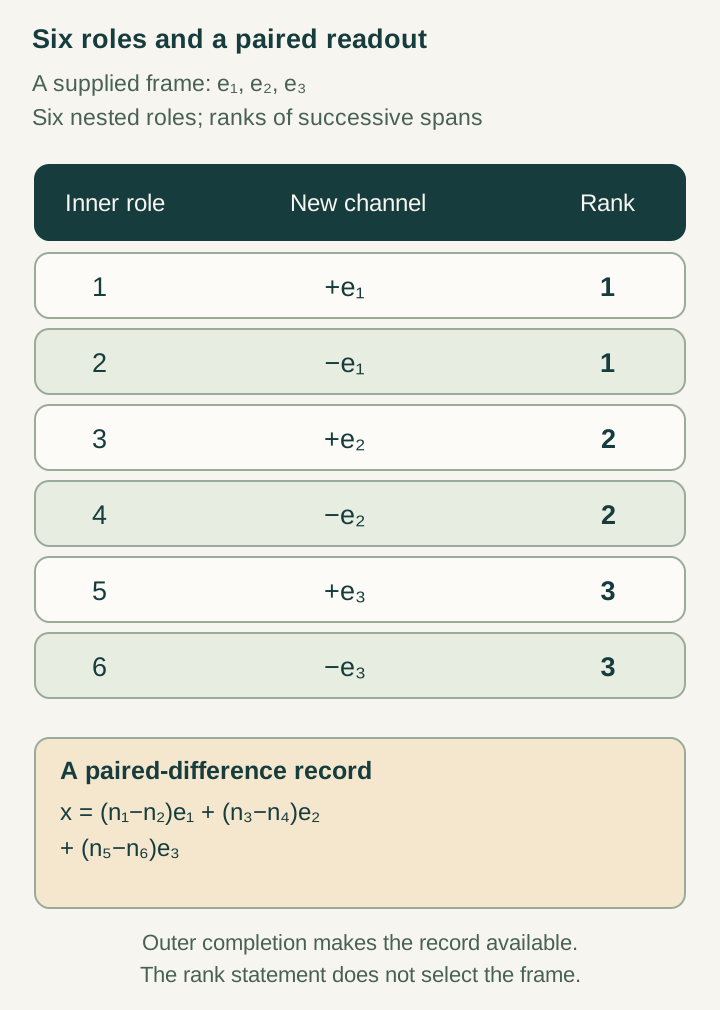
Open the full-size diagram →
Step 3: count sites as well as directions
For a completed pair, d2b−1−d2b takes every integer from −(q−1) to q−1. Distinct coordinate triples give distinct outputs because the frame is independent. Thus a prefix ending after m complete pairs has (2q−1)m sites, although it has q2m addresses.
If one further unpaired digit has opened the next direction, that coordinate takes q values from zero to q−1. The image count is then q(2q−1)m. These formulas distinguish the number of states, the number of displayed sites and the affine rank.
|Q(prefix 2m+1)|=q(2q−1)m
For q=3, the successive site counts are 3, 5, 15, 25, 75 and 125, while the final address count is 729. The rank remains three. Increasing the radix changes resolution and multiplicity without adding another independent direction.
Step 4: establish the restricted six-channel bound
Now consider a more general linear readout C from m primitive channel coordinates to a spatial vector space. Suppose an involution P exchanges opposite channel partners and the readout is odd: CP=−C. Decompose a channel vector into x+=(x+Px)/2 and x−=(x−Px)/2. The even component satisfies Cx+=0, so every output comes from the odd eigenspace.
If P has p exchanged pairs and f fixed channels, m=2p+f. Each pair contributes one independent odd difference; fixed channels contribute none. Therefore dim ker(P+I)=p and rank C≤p. A rank-three output requires p≥3 and hence m≥6.
The paired counter attains the bound with three pairs. To interpret it as a six-level lower bound requires the extra architectural rule that each level supplies exactly one primitive channel.
What changes when the channel assumptions change?
The lower bound applies when channels are primitive nonnegative contributions organized in individual opposite pairs. Three coordinates that are signed from the outset do not satisfy that primitive-channel description. Four nonnegative tetrahedral directions also evade the pairing assumption.
For example, take (1,1,1), (1,−1,−1), (−1,1,−1) and (−1,−1,1). They span three dimensions and sum to zero, so the negative of any one is the sum of the other three. No individual vector is the opposite of another. This explicit alternative shows why rank three does not universally imply six generators. A physical necessity claim must first justify the opposite-pair architecture through source operations and completed tests.
Outer completion and predictive memory
The seventh role can certify that the chosen sweep has produced an available archive. It is not a seventh digit or an extra spatial coordinate. If different sweeps must be distinguished, their completion record needs its own retained history or counter; simple recurrence of the inner address does not create an arrow by itself.
The spatial image also fails to predict every elementary successor. Addresses zero and q²−1 both have readout zero, but their next outputs are ℓe1 and ℓe2. A unique public update on sites alone is therefore impossible at that boundary. A completed state must retain the missing carry information, use a different boundary, or admit history dependence. Private counter jumps likewise cannot be identified with particle transport without a local influence law.
Result and the source-level obligation
The calculation establishes the exact rank sequence, prefix image counts and a restricted channel lower bound. It expresses the DTT pairing idea in a finite model with explicit state and update rules. The six roles are nested functions of one process, while three is the number of independent output directions.
A stronger SMM/DTT construction should derive the frame and pairing, account for memory and completion duration, and preserve local transport on the resulting records. The binary calculation studies the measure that this same map produces; the locality problem explains what must be added before the image serves as physical space.
Continue with the articles
- Six inner stages and one publication interface
Explain the hierarchy of readout ranks 1, 1, 2, 2, 3, 3 followed by completion. These are nested functional roles rather than six independently readable temporal coordinates.
- Generating a neighborhood and preserving local transport
Separate reconstruction of spatial adjacency from the requirement that subsequent dynamics remain local. Explain the guarded transport rules used to preserve the generated metric.
- What spatial readout forgets
Investigate information lost when a full generative state is reduced to spatial records. Explain why an apparently complete geometry may still be insufficient for autonomous prediction.
- Why a bare source does not imply spacetime
Introduce the obstruction showing that source order alone lacks enough structure to fix Lorentzian geometry. Use it to explain the role of the reconstruction’s additional assumptions.