
A decisive next theorem would derive a relation between record refinement, a physical clock and matter transport across a family of settings, while accounting for retained memory and completion resources.
The joint theorem to pursue
Specify a source state space, retained memory, one autonomous update, admissible preparations and a completion instrument. Define spatial scale, record number, clock reading and transport independently. The goal is to prove a relationship among those outputs that cannot be removed by adjusting an otherwise admissible internal coupling.
For a refinement family with B children and contraction q⁻¹, one proposed target is Nn=Bn, ℓn=Lq−n and D=log B/log q, together with a material conversion Δu/ΔT=D. If a matter coefficient vg is independently defined per unit u, its clock-measured value would be Dvg. Calling that value a universal causal speed requires an additional propagation theorem.
The existing constructive starting point
The positive phase–dilation model supplies a useful interaction restriction. Let Q=log z, let θ be a circular phase and let K,J be their conjugate momenta. With a work connection W independent of those momenta, set C=K+ηJ+W and H=F(C). Hamilton’s equations give Q̇=F′(C) and θ̇=ηF′(C), hence θ−ηQ is conserved.
This exact identity couples two readouts through one charge. The corresponding quantum construction preserves exp(iθ−iηQ) under its stated operator assumptions. It establishes a nonempty common-source architecture, although endpoint contacts, material clock couplings and the substrate remain specified ingredients.
Which independent assumptions remain?
The refinement relation currently uses independently supplied capacity and scale contacts. The first detects B children and the second checks q; a shared phase calibration then yields u=a*log B and τ=a*log q. A protected clock reads τ, and a separately defined matter sector evolves with u. These interfaces are mutually compatible, but compatibility does not force their selection.
The source also needs a physical resource account. A unique active cursor can control a large stored archive; that archive is still a resource. Acceptance, rejection recovery, export and later readout can consume duration or energy. A theorem about selected successful outputs must not silently omit those branches from its clock law.
A candidate construction to investigate
Start with the one-charge interaction class and enlarge its work register to include the geometry certificate, an encoded clock and a propagating carrier. Derive each interaction from the same admitted operation algebra and conserved quantities. Keep separate ports for counting records, comparing scales and reading matter phases, so the intended relation is measured rather than defined into the ports.
Use the six inner levels as nested dependencies: each higher operation acts on retained outputs of lower operations. The seventh role exposes a completed record. The substantive task is to prove that the interaction algebra enforces the required clock and matter restrictions, rather than inserting them as independently chosen controls.
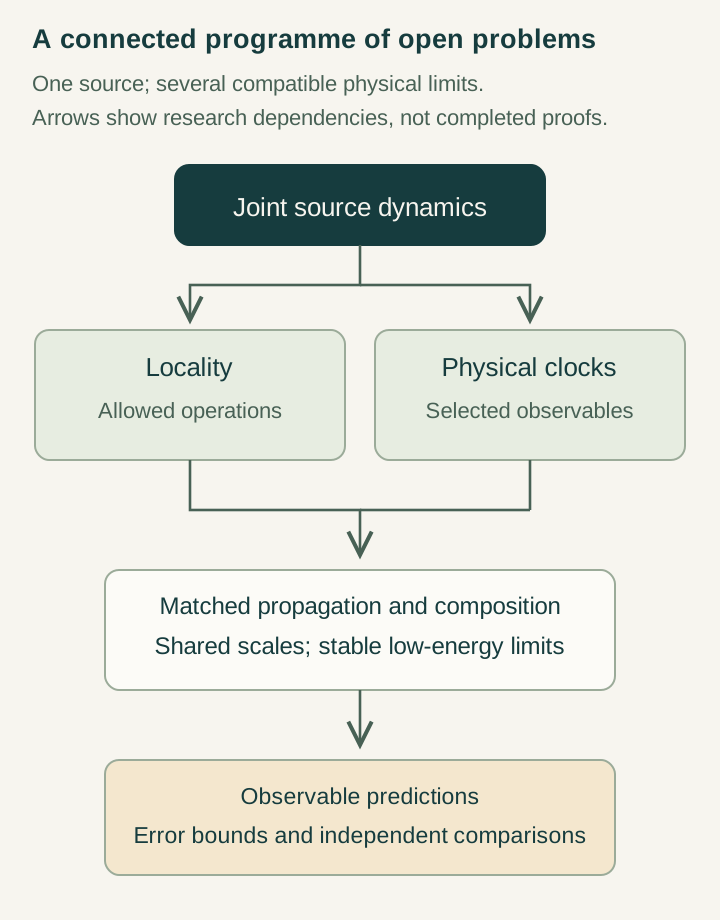
Open the full-size diagram →
A toy example that tests joint selection
Set q=2 and compare B=4 with B=8. Their record dimensions are two and three. Suppose a clock reads T=τ+λu. Then the same source and record measurements give:
For λ=0 the two outputs are two and three. For λ=1 they are 2/3 and 3/4. Both clock laws can coexist with the stated phase–dilation identity. No fixed change of units makes them agree over the family. The desired source theorem must identify a derived physical condition that removes or fixes λ. Merely naming the λ=0 device the outer clock leaves the selection problem unchanged.
A finite completion result worth proving first
A tractable intermediate result is an accepted channel Iacc(ρ)=pVρV† with p independent of an unknown payload. This ensures acceptance does not secretly select favorable inputs. Prove the identity on the entire admitted sector, including inputs entangled with a passive reference.
Failure requires a separate analysis. If it restores the input and fresh trials have the same independent probability p, the mean number of attempts is 1/p. A clock that counts actual attempts therefore differs from a clock that labels only successful completions. State which reading enters the joint law and derive any conversion between them from the same source resources.
What would count as progress?
A successful result would exhibit a nonempty refinement family, fixed microscopic rules, independently calibrated outputs and a proved relation with explicit errors. Varying B and q must not trigger a fresh fit of the clock or matter coefficient. Perturbing the source should produce controlled changes in the same joint measurements.
Even a precise surviving freedom would be useful: it would identify the additional principle needed. The programme becomes predictive when one source restriction rules out a countermodel that previously satisfied every premise. The clock-selection problem and locality problem are two concrete parts of that larger task.
Continue with the articles
- Why one clock model does not prove universality
Use the ungated-clock countermodel to show that a realizable clock law need not be physically universal. Explain the extra selection principle required for all material clocks to agree.
- A quantum source for generation and completion
Introduce the positive phase–dilation model as an explicit realization within quantum mechanics. Explain how it distinguishes inner work from completed observation without deriving quantum kinematics itself.
- Completion without biasing an unknown input
Explain the construction of a loaded completion channel with input-independent success probability. Clarify why this condition matters when the matter state is unknown.
- From record refinement to a joint clock–band relation
Introduce the conditional relation connecting geometry, clock response, and matter transport. Explain why the interfaces and coefficients must be independently calibrated.
- A record that carries its own completion certificate
Introduce autonomous generation of a record and a flag certifying completion. Explain why the certificate must arise from the specified dynamics rather than an external declaration.
- Six inner stages and one publication interface
Explain the hierarchy of readout ranks 1, 1, 2, 2, 3, 3 followed by completion. These are nested functional roles rather than six independently readable temporal coordinates.
- What Lorentzian reconstruction leaves open
Summarize the boundary of the constraint-relative theorem. Recovering a causal geometry does not itself determine matter dynamics, the numerical limiting speed, or Einstein’s field equations.