Summarize the boundary of the constraint-relative theorem. Recovering a causal geometry does not itself determine matter dynamics, the numerical limiting speed, or Einstein’s field equations.
The reconstruction assembles phase, quaternionic readout, an ordered duration, a symmetric completion cone and calibrated volume into a Lorentzian observer geometry. That is a substantial conditional result because it specifies how many familiar structures can fit together without assuming a Minkowski metric at the first step. Its usefulness depends on preserving the scope of the conclusion. A causal geometry tells us which directions are possible and how durations are measured. It does not determine which fields exist, their masses, their equations of motion or their quantum state. These are downstream physical questions.
02Geometry does not choose matter dynamics
On the same Lorentzian manifold one can define scalar, spinor and gauge fields, with many different masses and interaction strengths. Even imposing covariance leaves choices of representations and couplings. A Klein–Gordon equation illustrates the issue: every positive mass parameter gives a covariant equation on the same background. Introducing a Dirac spinor adds algebraic structure and changes the observables without changing the spacetime dimension. A complete SMM/DTT account should derive the material carrier and its propagation from the same source that generates geometry; selecting a compatible matter equation afterwards demonstrates consistency but not uniqueness.
(□g − m²c²/ħ²)φ = 0 is compatible with many choices of m.
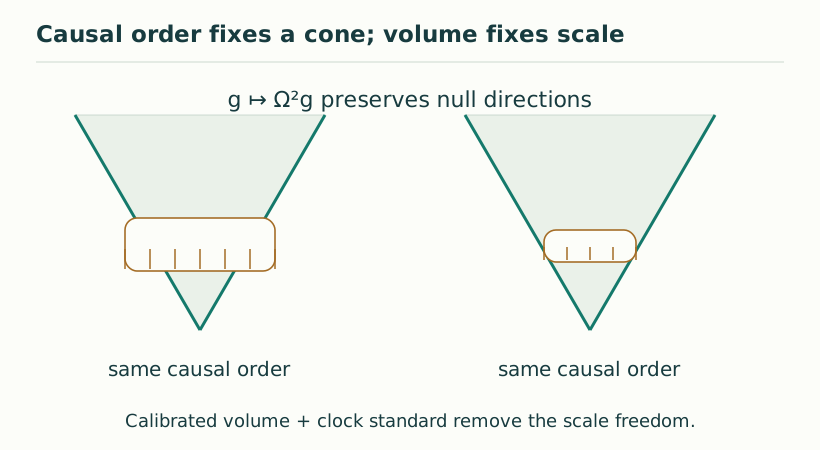
Figure 1. Causal order fixes a cone; volume fixes scale. A causal cone determines conformal geometry, while a calibrated volume law can fix the remaining scale. A physical interpretation as observer boosts requires the separate clock and detector covariance assumptions. View full size ↗
03A limiting cone is not a numerical constant
The reconstructed cone contains a slope relating the chosen temporal and spatial units. Its numerical speed changes if metres and seconds are independently relabeled. A physically informative derivation must specify how a length standard and a clock standard arise and how their ratio is fixed. A universal limiting speed further requires all admitted material propagation to respect the same calibrated cone. Identifying the fastest record update with light must be supported by an electromagnetic sector, not merely by calling the bound c. These metrological and universality issues are separate from the round shape of the cone.
04Curvature does not determine Einstein’s equations
A smoothly varying Lorentzian metric has curvature by differential geometry. Einstein’s field equations are a dynamical relation between that curvature and stress–energy, with a gravitational coupling and possibly a cosmological term. Many alternative covariant actions have Lorentzian geometry. Recovering Einstein dynamics therefore requires an action, conservation structure, approximation regime and matching to matter. A record-density law might contribute to such a derivation, but a chosen density alone is not an equation of motion. The source program must show why the same generated geometry responds to energy in the required manner.
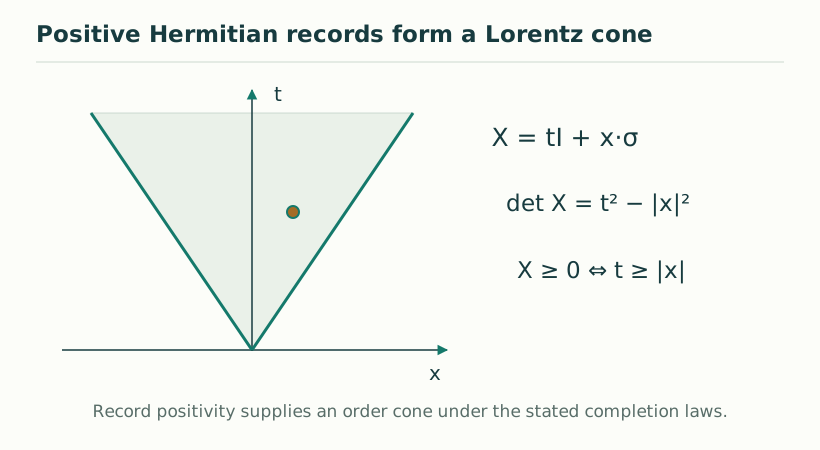
Figure 2. Positive Hermitian records form a Lorentz cone. Writing a Hermitian 2×2 record as X = tI + x·σ gives det X = t² − |x|². Positivity is equivalent to t ≥ |x|. The diagram is a two-dimensional section of the four-dimensional cone. View full size ↗
05A dependency table for the next stage
The outputs of the current construction can be used as interfaces for future work. Each interface should state what is already available and what a new calculation must add. This prevents a later paper from treating a conditional dictionary as a proved source law. It also permits independent mathematical modules to be tested without claiming that all have a single dynamical origin.
A dependency table for the next stage
Available structure
Further requirement
Rank-three readout
Stable spatial locality and continuum convergence
Calibrated causal cone
Species-independent matter propagation
Clock standard
Autonomous material-clock construction
Lorentzian metric
Gravitational action and source equation
Phase carrier
Probabilities, interactions and physical couplings
06Why the remaining tasks are constructive
The important open question is not whether familiar physics can be written using SMM/DTT vocabulary. It is whether one declared update with retained memory and six nested inner stages forces the geometry, clocks and matter dictionary to agree. A model that separately programs all three can reproduce them, but its explanatory burden remains. A stronger paper would prove a joint relation and exhibit a countermodel when a key assumption is removed. Such a result could identify a genuine restriction of the source architecture. Until then, the Lorentzian reconstruction provides a precise target and a map of missing bridges rather than a completed unified theory.
KEEP THE CONNECTION
Key ideas
Lorentzian geometry is a kinematic output, not complete dynamics.
Matter, clock universality and gravitational response need their own derivations.
A common autonomous source should explain their agreement.
Scope of the argument. This article audits the conditional theorem’s boundary and does not claim Einstein dynamics or measured constants have been derived.
Sources & further reading
Symmetric Completion Order and Lorentzian Chronogeometry, working draftsymmetric_completion_order_lorentzian_chronogeometry_v3(1).pdf, §§2–10, pp.5–28
Source editions and catalogue entries
Working manuscript
Symmetric Completion Order and Lorentzian Chronogeometry
Working manuscript. Article-level references identify the consulted sections and the scope of the interpretation. No public URL was supplied for this exact manuscript version.