
In this article
- The first atomic question is binding
- The declared record interface
- Why a finite gap is insufficient
- The balance behind localization
- A concrete dimensionless example
- What makes this an SMM/DTT test case
Explain why neutrality alone does not establish binding. Introduce the need for a localized state below the separated-particle threshold in the minimal hydrogen model.
A positive and a negative label can have zero total charge while remaining arbitrarily far apart. Neutrality is a conservation statement; an atom additionally requires a stable relative configuration. The minimal hydrogen note chooses a concrete target: a normalizable state with energy below the separated-particle threshold. This makes atomic formation a mathematical question about an operator rather than a resemblance between opposite phases. It also fits the SMM/DTT aim of explaining persistent objects: the relevant completed record should survive as a localized relative state, even though its generative description may involve recurring internal operations.
The first model supplies a connected graph with a distinguished root. A basis state |x⟩ records the relative position of a mobile negative sector with respect to a fixed heavy positive source. Amplitudes belong to ℓ²(V), and their squared magnitudes are read using the Born rule. The graph, its measure and this probability convention are inputs. They are not derived from a Single Monad in the note. This separation is useful because it isolates a tractable downstream problem: once a local record geometry is available, what additional dynamics produces a bound neutral object?
A particle in a finite box has discrete levels even without attraction. Enlarging the box makes the lowest energies and their spacings approach zero. Such a finite-volume gap therefore does not prove atomic binding. The relevant comparison is with the energy of particles separated to infinity in the same model and the same energy convention. For the continuum Coulomb operator, the essential spectrum begins at zero and the ground energy is negative. That establishes genuine binding. On a finite graph, the Green kernel’s additive reference and changing sign require care before assigning any dissociation threshold.
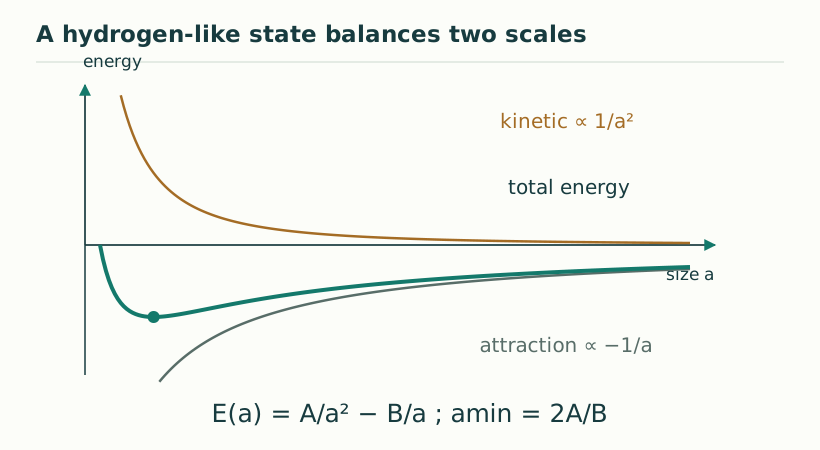
The effective continuum model contains a positive kinetic cost and an attractive potential. A trial state localized on a length r has kinetic energy of order D/r² and potential gain of order −C/r. The first dominates at very short distances, preventing unlimited collapse in this nonrelativistic operator. At large distance both approach zero. Their competition produces a finite minimizing scale. This elementary argument explains why both terms are needed: neutrality does not supply either coefficient, and opposite phase labels alone do not determine the sign or spatial form of a force.
Choose D=1/2 and C=1 in model units. The exact ground scale is rB=1 and the ground energy is −1/2, below the zero dissociation threshold. The radial probability is 4r²e^(−2r), peaking at r=1. The spatial probability density itself peaks at the origin, because radial probability also includes the volume of a spherical shell. This distinction matters when drawing the atom. A stationary 1s wavefunction has zero mean current; it does not depict an electron traversing a classical circle at a sharply fixed radius.
Inner time motivates a generative process and outer completion motivates a stable public record. The hydrogen note supplies a completed-record operator and an explicit preparation filter, providing a place to test those ideas quantitatively. The six inner stages remain nested levels of one hierarchy, not graph directions or independent particles. The next source model must generate the local graph, the coherent kinetic term, the mediator response and the clock/action normalization together. Passing the binding test would then be one necessary consequence. It would still leave the physical electric coupling, spin, proton structure and radiative spectroscopy to be established.
KEEP THE CONNECTION
Scope of the argument. Exact statements concern the supplied effective model, with geometry and the physical dictionary declared as inputs.
Draft file: smm_dtt_minimal_hydrogen.pdf
Working manuscript. Article-level references identify the consulted sections and the scope of the interpretation. No public URL was supplied for this exact manuscript version.
Source register →