Explain the additional three-dimensional Poisson assumption that yields a one-over-distance potential. Separate this matching step from the finite record-graph construction.
01Why an inverse distance is a geometric statement
An interaction proportional to 1/r is not a generic consequence of having opposite charges. It reflects the Green function of a particular local operator in three spatial dimensions with particular boundary conditions. A chain, a surface and a three-dimensional volume distribute flux differently. The minimal hydrogen note therefore states a Poisson continuum assumption explicitly: the completed record graph must approach Euclidean three-space, its kinetic form must approach a Laplacian, and its mediator kernel must approach the decaying inverse of −Δ. This assumption is where continuum geometry enters the Coulomb law.
02Deriving the radial Green function
Away from a point source, a radial harmonic function in three dimensions obeys (r²G′)′=0. Integrating gives G=A/r+B. Decay at infinity sets B=0. The coefficient is fixed by requiring unit outward flux for the operator −Δ: integrating −∇G over a sphere gives 4πA. Setting that flux to one gives A=1/(4π). This calculation derives the shape and geometric normalization of the kernel after the three-dimensional Poisson problem is supplied. It does not yet fix the strength with which the matter source couples to that kernel.
(−Δ)G = δ₀; G(r) = 1/(4πr).
−∮Sr ∂rG dS = 1.
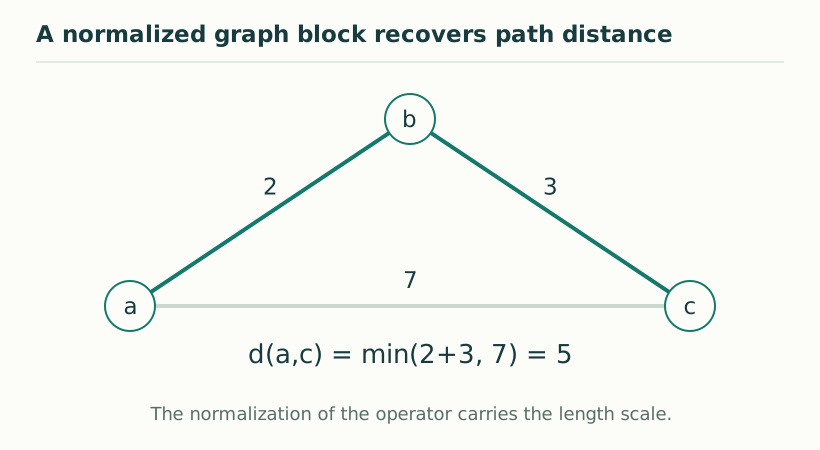
Figure 1. A normalized graph block recovers path distance. For the specified normalized spectral block, the distance equals weighted shortest-path distance. Here the illustrative route a–b–c has length 2+3 = 5, shorter than the direct edge of length 7. View full size ↗
03What changes in another dimension
In d dimensions, a spherical shell’s area grows as r^(d−1), so a fixed radial flux requires a gradient scaling as r^(1−d). Integrating gives a power r^(2−d) for d≠2 and a logarithm for d=2, with boundary conditions deciding the reference. Thus the inverse-distance law contains dimensional information. This observation motivates SMM/DTT’s effort to derive three-dimensional readout before claiming an atomic interaction. It does not prove three-dimensionality from the existence of hydrogen, which would use the observed target to choose the geometry.
04Why finite graphs need a careful limit
The pseudoinverse of a finite graph Laplacian removes the constant mode and normally has zero mean. It depends on the finite geometry and its boundaries. Passing to an infinite decaying Green function requires changing the domain, specifying how edge lengths and measures scale, and controlling convergence away from the source. Near the source, point-charge self-energies require a regulator. The note subtracts common regulated self-energies before removing that regulator, leaving the finite cross interaction. A numerical plot resembling 1/r at a few separations would be evidence for a limit, not a proof of it.
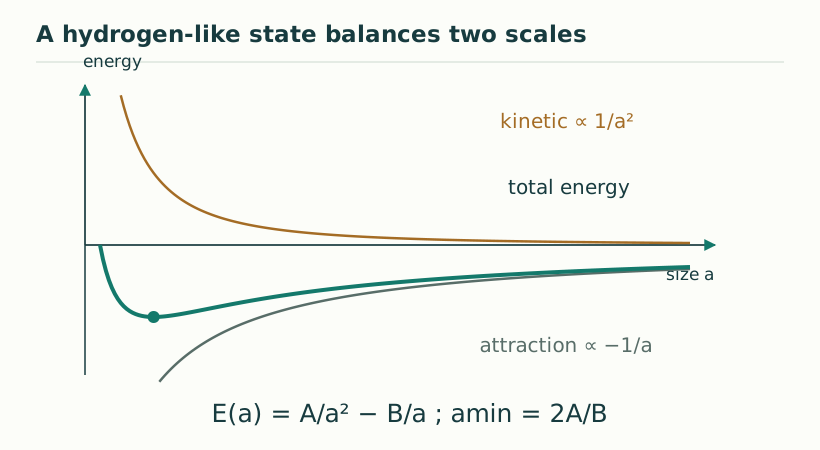
Figure 2. A hydrogen-like state balances two scales. The illustrative variational form E(a) = A/a² − B/a has a minimum at a = 2A/B for A,B > 0. Binding follows once kinetic and attractive terms are supplied; this calculation leaves B, and hence the coupling, free. View full size ↗
05The coupling survives the geometric derivation
With continuum mediator coefficient γ, the pair potential is −γ/(4πr), written −C/r with C=γ/(4π). The continuum γ includes graph-to-continuum normalization and is not automatically the raw edge-energy coefficient η. To identify C with αħc requires an action scale, a speed conversion and electromagnetic matching. Geometry fixes the Green kernel’s r-dependence; it does not generally determine the remaining coefficient. Keeping these roles separate prevents a successful derivation of 1/r from being overstated as a derivation of the measured fine-structure constant.
V(r) = −C/r; C = γ/(4π); g = C/(a c).
06A source-level theorem worth pursuing
For SMM/DTT, the next target is a refinement family generated by one recurrent source. Show that its observable distances converge to three-dimensional geometry, that the same update produces a positive local quadratic response, and that its neutral resolvents converge to the Poisson kernel with a controlled coefficient. The six inner stages should enter as specified nested refinement operations rather than an analogy with coordinate directions. Ideally the theorem would give finite-resolution error bounds for both the kinetic term and mediator response. Hydrogen would then test their joint continuum output instead of providing the geometry or coupling used to define them.
KEEP THE CONNECTION
Key ideas
The Coulomb kernel depends on dimension, operator and boundary conditions.
Graph-to-continuum convergence is a substantive additional assumption.
A derived inverse-distance shape still leaves the interaction coefficient free.
Scope of the argument. The continuum derivation is exact within a supplied three-dimensional Poisson limit; that limit is not proved from source dynamics in the note.
Sources & further reading
A Minimal Neutral-Pair Hydrogen Model for SMM/DTT, working notesmm_dtt_minimal_hydrogen.pdf, complete note, pp.1–8
Working manuscript. Article-level references identify the consulted sections and the scope of the interpretation. No public URL was supplied for this exact manuscript version.