Describe the local quadratic mediator and its exact Green-function interaction. Explain how the chosen source signs and response operator enter the effective pair energy.
To obtain an interaction, the hydrogen note assigns flux variables to edges of a connected record graph. A neutral pair imposes a divergence constraint: flux must begin at one charge and end at the other. A positive quadratic energy penalizes the amount of flux. Minimizing that energy finds the least costly mediator configuration compatible with the pair. This is a concrete mechanism linking charge arrangement to energy. It does not derive a quantum electromagnetic field; the flux here is continuous and quasistatic, with its local response law supplied as part of the effective model.
02Incidence, Laplacian and the neutral source
Choose an arbitrary orientation for each graph edge and let B be its incidence matrix. Then L=BᵀB is the graph Laplacian. Connectedness makes its kernel the constant vectors. The source vector ρx=δ₀−δx has zero sum, so it lies in the subspace on which the Laplacian is invertible. The Moore–Penrose inverse G=L⁺ handles the unused constant mode cleanly. Reversing an edge orientation changes the sign convention for its flux but not the minimized physical energy.
L = BᵀB; G = L⁺; ρx = δ₀ − δx; BᵀF = ρx.
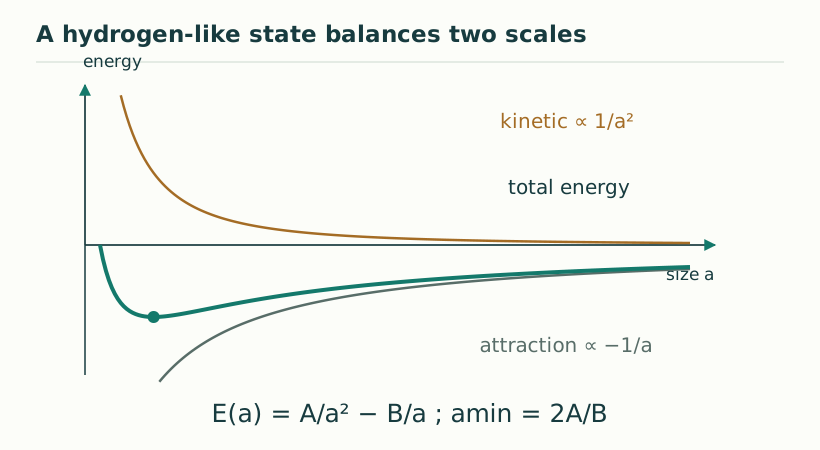
Figure 1. A hydrogen-like state balances two scales. The illustrative variational form E(a) = A/a² − B/a has a minimum at a = 2A/B for A,B > 0. Binding follows once kinetic and attractive terms are supplied; this calculation leaves B, and hence the coupling, free. View full size ↗
03The exact minimization in three steps
First define F*=BGρx. Since LGρx=ρx on neutral sources, F* satisfies the constraint. Second, any other feasible flux is F*+z with Bᵀz=0. Third, F* and z are orthogonal because their inner product is ⟨Gρx,Bᵀz⟩=0. The squared norm therefore splits into the norm of F* plus a nonnegative surplus. This proves the minimum without assuming a force law. Substitution gives a quadratic Green-function energy of the neutral source.
min[BᵀF=ρx] (η/2)||F||² = (η/2)ρxᵀGρx.
||F*+z||² = ||F*||² + ||z||².
04How an attractive cross term appears
Expanding the neutral-source quadratic form gives self terms G₀₀ and Gxx and a cross term −2G₀x. On a vertex-transitive graph the diagonal terms are equal and position independent. Subtracting the common self-energy leaves V(x)=−ηG₀x. This is the sense in which opposite source signs generate an attractive contribution. On a finite periodic graph the zero-mean Green kernel can change sign, so the whole expression should not be described as a positive Coulomb kernel at every separation. Boundary conditions, volume limits and energy reference remain part of the physical interpretation.
05A two-site worked example
For two vertices joined by one edge, L has diagonal entries 1 and off-diagonal entries −1. Its pseudoinverse is one quarter of that same matrix. For ρ=(1,−1), the quadratic form ρᵀGρ equals one. The least flux has magnitude one and energy η/2, agreeing with the Green formula. This example tests signs and normalization without invoking any atomic data. It is deliberately too small to establish a hydrogen continuum or a binding threshold; its value is to make the mediator elimination entirely transparent.
06The network-resistance interpretation
The quadratic form ρxᵀGρx is also the effective resistance between the two vertices when every edge has unit conductance. It quantifies how the whole network distributes a neutral unit flux. Multiple parallel routes lower the minimizing flux energy, while a narrow bottleneck raises it. This gives a useful intuition for why the inverse Laplacian is nonlocal even though the energy and constraint are local: solving the constraint coordinates flux over every available path. On a non-transitive graph, however, the self-term Gxx can depend on position. Then it cannot be removed as a single common constant, and the effective potential contains that geometry-dependent contribution. A source-generated irregular graph would therefore require the full quadratic form, not merely the transitive expression −ηG₀x.
07The conceptual link to a common source
The mediator calculation converts a local compatibility rule into a global interaction through an inverse operator. In SMM/DTT language, it suggests how many completed spatial records could share one coherent response without postulating independent fundamental substances at every vertex. The explanation becomes source-level only when the same inner update selects the graph, the Gauss constraint and the coefficient η relative to coherent motion. If those ingredients are programmed independently, the elimination is still correct but their agreement remains unexplained. A future extension must also decide whether mediator fluctuations, compact charge sectors and radiation belong to the retained dynamics.
KEEP THE CONNECTION
Key ideas
A constrained quadratic mediator gives an exact Green-function energy.
The attractive cross term follows from the neutral source signs.
The source origin and normalization of the mediator remain separate questions.
Scope of the argument. The graph calculation is exact; its interpretation as electromagnetic dynamics requires additional continuum, quantum-field and normalization input.
Sources & further reading
A Minimal Neutral-Pair Hydrogen Model for SMM/DTT, working notesmm_dtt_minimal_hydrogen.pdf, complete note, pp.1–8
Working manuscript. Article-level references identify the consulted sections and the scope of the interpretation. No public URL was supplied for this exact manuscript version.