
In this article
- Allowed transformations and realized observers
- How calibration narrows the automorphism group
- The additional frame-richness requirement
- A short group-theoretic proof
- A worked boost example
- What SMM/DTT should derive next
Compare automorphisms of a mathematical geometry with transformations realized by physical observers. Explain why frame richness is an additional requirement for identifying the two.
A mathematical geometry may admit more symmetries than physical apparatus can realize. A spherical surface has rotations whether or not a particular machine can reach every point. Similarly, a Lorentzian cone can possess boost automorphisms while a proposed record dynamics supports only a restricted family of material clocks. The draft therefore distinguishes the automorphism group of calibrated record geometry from the group generated by physically equivalent observer transformations. This distinction is especially important for SMM/DTT: deriving a geometry for completed records does not automatically prove that all matter propagates and all clocks respond in the same relativistic way.
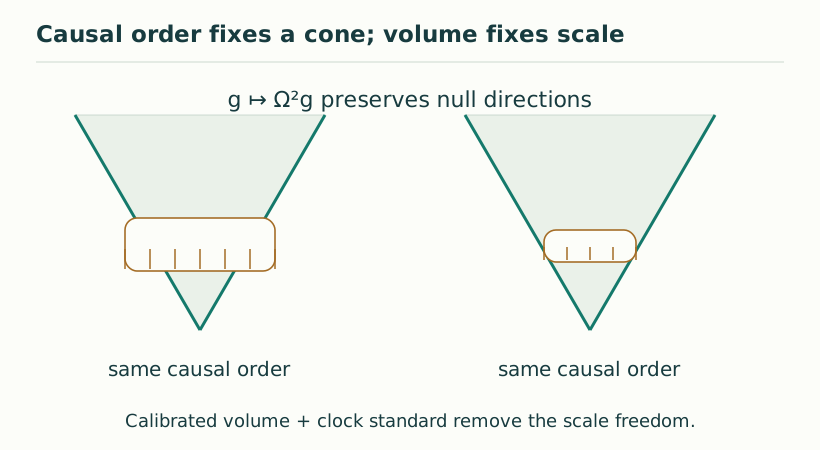
In a flat affine sector a cone-preserving linear map preserves the Lorentz form up to a positive scale. Cone preservation alone permits a dilation in addition to a Lorentz transformation. Calibrated four-volume removes the dilation: its determinant must have magnitude one. Future orientation excludes time reversal, and the selected spacetime orientation excludes the improper component. Adding translations gives the proper orthochronous Poincaré automorphisms of the calibrated geometry. The conclusion is a statement about maps preserving the declared mathematical structures, with each restriction doing visible work.
Let Gfr be the connected group generated by physically realized changes between equivalent inertial readouts. Operational preservation of the metric gives only Gfr⊆SO⁺(1,3). Frame richness asks for two more facts: ordinary spatial rotations belong to Gfr, and every future-directed unit timelike direction can be the rest direction of an equivalent calibrated observer. It is a transitivity requirement on the unit hyperboloid. A source model must support clocks and rods in those states and preserve their calibration; writing a coordinate transformation alone cannot supply that material content.
Take any proper orthochronous Lorentz transformation Λ and the standard rest direction e₀. Frame richness supplies g in the physical group with ge₀=Λe₀. Then g⁻¹Λ leaves e₀ fixed. The stabilizer of a rest direction is the spatial rotation group, which is already in Gfr. Both factors therefore belong to the physical group, so Λ does too. This proves equality of the groups under the two richness assumptions. The proof is elementary and useful because it identifies the exact gap between a cone calculation and a full physical relativity principle.
In one spatial direction a boost with dimensionless speed β=v/c transforms a displacement using t′=γ(t−vx/c²) and x′=γ(x−vt), where γ=(1−β²)^(−1/2). For β=3/5, γ=5/4. The null relation x=ct remains null after substitution. That checks the geometry. A physical test asks more: does a clock made of the model’s bound records measure the corresponding proper duration, and do different matter species agree? A source-dependent preferred clock rate could preserve a formal cone while failing observer equivalence. This is why the matter sector must join the reconstruction.
The inner generative hierarchy may use an ordered sequence without making that sequence an observable preferred inertial frame. To establish this, the completed interface must hide or covariantly transform the relevant microscopic ordering. The next source-level target is a family of mobile, stable clock records whose calibration is independent of species and whose accessible rest directions fill the future hyperboloid. Approximate realizations should come with an error bound on clock comparisons. This turns the philosophical claim of a shared source into a concrete compatibility problem between source recurrence, material persistence and observer transformations.
KEEP THE CONNECTION
Scope of the argument. The group result is conditional on frame richness and the flat affine calibrated sector; material-clock realization is a separate obligation.
Draft file: symmetric_completion_order_lorentzian_chronogeometry_v3(1).pdf
Working manuscript. Article-level references identify the consulted sections and the scope of the interpretation. No public URL was supplied for this exact manuscript version.
Source register →