Explain why a causal cone fixes less than a fully scaled metric. Introduce the record-density and clock standards used to supply the remaining scale in the draft.
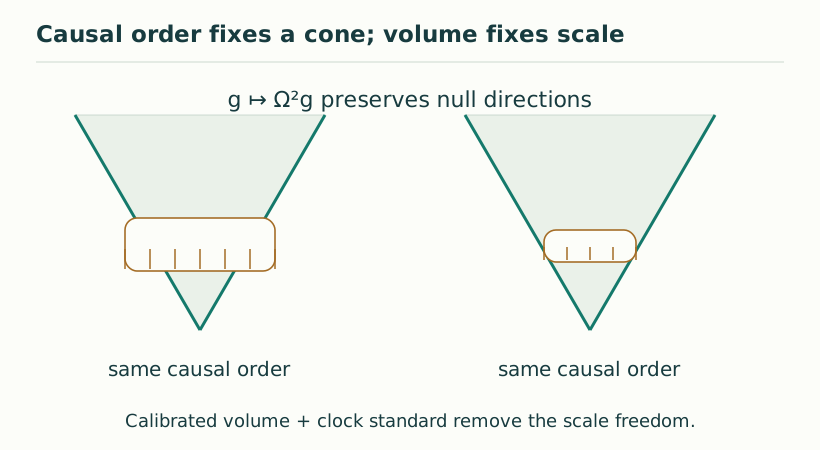
If a metric g is multiplied by a positive function Ω², a vector that was null remains null and a timelike vector remains timelike. The causal cone therefore cannot distinguish the two metrics. Yet proper durations and physical volumes change. A completion order can be highly informative while leaving this freedom. In the SMM/DTT reconstruction this is a desirable separation: first establish which records can succeed which others, then ask how many records correspond to a physical volume and how a material clock assigns a duration. These are different measurements and should not be equated by notation.
02From counts to a smooth density
Consider a region B and count completed stable records at resolution ε. A normalization factor compensates for the changing density of records as resolution is refined. The manuscript assumes that independently specified admissible protocols converge to the same positive density up to known overall multiplicities. The protocol class must be declared before choosing the desired density; otherwise agreement would be built into the definition. Duplicate detector species, relabeling and refinement can change raw counts without changing geometry, so their normalization must be tracked explicitly. The physical burden is universality across such operational changes.
Figure 1. Causal order fixes a cone; volume fixes scale. A causal cone determines conformal geometry, while a calibrated volume law can fix the remaining scale. A physical interpretation as observer boosts requires the separate clock and detector covariance assumptions. View full size ↗
03The simple conformal calculation
In n dimensions, multiplying g by Ω² multiplies the determinant by Ω²ⁿ and the volume density by Ωⁿ. Let μ₀ be the density of some representative g₀ and let μrec=rμ₀ be the density obtained from records. Choosing Ω=r^(1/n) gives exactly the desired volume. Thus order plus an independently calibrated density fixes a metric representative. The construction is unique because a further positive conformal factor preserving the same density must equal one.
g = r^(2/n) g₀; μg = r μ₀.
For n = 4: g = √r g₀.
04A numerical example without physical units
Suppose a region’s record density is sixteen times the density associated with the current four-dimensional representative. Then r=16 and the calibrated metric is 4g₀. Proper lengths and durations scale by the square root of the metric factor, so each increases by two; four-volume increases by sixteen. This illustrates why count density sets more than an overall tally. If r varies smoothly from place to place, the same calculation sets a local conformal factor. It does not explain why that spatially varying density occurs or which equation governs its evolution.
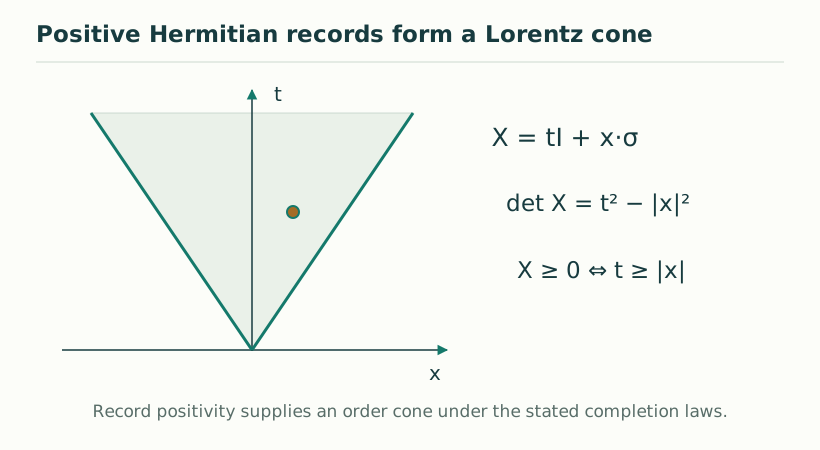
Figure 2. Positive Hermitian records form a Lorentz cone. Writing a Hermitian 2×2 record as X = tI + x·σ gives det X = t² − |x|². Positivity is equivalent to t ≥ |x|. The diagram is a two-dimensional section of the four-dimensional cone. View full size ↗
05One reproducible clock fixes the remaining unit
If protocols agree only on a projective density, their common multiplicative constant remains arbitrary. Choose a timelike process between two marked records and independently assign it a reproducible duration τ*. If the current metric assigns τ₀, rescale the metric by (τ*/τ₀)². Additivity under repeated operation makes this a clock standard rather than a convenient numerical label. Rods and clocks must then share the cone calibration. Independently resetting their relative scales would change the numerical conversion between duration and displacement and would require updating the physical dictionary.
gcal = (τ*/τ₀)² g₀.
06The conceptual connection and next test
SMM seeks a common origin for spatial multiplicity and material persistence; DTT supplies inner generation and outer completed record order. Density calibration links those ideas to an operational geometric quantity: stable completed records per region. The next theorem should derive a protocol-independent density from the source update and show that physical clocks reproduce the same scale. Counting states in an abstract Hilbert space is insufficient because many states may be unpreparable or observationally indistinguishable. A useful computational test would vary refinement and detector multiplicity while checking convergence of normalized counts and the clock standard against a single reconstructed metric.
KEEP THE CONNECTION
Key ideas
Causal cones determine a conformal class rather than absolute scale.
A universal record density fixes the conformal factor.
One reproducible clock sets any remaining global unit.
Scope of the argument. The volume-scaling identity is exact; universal record-density convergence is a stated physical calibration assumption.
Sources & further reading
Symmetric Completion Order and Lorentzian Chronogeometry, working draftsymmetric_completion_order_lorentzian_chronogeometry_v3(1).pdf, §§2–10, pp.5–28
Source editions and catalogue entries
Working manuscript
Symmetric Completion Order and Lorentzian Chronogeometry
Working manuscript. Article-level references identify the consulted sections and the scope of the interpretation. No public URL was supplied for this exact manuscript version.