
In this article
- Causality as an order on completed records
- The two symmetry assumptions
- How rotations restrict the product
- The cone from its two eigenvalues
- A matrix picture and a worked comparison
- What the construction contributes to SMM/DTT
Introduce the homogeneous self-dual cone assumptions behind the Lorentz-cone result. Explain how symmetry and readout constraints narrow the possible ordered geometries.
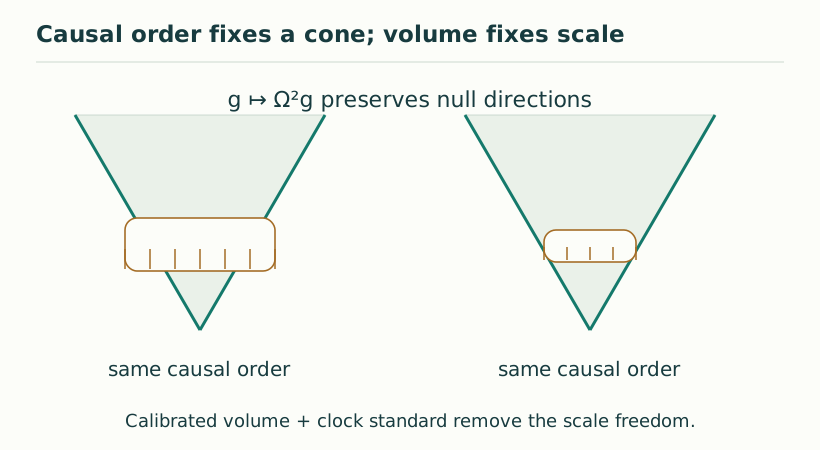
A causal cone specifies which small event increments count as possible future completions. In the DTT interpretation, it should be built from relations between completed records, while the inner generative steps remain upstream. A proper cone is closed under positive scaling and addition, contains no complete line, and has enough directions to span the record space. Pointedness prevents the same nonzero increment from being both future and past. These are geometric properties of an order; they do not by themselves supply a field equation, an electromagnetic signal or a numerical speed.
Self-duality means the allowed cone can be recovered from nonnegative pairings with every allowed test direction. The pairing used here is positive definite and represents preparation–record calibration. It is not already a Lorentzian metric. Homogeneity means suitable reversible filters and positive scalings can take any interior allowed increment to any other. Together these make a symmetric cone, for which the imported Jordan-algebra correspondence supplies a product and a spectral decomposition. The physical motivation is a reciprocity between preparations and records plus an absence of privileged interior states. Their universal validity is an additional assumption.
Write the record fiber as a scalar order-unit direction and an irreducible rotation module W of dimension three. The product of two spatial vectors is symmetric and rotation covariant. A symmetric product of two ordinary three-vectors contains a scalar trace and a traceless rank-two tensor; it contains no ordinary vector component. Therefore a Jordan product landing back in the scalar-plus-vector record space can retain only the scalar inner product. Formal reality makes its coefficient positive, and a length rescaling sets that coefficient to one. This is the key rigidity step rather than a guess of Minkowski signature.
For x≠0 let u=x/|x| and form two idempotents e±=(e±u)/2. The record element (T,x) decomposes with coefficients T+|x| and T−|x|. It belongs to the cone of squares precisely when both coefficients are nonnegative. The resulting inequality is the familiar round future cone. The determinant is the product of these coefficients, giving a quadratic form of signature one plus three. A positive pairing thus supports an indefinite determinant; there is no contradiction because they perform different jobs.
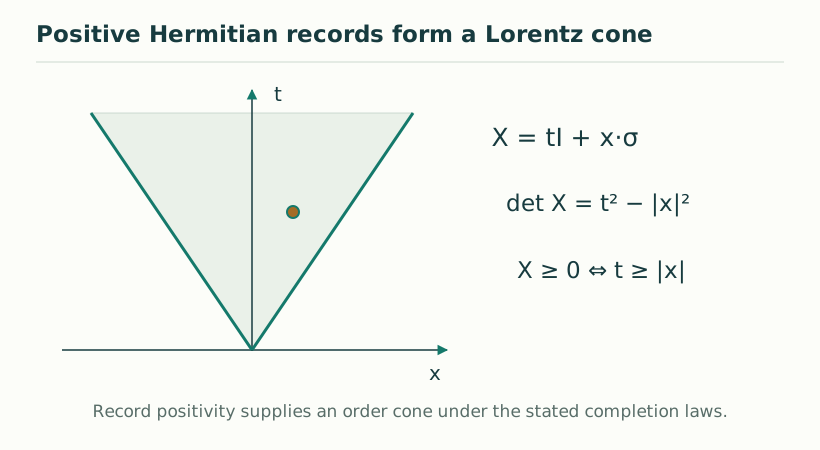
The same object can be written as the Hermitian matrix X=T I+x·σ, with σ the Pauli matrices. Its eigenvalues are T±|x|. An increment T=2, |x|=1 lies inside the cone because its eigenvalues are 3 and 1. T=1, |x|=1 lies on the boundary, and T=1, |x|=2 lies outside. These dimensionless examples depict allowed, extremal and disallowed increments. They do not yet mean two seconds or one metre. Identifying T with cΔτ requires the common clock and distance calibration developed separately.
The result connects observable order to Lorentzian shape through a sequence of explicit constraints. It sharpens the claim that relativity might arise from completion: the relevant output must have the stated detector rank, reversible filtering symmetry, self-duality and smooth soldering. A microscopic source could explain these properties, violate them, or realize them only approximately. Testing that question is more informative than inserting a light cone into a diagram of inner time. The draft also leaves open whether a weaker order package can force the cone without the full symmetric-cone assumptions, an opportunity to reduce the reconstruction’s premises.
KEEP THE CONNECTION
Scope of the argument. A constraint-relative mathematical derivation, not a proof that every SMM/DTT source necessarily produces Lorentz symmetry.
Draft file: symmetric_completion_order_lorentzian_chronogeometry_v3(1).pdf
Working manuscript. Article-level references identify the consulted sections and the scope of the interpretation. No public URL was supplied for this exact manuscript version.
Source register →