
In this article
- Four roles rather than four primitive coordinates
- Why the clock is a line
- Why the readout has three directions
- The bridge called soldering
- A local example and what it does not determine
- The six nested levels in this construction
Explain the rank-one clock and rank-three readout used in the conditional four-dimensional construction. Clarify why a soldering map is needed to identify them with tangent directions.
The familiar expression “three space dimensions and one time dimension” can hide several different questions. How many independent differences can an observer resolve? How are durations compared? Can local readout spaces be joined smoothly? Only after these have been answered can a spacetime chart be introduced. The draft separates a rank-three displacement bundle W from an oriented duration line L. Their direct sum has rank four as an internal record space. This organization fits DTT because spatial distinctions emerge through inner generation while duration compares completed records; neither role has to be a primitive coordinate of the Monad.
Completed durations are assumed to compose additively, to cancel consistently and to possess an Archimedean order. Informally, a finite duration cannot remain greater than every integer multiple of a positive clock unit. Under the stated hypotheses, an order-preserving additive representation places these durations on the nonnegative real line. Fixing one reproducible unit fixes the representation. This is a result about comparative duration, not a declaration that every underlying source variable is one-dimensional. Several microscopic phases can contribute to one public clock, just as many internal states can support one instrument reading.
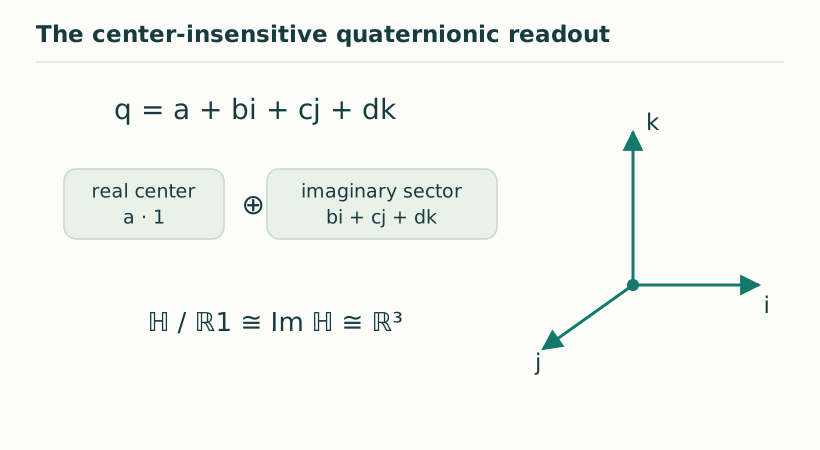
The quaternionic part starts with an associative carrier with positive multiplicative norm and noncommutative phase composition. Within that stated class, the carrier is H. Its real scalar center describes a component that the specified center-blind detector does not distinguish. The complete quotient H/Z(H) is therefore identified with the imaginary quaternions, a real vector space of dimension three. “Complete” matters: a detector that measures only one component would see a smaller quotient. The conclusion is about accessible record rank under a detector-completeness assumption; it is not obtained from the name of a division algebra alone.
An internal space of possible readings is not automatically the tangent space of a smooth world. The draft supplies a bundle isomorphism σ from L⊕W to TM, the tangent bundle of an observer manifold. This is the soldering map: it connects changes in recorded duration and displacement to infinitesimal changes of events. Since an isomorphism preserves rank, the observer manifold must then have dimension four. The rank argument is short; the substantive physical task is showing that completed records actually admit this smooth manifold and this compatible identification.
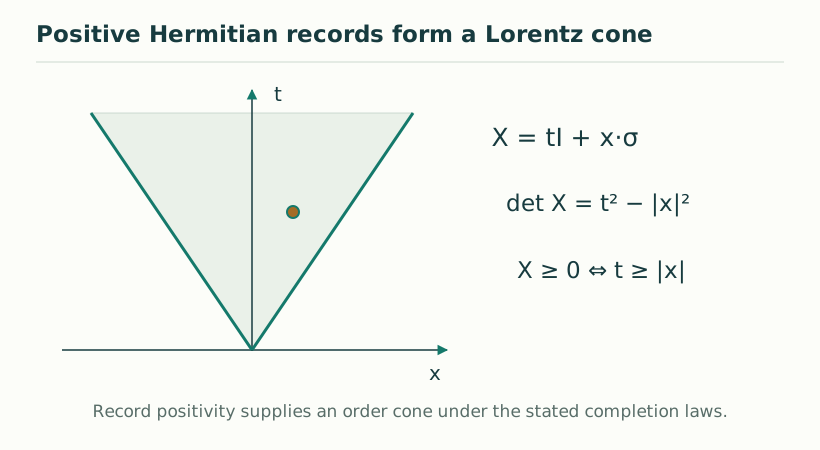
Take a local record increment (Δτ,Δx₁,Δx₂,Δx₃). A chosen soldering sends these four numbers to a tangent vector at an event. This is enough to describe directions, but not yet lengths or a causal speed. One may place a Euclidean metric, a Galilean structure or a Lorentzian structure on a four-dimensional manifold. Therefore the count 1+3 does not select relativity. Completion order must separately constrain which increments are possible, and record-density and clock calibration must set scale. This example prevents a dimensional count from silently carrying an entire dynamical theory.
SMM/DTT’s six inner stages are a proposed generative hierarchy, often organized in pairs contributing to spatial realization. They should not be identified directly with the three components of W or the four components of L⊕W. A hierarchy is an ordered construction; a fiber dimension counts independent final readouts. Establishing their relation requires maps between stages, compatible refinement and a proof that the completed quotient has the claimed rank. The current soldered construction shows what the output must support. It gives a precise target for a source model: derive the readout, the public duration and their smooth attachment together.
KEEP THE CONNECTION
Scope of the argument. The rank calculation follows under the stated clock, detector and smooth-realization assumptions; those assumptions are not all derived from a bare Monad.
Draft file: symmetric_completion_order_lorentzian_chronogeometry_v3(1).pdf
Working manuscript. Article-level references identify the consulted sections and the scope of the interpretation. No public URL was supplied for this exact manuscript version.
Source register →