A record that carries its own completion certificate
Introduce autonomous generation of a record and a flag certifying completion. Explain why the certificate must arise from the specified dynamics rather than an external declaration.
01A data value does not certify that a write finished
A blank memory and a completed memory can contain the same numerical data value. A reliable record therefore needs a separate indication that its writing operation has completed. The draft builds this certificate into the same autonomous quantum dynamics that generates the data.
This gives a concrete version of the SMM/DTT distinction between inner generation and outer access. The outer observer reads a flag and record produced by the dynamics, rather than declaring completion because a nominal time has elapsed. The quantum kinematics and the chosen program remain supplied inputs.
02Encode a program in a history Hamiltonian
Let V₁,…,V_K be work gates, and let G_j be their ordered prefix product, padded by identities up to a clock length L. A clock basis |j⟩ labels history stages. The time-independent Hamiltonian couples neighboring stages while applying the corresponding gate.
Its edge weights are proportional to √[(j+1)(L−j)]. This engineered choice permits an exact solution by mapping the clock to a symmetric spin system. The program is encoded in the couplings before initialization, so no externally changing gate schedule is required during the run.
H=(ℏω/2)Σj√[(j+1)(L−j)](|j+1⟩⟨j|⊗Vj+1+h.c.)
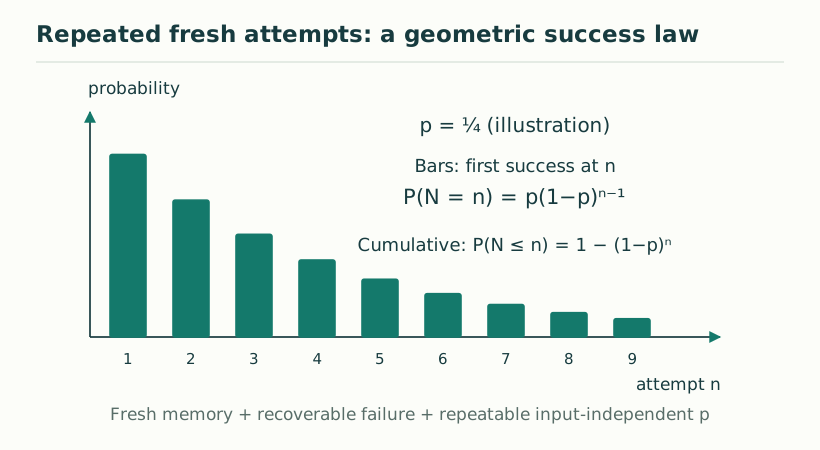
Figure 1. Repeated fresh attempts: a geometric success law. When a failed attempt restores the input and fresh attempts have the same independent success probability p, P(first success at n) = (1−p)ⁿ⁻¹p. The plotted example uses p = 0.25 and is not experimental data. View full size ↗
03The dressing identity solves the evolution
Define D=Σj|j⟩⟨j|⊗G_j. Since each G_j is unitary, D is unitary. Conjugating H by D removes the work gates from the clock edges, leaving a solvable clock Hamiltonian tensored with the work identity.
Starting from stage zero, the probability of stage j is binomial with parameter p_s=sin²(ωs/2). Conditioned on a stage measurement j, the work state is exactly G_jρG_j†. At s*=π/ω, the clock reaches stage L and the full padded program has been applied.
D†HD=Hclock⊗I
Pr(J=j)=binom(L,j)p_s^j(1−p_s)^(L−j)
04Generate the flag as part of the write
Choose a flag for each completed prefix and flip it only after that prefix’s required record operations. On the legal initialized history subspace, flag m equals one exactly on stages j≥k_m, where k_m is its completion threshold.
Consequently the probability of a false certificate together with J<k_m is exactly zero in the ideal model. Later completed flags imply earlier flags. If all subsequent gates preserve the earlier pointer effects, conditioning on flag m gives the completed prefix’s record distribution, independently of how far the clock has progressed beyond that threshold.
Pr(F_m=1,J<k_m)=0
Pr(F_m=1)=Σj≥k_m binom(L,j)p_s^j(1−p_s)^(L−j)
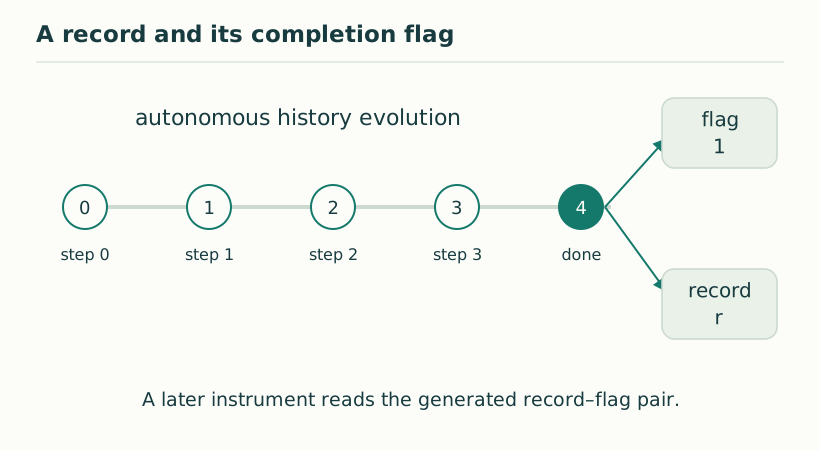
Figure 2. A record and its completion flag. A prescribed autonomous history dynamics can place a retained result and a flag in the same state. A later readout checks the flag and the result; assigning a flag by hand is not a dynamical construction. View full size ↗
05A simple write-and-flag example
Suppose a qubit controls a reversible write into a blank data bit, followed by a flag flip. A completed data value zero and the untouched blank data value zero are indistinguishable without the flag. Reading the pair distinguishes “no completed write yet” from “completed outcome zero.”
The flag must be correlated by the actual program. An unrelated clock pulse that flips it at a nominal time can produce false certificates if the work failed. In the autonomous construction, the encoded history relation ties the flag to the completed prefix on the legal subspace. Preparation errors and perturbations require bounded corrections to that ideal identity.
06Coherent stages are not a hidden classical trajectory
At intermediate times the clock is usually in a coherent superposition of many stages. A later completed record has the correct ordered prefix content, but this does not prove that the unmeasured device followed a unique sequence of sharp crossing times. Small completion amplitudes can occur before the nominal peak.
The finite closed model also recurs. Completion probabilities rise on a prepared forward branch and later fall under the reversible dynamics. Padding creates a useful finite observation window; it does not establish permanent writing by a finite analytic unitary system.
07The SMM/DTT contribution and its boundary
The construction internalizes control after preparation and gives generation, certification, and observation one explicit probability model. It separates the clock stage, calibrated duration, data value, and completion flag instead of treating them as interchangeable.
It does not derive the six nested inner functions merely from the number of gates, and it does not create spatial locality from source unity. A stronger source theory would select the program and its resources. The present result is a rigorous witness that a record can carry a dynamically generated certificate, with a known success law and finite retention limits.
KEEP THE CONNECTION
Key ideas
A separate flag distinguishes completed data from a blank with the same value.
The autonomous history Hamiltonian generates both data and certification.
Coherent stage evolution and finite recurrence limit claims of classical trajectory or permanence.
Scope of the argument. Exact finite quantum construction on a legal initialized subspace; supplied gates, resources, and quantum rules remain inputs.
Sources & further reading
SMM_DTT_Autonomous_Records_Free_Field_Limits_v10(6).pdfWorking draft, pp. 7–10, 13–15
Source editions and catalogue entries
Working manuscript
Autonomous records and free-field limits — working draft v10
Working manuscript. Article-level references identify the consulted sections and the scope of the interpretation. No public URL was supplied for this exact manuscript version.