Describe how a smeared field measurement avoids assigning an ideal point measurement an uncontrolled energy cost. Introduce the probe and register used in the draft’s free-field model.
01A field record needs a physical measurement operation
A continuum field at a mathematical point is not automatically a finite-energy observable that an apparatus can record sharply. The draft instead couples smooth spatially smeared field observables to a probe. Smearing fixes an apparatus region and resolution while keeping the relevant vacuum moments finite.
This extends the SMM/DTT record program beyond finite qubits: a completed file can contain information about a genuine free quantum field. The field theory and its localization structure are supplied inputs; the apparatus construction does not derive them from the single-source principle.
02Define system and probe observables
Take independent massive system and probe fields with positive free Hamiltonians. Choose real smooth compactly supported test functions f,g,h in a bounded region, with ∫gh=1. Define A=φS(f), B=φP(g), and P=πP(h), so [B,P]=iℏI.
System and probe operators commute strongly. The write unitary Vdata=exp(−iλAP/ℏ) is therefore defined through their joint spectral calculus. It acts as a canonical shear: A is unchanged and the probe pointer B shifts by λA. A separate binary flag certifies completion.
Vdata=e^(−iλAP/ℏ)
Vdata†BVdata=B+λA; Vdata†AVdata=A
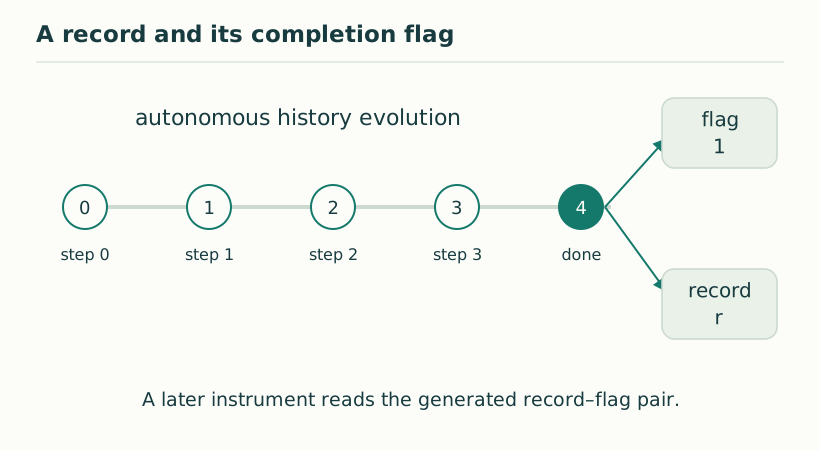
Figure 1. A record and its completion flag. A prescribed autonomous history dynamics can place a retained result and a flag in the same state. A later readout checks the flag and the result; assigning a flag by hand is not a dynamical construction. View full size ↗
03The induced noisy measurement
Prepare the probe in its vacuum with pointer variance vB. After the shear, reading B gives a Gaussian-modulated system measurement centered at λA. For a system vacuum with variance vA, the pointer variance is vB+λ²vA and its covariance with A is λvA.
Thus the output contains a calibrated signal and a known noise contribution. Dividing the pointer by λ gives measurement-noise variance vB/λ². Increasing the response changes both signal and physical disturbance, so it is not a free improvement in accuracy.
E(db)=db exp[−(b−λA)²/(2vB)]/√(2πvB)
Var(Bout)=vB+λ²vA
04Why smooth spatial support matters
The unitary uses smeared fields rather than unspecified coincident-point products. Smooth compact support controls high-momentum tails and gives finite quadratic moments in the chosen free-field state. The gate is localized to an extended apparatus region.
This does not make the entire autonomous controller a point-local relativistic interaction. Its many-body control couplings can extend across the apparatus. The free field may be Poincaré covariant while a prepared measurement device selects a frame. A fully covariant distributed controller requires an additional construction.
05Energy has to be checked for the write and the register
The shear changes the free-field energy by terms determined by the smearing functions, response λ, and input moments. Storing a finite label from the continuous pointer is a further operation with its own cost. A discontinuous sharp threshold can create an energy-domain problem even when the pointer probability law is well defined.
The draft therefore uses a smooth threshold with width δ. Its registration energy is finite for finite-energy input at fixed δ, but the sharp-resolution limit generally diverges. Finite resolution is part of the physical apparatus specification, not a numerical inconvenience that can be removed without consequence.
06Autonomous certification and field limits
The field write can be embedded in the dressed history Hamiltonian, so the same dynamics generates the pointer response and its flag. For stationary ready inputs, the model has an exact completed-output law with a finite observation window. Nonstationary inputs add an error controlled by their own dynamical change.
At fixed smooth smearings and fixed registration resolution, the corresponding free-field correlations and record probabilities can be taken through the stated regulator limits. This order matters: removing a spatial regulator is different from demanding an infinitely sharp detector at the same time.
07The SMM/DTT lesson
A public field record requires more than assigning an observable symbol. One must specify the source field, probe, coupling, completion certificate, pointer noise, energy cost, and later memory. This is the operational content of connecting inner generation to outer observation.
The construction establishes a controlled free-field witness for that architecture. It does not provide an interacting continuum theory, a universal detector, or the emergence of locality from ontology. Its value is that measurement and record resources remain inside the mathematical account instead of being treated as ideal external operations.
KEEP THE CONNECTION
Key ideas
Smooth field smearing gives a controlled finite-resolution measurement.
The Gaussian pointer separates signal response from probe noise.
Writing a binary record adds an energy cost beyond the field–probe shear.
Scope of the argument. Free-field apparatus construction with fixed resolution and supplied locality; full relativistic controller realization remains additional.
Sources & further reading
SMM_DTT_Autonomous_Records_Free_Field_Limits_v10(6).pdfWorking draft, pp. 31–34, 40–43
Source editions and catalogue entries
Working manuscript
Autonomous records and free-field limits — working draft v10
Working manuscript. Article-level references identify the consulted sections and the scope of the interpretation. No public URL was supplied for this exact manuscript version.