
An observable quotient retains distinctions needed by future tests; an oriented real flow selects phase on its dynamic sector. A physical cone requires additional displacement and delay data.
The publication and its central question
Completion principles, real commutants, and positive-frequency geometry for orthogonal Hilbert representations is a journal article in the Open Journal of Mathematical Sciences. Its opening construction separates histories, completed records, real representations, phase selection, and causal readout. The author-hosted published text supports that modular reading.
The practical question is which structures become available at each step. A quotient describes observable distinctions; it need not be a Hilbert space. A compatible phase describes scalar multiplication; it need not define a physical clock. Reading the paper in this order makes its mathematical contribution more useful because each construction has a clear input and output.
A predictive quotient in four states
Consider four states written (b,m), where b and m are bits. A detector reports b, while a later allowed update replaces b by b XOR m. The states (0,0) and (0,1) have the same present label but produce different labels after that update. Their hidden memory is therefore relevant to the admitted experiment.
Define equivalence by equality of every allowed completed-future outcome. If those future tests include the update just described, the two states remain distinct. The construction gives the largest identification consistent with those tests. Changing the test family changes the quotient, which is why specifying experimental access is substantive rather than decorative.
Selecting a complex structure
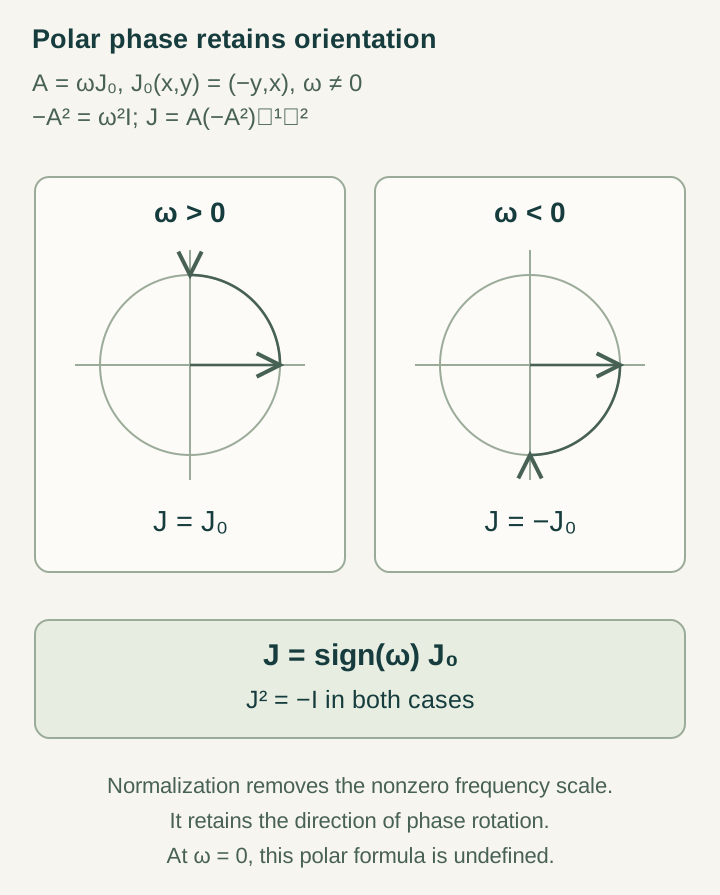
On a real plane let J(q,p)=(-p,q). Then J²=-I and J transposed equals -J. Defining multiplication by i to mean J makes this plane a complex line. For a rotation A=ωJ with positive ω, the positive magnitude is |A|=ωI and A=J|A|. Reversing the oriented generator reverses the selected phase.
A symmetry-compatible choice must also commute with the supplied representation. The commutant is the natural place to find such operators. Stationary modes need separate treatment because zero evolution does not choose a phase direction.
Open the full-size diagram →
A cone needs another interface
Suppose every completed transition has displacement x and positive delay τ with ||x||≤c*τ. For a chain of transitions, the triangle inequality gives ||Σx||≤Σ||x||≤c*Στ. This is the elementary mechanism by which a bound survives composition.
Both observables were supplied in the hypothesis. Phase selection alone does not determine their units, establish a shared material clock, or select the constant c*. To use this construction physically, the same source model must explain why these completed transitions and calibrations describe the records of actual measuring procedures.
How the modules express SMM and DTT
SMM motivates a common source of observable multiplicity. DTT distinguishes internal generation from completion available to an observer. The quotient makes the second distinction precise: two internal histories can count as one observed state when the admitted tests cannot separate them.
The phase module then concerns a real carrier chosen for that generative dynamics. The cone module concerns completed events. Their common interpretation supplies a research direction, while their explicit interfaces show exactly what a joint source construction still needs to deliver. Six nested inner roles can organize that construction without becoming six independently measured clocks.
A reading route and a concrete next problem
Read the operational principles first, then work through the four-state example here before studying the commutant and polar selection. Next compare the spectral-distance and cone modules. Keep a list of new data introduced at each transition, including measures, domains, record tests, length budgets, and delay laws.
A valuable next problem is to give one finite source whose retained memory supplies a predictive quotient, whose reversible action supplies a nontrivial phase, and whose completed transitions have independently measured durations and distances. Can one parameter be eliminated because these constructions constrain one another? That would strengthen the architecture through an actual shared consequence.
Continue with the articles
- Completion, commutants, and positive frequency
A reading guide to the published paper’s relationship between completion principles, real representations, and positive-frequency geometry. Focus on the theorem assumptions before discussing physical interpretations.
- When two histories count as the same observation
Introduce completion and observational equivalence as distinct ways of identifying histories. Explain why the tests available to an observer determine which differences survive.
- Test languages and observable quotients
Explore how richer tests alter the distinctions retained by a record model. Introduce the draft’s correspondence between test languages and observational congruences.
- A finite-update cone
Introduce the bound relating horizontal displacement to temporal projection in the limiting-speed draft. Explain that the finite-update inequality is a stated geometric assumption.
- A spectral triple as a reconstruction interface
Introduce the algebra, Hilbert space, and Dirac-type operator used by the temporal spectral model. Explain the different jobs of observables, states, and spectral data.
- Selecting phase by polar decomposition
Explain how a positive-time generator can select a compatible complex structure on the dynamic sector. Make clear why zero-frequency modes need separate treatment.
Sources and reading
Read the original source for its exact formulation and edition. The examples on this page are explanatory reconstructions.