
The symmetric square of a four-dimensional envelope has ten modes. Its normalized pair basis is exact, while the quaternionic product has rank four and erases six independent pair-memory directions.
Inputs: a unital envelope and a retention task
Let W be a three-dimensional real readout module. Restore an identity channel and form Vℝ=ℝ⊕W, with orthonormal basis e0,e1,e2,e3. The identity component is not a fourth spatial direction; it belongs to the operation envelope. Complexifying gives V=ℂ⊗Vℝ, of complex dimension four.
The declared task is to retain every symmetric bilinear combination of two inputs, without additional relations. This selects the symmetric square Q=Sym²V. The real version has real dimension ten; the complexified version has complex dimension ten and real dimension twenty. We count modes over the stated scalar field rather than conflating amplitude coordinates with spatial dimensions.
In SMM/DTT, this is a candidate memory interface for generated histories. Its physical selection is an assumption to investigate, separate from the following linear-algebra theorem.
Step 1: construct the symmetric subspace
On V⊗V define the swap S(u⊗v)=v⊗u. It obeys S²=I and S†=S. Hence P+=(I+S)/2 satisfies P+²=P+ and is the orthogonal projector onto symmetric tensors. Write u⊙v=P+(u⊗v)=(u⊗v+v⊗u)/2.
This construction distinguishes two normalizations. The symmetrized product u⊙v is convenient for bilinear formulas, but for orthonormal unequal basis vectors it has norm 1/√2, not one. An orthonormal receiver basis therefore needs a factor √2 on its mixed pairs. Keeping that factor prevents later response or probability calculations from treating unequal-norm basis vectors as equivalent channels.
Step 2: enumerate and normalize all ten modes
Use saa=ea⊗ea for the four diagonal pairs. For 0≤a<b≤3, use sab=(ea⊗eb+eb⊗ea)/√2. The two summands in each mixed mode are orthogonal, so its squared norm is (1+1)/2=1. Different unordered pairs have disjoint tensor basis support and are mutually orthogonal.
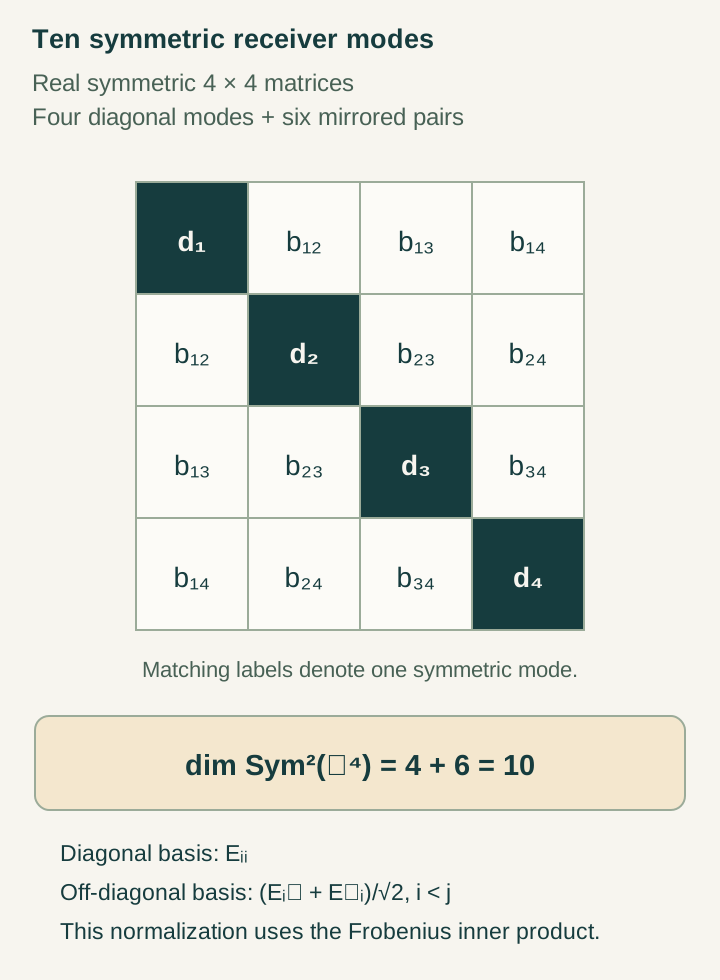
Every symmetric tensor has equal coefficients in positions ab and ba, so these ten vectors span Q. Four diagonal positions and binom(4,2)=6 off-diagonal pairs give:
Open the full-size diagram →
The figure displays the real symmetric-matrix basis. The same ten basis labels with complex coefficients give the complex symmetric receiver used here.
Step 3: check a normalized pair explicitly
Take u=(e0+e1)/√2. Its prepared pair tensor u⊗u is symmetric. Expanding in the normalized receiver basis gives:
The squared coefficient magnitudes sum to 1/4+1/2+1/4=1, confirming normalization. If a projective measurement in that basis is supplied, the three displayed probabilities are therefore 1/4,1/2,1/4. Simply assigning equal coefficients to the three written pair labels would describe a different state.
This is a calculation for a pair input already prepared in V⊗V. It is not an instruction that one unknown state can be physically copied into two independent instances. Bilinear algebra specifies the receiver’s information structure, while preparation specifies how that information becomes available.
Step 4: prove the universal retention property
Let b:V×V→X be any complex bilinear symmetric map. Define a linear map L:Q→X on the normalized basis by L(saa)=b(ea,ea) and L(sab)=√2 b(ea,eb) for a<b. Expanding arbitrary u and v shows L(u⊙v)=b(u,v). The factor √2 precisely compensates the mixed-pair normalization.
The map is unique because the tensors u⊙v span Q. Thus every symmetric bilinear test factors through this receiver. If a linear compression has a nonzero kernel vector, at least one linear functional on Q distinguishes that vector from zero. Composing that functional with u⊙v gives a symmetric bilinear test lost by the compression.
Therefore faithful retention of all tests in this declared class requires an injective encoding of Q. The theorem establishes sufficiency and minimality for the task; it does not prove that every physical source admits or needs the entire test class.
Step 5: compute what quaternionic multiplication discards
Identify the real envelope with ℍ, setting e0=1 and the other basis elements to imaginary quaternion units. Define m(u⊙v)=(uv+vu)/2, and extend complex linearly if using V. Since m(1⊙x)=x, the map is onto the four-dimensional envelope and has rank four.
Its kernel is explicit. For 1≤i<j≤3, anticommutation gives m(sij)=0. For each i=1,2,3, the relation ei²=−1 gives m(sii+s00)=0. The three mixed vectors and three diagonal combinations are linearly independent: the mixed supports are distinct, and each diagonal combination has its own sii coefficient.
These six vectors exhaust the kernel by rank–nullity. The normalized mixed identity pairs satisfy m(s0i)=√2 ei, providing a direct check on the chosen basis factors.
Step 6: interpret retained history without assuming cloning
A source that stores only the accumulated quaternionic product has erased those six pair distinctions. To claim a ten-mode receiver, it must preserve them in another register or a faithful alternative encoding. This gives an explicit memory obligation to the SMM/DTT interpretation of history-dependent generation.
For orthogonal labels, a unitary interaction can correlate a system and a fresh register as |j⟩|0⟩→|j⟩|j⟩. On a superposition it creates a correlated joint state, not two independent copies. Nonorthogonal inputs cannot be nondisturbingly assigned perfectly distinguishable labels. A physical completion model must therefore identify its pair preparation, retained coherence, register capacity and reading instrument.
The six inner roles organize dependent operations that can build and use this memory. They are neither the ten receiver modes nor six independent clocks; the seventh completion role certifies that the required record is available.
Result and the bridge to the structural integer
The ten modes now have an explicit orthonormal basis, a universal task and an exact comparison with a smaller product receiver. A changed basis preserves their dimension; an additional physical relation can reduce it. Ten therefore describes this free symmetric memory rather than a preferred numeral notation.
The next derivation uses Q as a continuation factor. That use adds a new grammar assumption: all ten distinctions remain available whenever an earlier record is carried forward. Connecting either count to a coupling then requires a response operator, a normalized source and a common physical action dictionary. Those obligations begin after the pair-space proof rather than being hidden inside its arithmetic.
Continue with the articles
- From three-dimensional readout to retained records
Trace the latest draft’s route from quaternionic readout to a selected grammar with 137 distinguishable records. Keep each structural choice visible in the explanation.
- Retained observations versus predictive states
Ask when retained information is sufficient to predict future outputs autonomously. Explain the completion criterion and why keeping observations need not keep every dynamically relevant distinction.
- Why quaternions appear in the reconstruction
Introduce the positive norm, associativity, and incompatible-phase hypotheses that select a quaternionic carrier. Present the conclusion as conditional algebraic rigidity.
- The center-blind route to three dimensions
Explain how removing the scalar center from the quaternionic readout leaves three real directions. Clarify the operational meaning of a detector that cannot distinguish central changes.
- Why the symmetric receiver has ten modes
Count the independent symmetric quadratic combinations of a four-component envelope. Explain the receiver interpretation and why selecting that construction is a substantive modeling choice.
- Alternating branches and the ranks one, three, seven
Explain how positive-degree exterior sectors produce the branch counts used by the reconstruction. Keep the counting argument separate from any identification with particle families.