
In this article
- The question behind the comparison
- The single-source and nested-time proposal
- The comparator’s explanatory structure
- The precise agreement and difference
- Worked example: what follows and what does not
- What this comparison contributes


The two-state formalism describes an intermediate quantum situation in relation to both boundaries, whereas DTT’s becoming concerns how an event acquires completed accessibility. The comparison develops this distinction through a worked example and explains its implications for SMM/DTT’s nested generation, completed records and account of the observable world.
The present can mean an ontologically privileged reality, the event at which an observer is located, or the interval integrated into current experience. These meanings often overlap in ordinary speech but play different roles in a theory. SMM/DTT places outer completion at the transition between generative activity and accessible actuality. Its distinctive possibility is to explain the present through the constitution of records rather than take a moving instant as primitive. Whether this yields a universal present or only local completed events remains a further question.
A becoming theory must explain both novelty and continuity. If each completion is entirely independent, the world lacks inherited structure. If every completion is simply the unveiling of a fully fixed history, the theory may be closer to a block interpretation than its language suggests. DTT can articulate an intermediate construction in which lawful retained memory constrains new completions without making earlier physical tokens persist unchanged. The present would then be a dynamically sustained interface between inherited relations and newly accessible events. The proposal gains content through its memory rule.
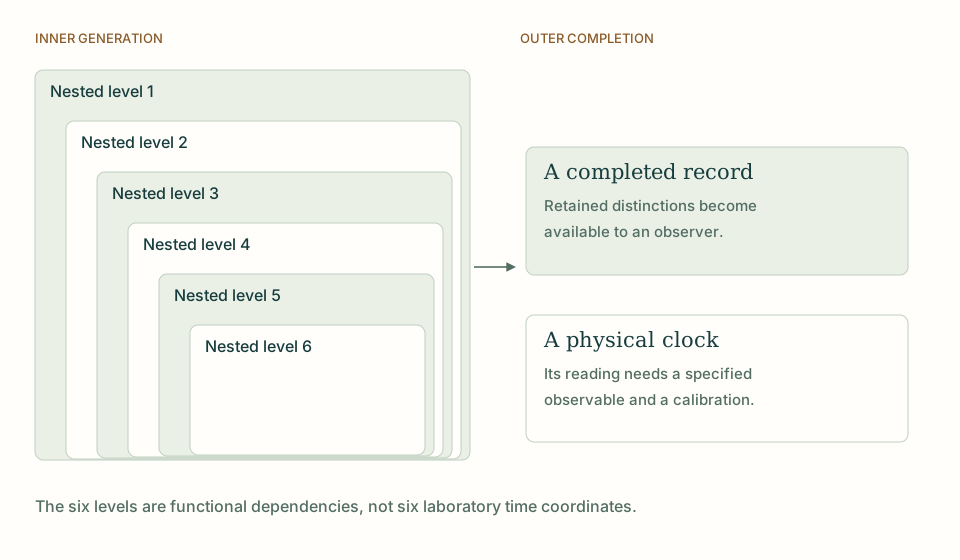
The six inner levels belong within that interface. They are not six past moments traversed before reaching a seventh ordinary moment. Nesting expresses how the capacities required for a completed observable world depend on one another. A reader should therefore distinguish a symbolic diagram of completion from a physical claim about how long the present lasts. Neither the duration of conscious experience nor the resolution of an atomic clock follows from the number of nested roles. Those quantities require separate models of observers and physical clocks.
SMM begins with one nonspatial generative source. DTT distinguishes its inner production from the outer order in which completed results become accessible. The six inner levels are nested functional dependencies within that production; the seventh denotes outer completion. They are not six independent clocks, six spatial directions, or six simultaneously occupied temporal axes. This distinction makes the framework more specific than a general claim that everything changes: it asks how a world of persistent relations can be generated before its spatial representation is taken for granted. [2]
The two-state description conditions quantum probabilities on both an earlier preparation and a later successful selection. For an intermediate ideal projective measurement with projectors Pk, the ABL probability is proportional to |⟨f|Pk|i⟩|², normalized by the sum over outcomes. This is a precise boundary-conditioned rule. It does not introduce two independently readable clocks.
For example, prepare a qubit in |0⟩, later select |+⟩, and measure the z basis in between. The only nonzero intermediate contribution is k = 0, so its conditional probability is one. Measuring the x basis instead gives certainty for the plus outcome within the successfully selected ensemble. The difference concerns the specified measurement context. It does not mean that both incompatible outcomes existed as one ordinary classical record. The formalism’s time symmetry is a useful comparator for DTT’s production/completion distinction, but identifying postselection with ontological creation would require an additional argument and careful accounting of failed selections. [1]
The two-state formalism describes an intermediate quantum situation in relation to both boundaries, whereas DTT’s becoming concerns how an event acquires completed accessibility. A final selection can help determine conditional statements about an intermediate event without making that event’s actuality wait for a conscious observer. This distinction is essential if the present is to be an objective part of the source model.
A DTT completion instrument could specify when a record is stable and which outcomes are retained. The ABL rule would then provide a benchmark for conditioning on additional later information. These are two different operations: producing a record and selecting an ensemble of records. Confusing them can make ordinary postselection appear to prove that the future creates the past. The constructive opportunity is to derive the instrument and the availability of its output from nested generation. That would give the present a precise operational role while leaving the broader metaphysical interpretation of actuality open to argument. It would also preserve the full probability accounting required by quantum theory. [1]
Imagine a ledger that records a sequence of transactions. At stage n it contains a stable history and a pending transaction whose validity depends on that history. At stage n+1 the transaction is accepted and can constrain later entries. The ledger’s current accepted state is a precise analogue of a completion boundary. Yet the analogy leaves open whether the future ledger already exists, whether old physical pages remain, and whether acceptance takes a definite duration. These are additional ontological or physical commitments. The example shows both the appeal and the limitation of identifying the present with completed accessibility.
The comparison becomes productive when it asks what a present does in the theory. Does it select what exists, what can cause later records, or what an observer can currently know? DTT has an unusually direct route to the second and third questions because completion and retention are central to its vocabulary. A successful account of the first would require a coherent ontology of uncompleted possibilities and of the past. This division allows philosophical ambition and operational precision to reinforce one another.
THE SAME QUESTION, DIFFERENT STARTING POINTS
| Question | SMM/DTT | The two-state vector formalism |
|---|---|---|
| Explanatory starting point | DTT interprets completion as the boundary at which generated relations become available to constrain subsequent events and observations. | Earlier preparation and later selection define conditional quantum statistics in a specified protocol. |
| Key distinction | A boundary of completed access does not by itself decide whether past events remain existent or future events are already real. | The two-state formalism describes an intermediate quantum situation in relation to both boundaries, whereas DTT’s becoming concerns how an event acquires completed accessibility. |
KEEP THE CONNECTION
Connects this comparison with the author’s discussion of present.
Connects this comparison with the author’s discussion of present.
Connects this comparison with the author’s discussion of present.
Connects this comparison with the author’s discussion of present.
Connects this comparison with the author’s discussion of present.
References support the comparator and the specific mathematical or interpretive claims indicated. SMM/DTT connections are developed in the analysis above.
How these comparisons distinguish premises, results and physical claims
SMONAD
Share this page, or keep a clear reference to the work you are reading.
Use this reference for the explanation on this page. “n.d.” means its first publication date is not specified; the update date is recorded separately.