


The answer in brief
A common source must forbid independent matter and clock response coefficients. Universal metric coupling supplies a conditional mechanism whose source origin remains to be established.
Go to the research challengeState which equivalence is being claimed
The equivalence principle connects several kinds of measurement: free-fall trajectories, local non-gravitational physics and the behavior of clocks in a changing gravitational environment. Deriving one equality between two masses is a useful step, but the wider claim concerns all admitted matter and clock systems. The site’s mass-equivalence guide frames this as a common-coupling problem.
The review by Clifford Will, The Confrontation between General Relativity and Experiment, distinguishes universal free fall from the broader local Lorentz and position independence conditions. Here the aim is a constructive theoretical question: what property of one generative source would force these different devices to share a gravitational response?
The six nested inner levels may organize how material records form, while outer completion supplies observable events. Their common origin becomes explanatory only when the allowed source couplings actually prevent species-dependent response coefficients.
One controller can still assign different falling rates
For species A, take a weak-field Lagrangian LA=mI,Av²/2−mG,AΦ(x), where the potential Φ is externally specified for this test. The Euler–Lagrange equation gives acceleration aA=−(mG,A/mI,A)∇Φ. A common potential does not force equality of these ratios.
A single update can implement mI,1=m, mG,1=m and mI,2=2m, mG,2=2m(1+ε). Both species are generated by the same controller, but the second falls faster by a factor 1+ε. With positive ε, the symmetric relative difference is 2ε/(2+ε). Choosing ε=0.01 gives 2/201. This is a constructed countermodel, not a measured violation.
A derivation must therefore exclude this allowed deformation. A universal source vocabulary, shared location or common temporal origin does not exclude it unless the dynamical law relates the kinetic and potential coefficients.
What would a universal metric coupling achieve?
If every structureless massive probe has the action SA=−mAc²∫dτ for the same metric, variation gives the same geodesic equation independently of the overall mass factor. In the weak, slowly varying limit, expanding the action produces a kinetic term mAv²/2 and a potential term −mAΦ. Their equality follows from the shared proper-time action.
This is a strong conditional result: universal metric coupling explains universal trajectories within the probe approximation. The new source theorem would show why all admissible material excitations reduce to that form. It must also address spin, finite size, binding and interactions at the appropriate scale. Declaring a separate proper-time action for each species with the same chosen metric is a valid starting model, but it has placed universality among the inputs.
A useful first theorem can classify the source symmetries that forbid an independent coefficient of Φ for each stable excitation. It should identify the approximation in which the classification applies.
Composite objects test more than constituent masses
Let a bound pair have constituent masses m₁,m₂ and binding energy Eb<0. An inertial energy accounting gives mI=m₁+m₂+Eb/c². A source law could nevertheless assign mG=m₁+m₂+ζEb/c². Constituent equality alone leaves ζ free.
For m₁+m₂=10 mass units and Eb/c²=−1, the inertial mass is nine. Choosing ζ=1 gives gravitational mass nine; choosing ζ=0 gives ten. A comparison of bound and unbound preparations would separate the two models. The calculation shows why the gravitational response must include interaction energy and retained source contributions, not only a sum of elementary masses.
For SMM/DTT, an attractive target is a conservation identity showing that the same completed total energy determines both inertial response and gravitational coupling. It must count hidden binding records consistently when the source is coarse-grained into a composite object.
What would make different material clocks agree?
Consider two devices with transition frequencies ν₁ and ν₂. Parameterize a weak-potential response by δνA/νA=(1+βA)ΔΦ/c². This defines a family of possible clock laws; it does not assume a measured departure. If β₁ and β₂ differ, the frequency ratio varies with potential even when the devices agree in a reference environment.
A single reference calibration cannot determine both potential responses. The source must constrain the derivatives of the transition energies as the environment changes. The universal-clock problem is therefore closely connected to equivalence: the same material law should govern energy levels, proper duration and gravitational coupling.
Constructing one protected clock is insufficient to establish a universal law for every admissible clock. A useful theorem either proves universality for a clearly defined class or calculates controlled corrections and identifies the devices to which they apply.
Local free fall leaves tidal information
A coordinate choice can remove a uniform acceleration along a freely falling trajectory. It cannot generally remove relative acceleration between neighboring trajectories over a finite region. That difference is the tidal information represented by curvature. Thus an equivalence derivation should distinguish a local probe limit from statements about extended bodies.
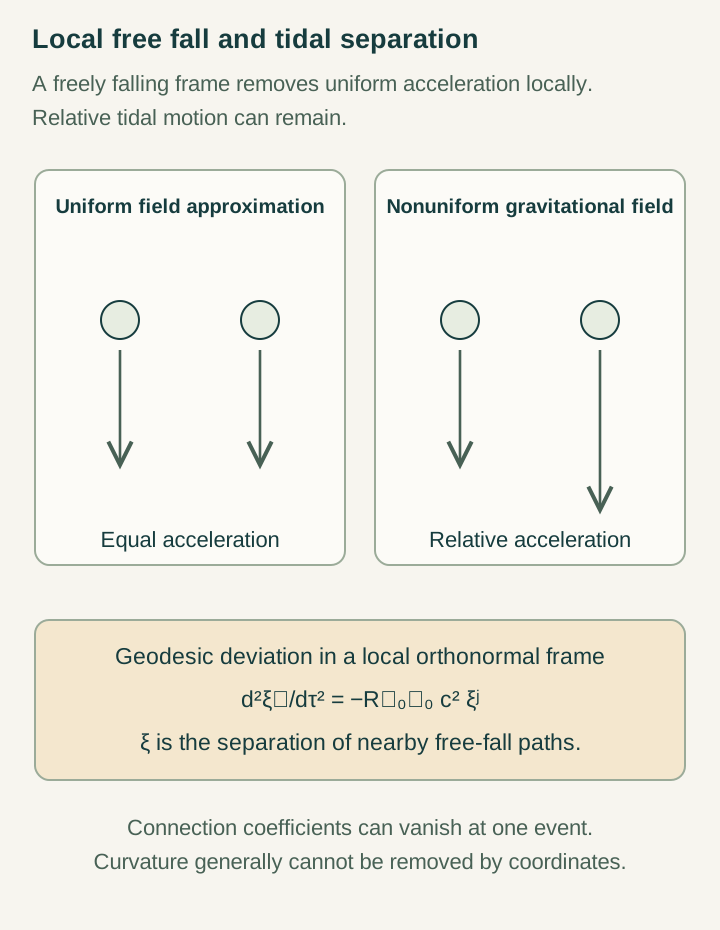
A source model can make this distinction operational by comparing two nearby completed records with independently calibrated separation and delay. A shared local acceleration can cancel from their relative motion, while a position-dependent response remains. The result should be expressed in measured record quantities before it is translated into a curvature tensor.
Universality should survive changing the internal state
A material clock can occupy two internal states separated by energy ΔE. A universal total-energy coupling assigns the excited state an additional inertial and gravitational mass ΔE/c². A competing source model could couple only part of that internal energy to gravity while leaving the clock’s ordinary transition frequency unchanged in the reference environment.
This gives a useful theoretical comparison without constructing a new elementary particle. Derive both states from one source, calculate their inertial response and then change the same gravitational background. The difference tests whether the coupling follows total completed energy or only selected constituents.
A protected identity that survives such an internal-state change is stronger than an equality fitted for one ground-state object. It is also a natural way to connect the clock question, composite binding and the equivalence principle within one manageable model.
A tractable common-source challenge
Use one autonomous source with at least two stable excitation types and one bound composite. Define inertial mass through a momentum–energy response, gravitational mass through response to the same source-generated weak field, and clock rates through two internal transitions. Keep all calibration procedures independent.
The deliverable is a theorem tying these quantities together or a finite countermodel identifying the surviving freedom. It should include binding energy and explain why an admitted perturbation cannot introduce βA or ζ independently. This would turn a common-source motivation into a demonstrable universality mechanism and provide a focused project for specialists in gravity, many-body theory and mathematical physics.
Develop the argument
Questions to take further
- Which source identity ties kinetic energy, binding energy and gravitational response together?
- What prevents two admissible material clocks from having different potential dependence?
A concrete next step
Test universality across matter and clocks
Construct two source-generated excitation types, one bound state and two clock transitions under a shared weak-field perturbation.
What to share
Independently defined inertial and gravitational responses, a binding-energy audit, and a universality proof or explicit deformation.
I welcome collaboration with experts in physics, mathematics and philosophy. Get in touch with a question or proposal.