
A universal proper-time coupling yields the same coefficient for kinetic energy and gravitational potential energy in the weak-field limit. SMM/DTT must derive that common coupling for different matter sectors, including their binding energy and clock response.
Two operational questions
In a Newtonian description, write a body's kinetic energy as miv²/2 and its gravitational potential energy as mgΦ. The equation of motion is mia=−mg∇Φ. Bodies with the same initial conditions fall identically only when the ratio mg/mi is universal.
This is the passive response to an external field. The strength with which matter sources gravity is a further question, handled by the gravitational field equation. SMM's shared source motivates agreement among these properties, but a mathematical model must specify the interaction that makes the agreement necessary.
Worked example: a small nonuniversal coupling
Take two hypothetical test bodies. Body A has mi=1 and mg=1; body B has mi=2 and mg=2.002 in compatible units. Their accelerations in the same field differ by a factor 1.001.
2|aB−aA|/(aA+aB)≈0.0009995.
These numbers are an illustrative model, not an empirical bound. Both species could live on the same coordinate space and possess relativistic free propagation. The differential response comes from their independently chosen gravitational coefficients. Lorentz kinematics alone does not remove that freedom.
One metric action removes the mass dependence of free fall
Suppose every sufficiently small, freely falling, structureless test body has action Ss=−msc²∫dτ, using the same metric to define dτ. Varying the path yields the geodesic equation:
The constant ms multiplies the whole action and cancels from the stationarity condition. Test trajectories with the same starting position and velocity are therefore independent of that mass. The shared metric coupling is the decisive premise; the result is not obtained merely by assigning the same source label to different bodies.
Open the full-size diagram →
Recovering equal coefficients at low speed
Use signature (−,+,+,+) and a weak static field with g₀₀≈−(1+2Φ/c²). At low speed, proper time satisfies dτ/dt≈1+Φ/c²−v²/(2c²). Substitute this in the same action:
The kinetic and gravitational-potential terms contain the same m. The equality is now a consequence of the common metric action rather than a separate coincidence of two fitted parameters. This derivation also links clock rates to free-fall motion: both depend on the same proper-time geometry. A DTT source should reproduce that joint response.
Free fall removes uniform gravity locally, not tides
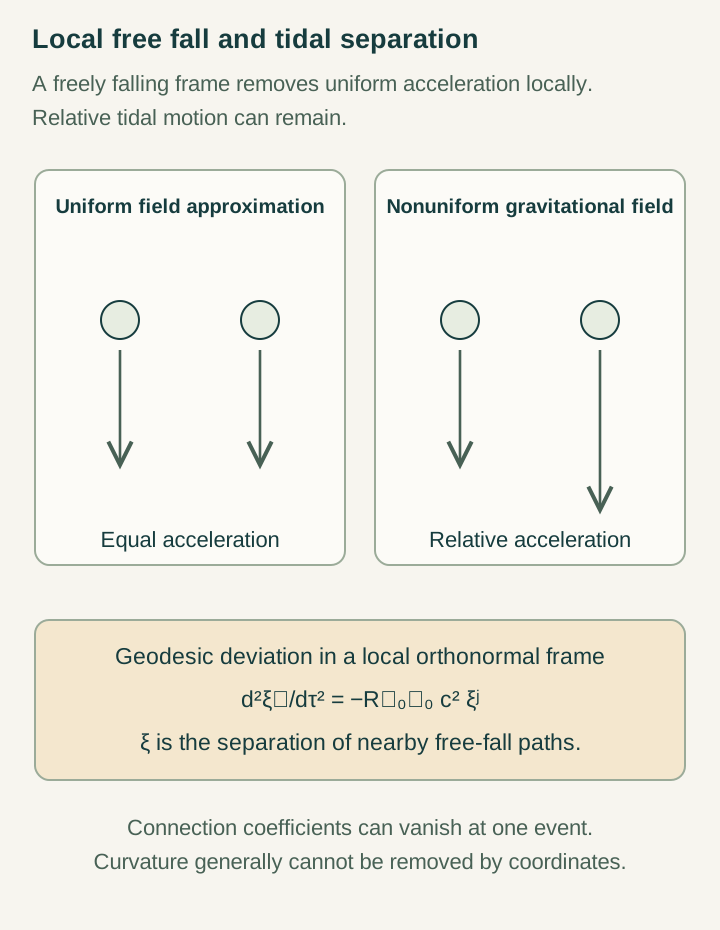
A freely falling frame can eliminate the connection at a chosen event for the Levi-Civita geometry. Neighbouring free-fall trajectories can still accelerate relative to one another because curvature remains. This is why the equivalence is local and why an extended laboratory can detect tidal structure.
For a Newtonian point-source potential, radial acceleration is −GM/r². Two nearby radial test bodies separated by δr have relative acceleration approximately (2GM/r³)δr. The derivative measures a gradient of the field, which cannot be removed by subtracting one common acceleration. A source reconstruction must therefore explain both common local free fall and the spatial variation encoded by curvature.
The coupling must include internal organization
Real material clocks and rulers are composite. Their masses contain constituent energies, binding contributions and internal excitations. A universal metric coupling must act consistently on the total system, rather than coupling differently to whichever microscopic component is easiest to identify.
This is particularly relevant to DTT, where particle identity is proposed to arise from different persistent generative patterns. Distinct patterns can have distinct rest frequencies while still sharing one metric response. The source-level theorem must show why changing the internal organization changes the mass coefficient without changing the ratio of gravitational response to inertia.
How a source model could fail the principle
Suppose an additional source field changes each species' mass coefficient through a different position-dependent factor As(x). Replacing the action by −msc²∫As(x)dτ introduces gradients of As into the path equation. Different factors can produce composition-dependent forces even though the action is written covariantly.
This example identifies a concrete selection task: constrain the allowed source couplings so that such species-dependent terms are absent, common or suppressed in a controlled regime. Coordinate covariance is valuable, but it is weaker than universal coupling. The six nested roles must constrain interaction coefficients, not only provide an execution schedule.
A constructive SMM/DTT programme
Begin with two different stable matter carriers and derive their effective actions in a slowly varying completed background. Extract inertial mass from momentum curvature, passive gravitational response from the background gradient and clock rate from an independent internal transition. Compare the three results before identifying their coefficients.
Success would mean that one source symmetry or interaction law enforces a common metric dependence, including composites and controlled corrections. This would establish a meaningful equivalence-principle mechanism. It would still leave the gravitational field equation and the value of its coupling G to be derived: universal test-body motion does not by itself determine how matter creates curvature.
Continue with the articles
- The Mass-Energy Equivalence
Use mass–energy equivalence as a focused case study in translating familiar physics into the language of temporal generation. State the physical relation before discussing proposed interpretations.
- Calibrating a conformal geometry
Explain why a causal cone fixes less than a fully scaled metric. Introduce the record-density and clock standards used to supply the remaining scale in the draft.
- When geometric symmetries become physical boosts
Compare automorphisms of a mathematical geometry with transformations realized by physical observers. Explain why frame richness is an additional requirement for identifying the two.
- What Lorentzian reconstruction leaves open
Summarize the boundary of the constraint-relative theorem. Recovering a causal geometry does not itself determine matter dynamics, the numerical limiting speed, or Einstein’s field equations.
- Four principles of quantum relativity: assumptions and consequences
Follow the four proposed principles through their mathematical dependencies. The guide connects complex temporal dynamics with SMM/DTT while identifying the extra assumptions needed to pass from an algebraic construction to a physical consequence.