
Independent local frames imply the endpoint law U′<sub>wv</sub>=h<sub>w</sub>U<sub>wv</sub>h<sub>v</sub><sup>−1</sup>. This supplies a relational comparison structure; it does not yet choose a gauge group, curvature, or interaction energy.
What a local frame describes
Attach a finite-dimensional complex carrier Ev to each completed record v. A frame is a choice of basis for expressing a vector in that carrier. If the inner product is physically meaningful, orthonormal frames provide equivalent descriptions related by unitary matrices. Components change when the frame convention changes, while the abstract vector and its norm remain the same.
This offers a concrete SMM/DTT interpretation: different completed records need not arrive with a preferred common coordinate basis. The source may supply meaningful states and comparisons without supplying absolute component labels. The hypothesis concerns the retained carrier and its measurements; it does not follow solely from calling the source a monad.
A phase change at one record
For a one-dimensional complex carrier, let a component ψv transform as ψ′v=exp(iχv)ψv. Its modulus is unchanged. If an isolated instrument measures only |ψv|², it cannot distinguish the phase conventions. At another record w, an independent convention χw may be used.
The expression ψw*ψv then acquires a phase exp[i(χv−χw)]. It is not a well-defined comparison under independent local choices. A rule is needed to transport one component into the frame of the other. The requirement arises even before an energy or a propagating field is introduced.
Deriving the endpoint transformation law
Let Uwv:Ev→Ew be a unitary comparison map. We use the component convention ψ′v=hvψv. Requiring the transported component to describe the same comparison means U′wvψ′v=hwUwvψv. Since this holds for every input:
The reverse link is Uvw=Uwv†. The endpoint law follows from the comparison map and the declared frame freedom. It does not require interpreting a gauge potential as a separately observable substance. Nor does it specify which unitary subgroup is physically available; preserved tensors and permitted operations can restrict that group.
Open the full-size diagram →
A comparison that survives both frame changes
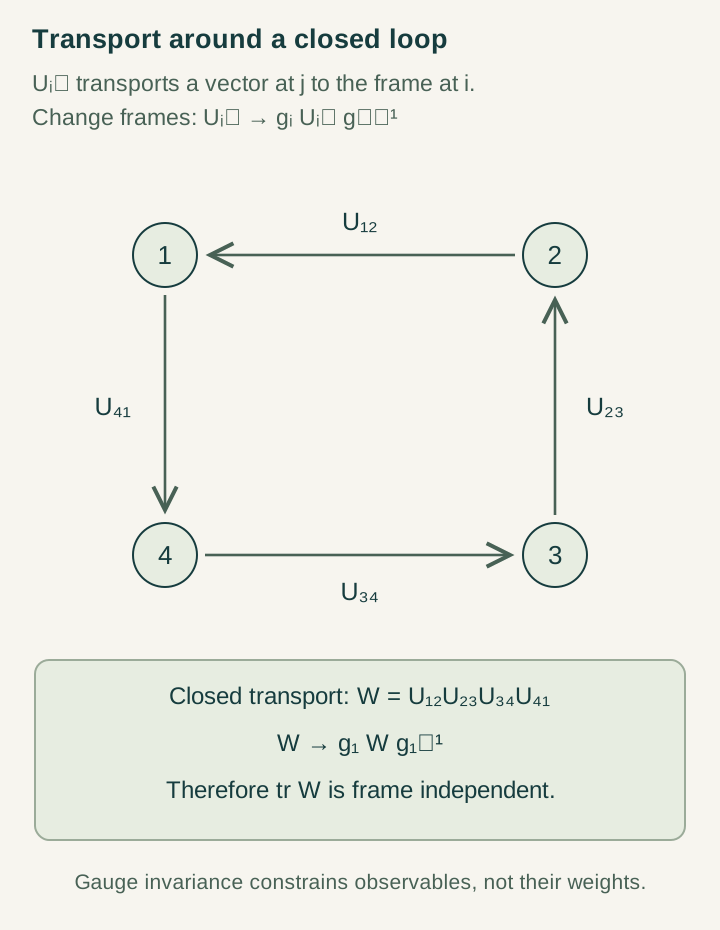
The scalar ψw†Uwvψv is invariant: substitution cancels hw†hw at the arrival end and hv−1hv at the departure end. A real interaction term can therefore use this scalar and its complex conjugate.
For one-component carriers this becomes −2t|ψw||ψv|cosδ, where δ includes both endpoint phases and the link phase. The energy depends on the relational phase combination. Choosing this energy law and its coefficient t remains a dynamical input, even though its invariance follows directly from the comparison structure.
Nontrivial components can describe a flat comparison
Suppose every link has the form Uwv=hwhv−1. Along a path v→w→u, the product is huhv−1 because the intermediate factors cancel. Around any closed graph loop it becomes the identity. A change of local frame can set all these links to identity simultaneously.
Thus complicated-looking local matrices can encode only a choice of description. To obtain a nontrivial loop comparison, the links must contain information that cannot be removed in this way. This distinction prevents a proposed source model from interpreting arbitrary basis variation as a generated force or nonzero field strength.
A consistent continuum convention
When records admit a smooth coordinate description, use Dψ=dψ+Aψ with an anti-Hermitian matrix-valued one-form A. Requiring D′ψ′=hDψ gives the connection transformation:
The derivative term is essential because h varies from record to record. Another common convention transforms components with h−1 and writes the corresponding inverse-frame formula. Either convention works if used consistently. Smooth charts, differentiability, and the existence of a nearby-record limit are additional assumptions; a finite carrier or a source composition algebra alone does not establish a continuum manifold.
The source-level problem now has a precise target
For SMM/DTT, this construction identifies a possible job for completion: retain carriers whose comparisons are meaningful although their local bases are arbitrary. The six nested inner roles could generate and validate those relational maps. They should be specified as dependent operations, not identified with six gauge components or six independent temporal axes.
The next task is to derive the carrier, its allowed frame group, and its link update from one source law. A useful result would calculate a nontrivial invariant comparison and show how its energy or transport response follows from that law. The parallel transport guide develops the comparison mechanism, while group reconstruction examines which preserved structures restrict the available frames.
Continue with the articles
- Relational transport and gauge freedom
Explain why independently unframed record fibers require a rule for comparison. Introduce gauge transport as a conditional reconstruction idea, distinct from the draft’s exact Hamiltonian results.
- An exact singlet-loop response
Introduce the four-position mobile carrier and stationary dual used in the solvable model. Explain how the holonomy-dependent resolvent determines the ground-state response under the supplied Hamiltonian.
- Controlled effective gauge Hamiltonians
Introduce the finite-cell effective Hamiltonian and its explicit remainder. Explain why a controlled approximation needs a stated norm bound and an evolution-error estimate.