Explain why independently unframed record fibers require a rule for comparison. Introduce gauge transport as a conditional reconstruction idea, distinct from the draft’s exact Hamiltonian results.
The gauge manuscript deliberately separates exact mathematics for a supplied singlet-binding Hamiltonian from a conditional SMM/DTT reconstruction of carriers, comparison rules and retained tensors. The static loop theorems use ordinary complex carrier spaces, positive penalties, hoppings and link matrices as inputs. The temporal interpretation asks whether one generative source and its completion records can select those inputs. Six nested inner stages are generative roles, not six separate clock axes or a pre-existing gauge multiplet. Exact solvability at the first layer is valuable, but it does not automatically close the selection problem at the second.
02Why comparison needs a transport rule
At each completed record attach a Hermitian carrier E_v whose basis has no absolute physical meaning. Comparing vectors at different records requires a map U_wv:E_v→E_w. Under independent frame choices h_v and h_w, the same relational comparison is represented by h_wU_wv h_v⁻¹. This endpoint transformation law expresses how local descriptions are coordinated. It follows from the stated comparison structure and frame freedom, not from an assumption that gauge potentials are independently observable substances.
U_wv→h_wU_wv h_v⁻¹
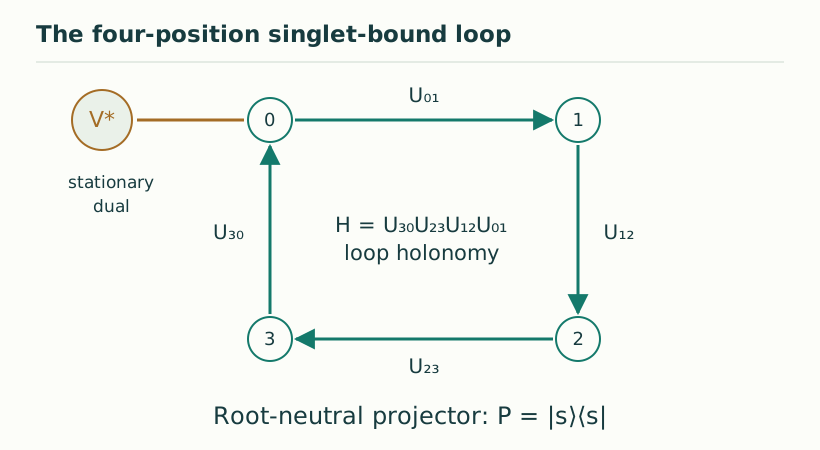
Figure 1. The four-position singlet-bound loop. A mobile carrier hops around four supplied positions while its stationary dual remains at the root. The root singlet penalty and the link holonomy determine the finite model response. This construction presupposes the lattice and carrier data. View full size ↗
03The continuum connection law
For sufficiently smooth nearby records, expand the faithful comparison map to first order. In a local frame the differential comparison becomes Dψ=dψ+Aψ. Changing frames produces the inhomogeneous derivative term in A′=g⁻¹Ag+g⁻¹dg. That extra term ensures that Dψ transforms like ψ. Smoothness, a record chart and the existence of appropriate comparators are prerequisites; a nonspatial source algebra alone does not supply a differentiable manifold.
Dψ=dψ+Aψ
A′=g⁻¹Ag+g⁻¹dg
04A loop example
Transport around a closed loop gives a holonomy W. A change of frame at its base point conjugates W, so its trace and eigenvalues are frame independent. Along an open path the transport matrix itself depends on endpoint frames. If every link is pure gauge, a contractible loop has trivial holonomy even though individual link matrices look nontrivial. This separates a physically meaningful comparison around a loop from arbitrary local coordinates on the carriers.
05Curvature needs more than frame freedom
A protected spectral subspace with projector P can carry the projected connection ∇s=Pds and curvature P(dP∧dP)P. A fixed projector with a varying basis has only pure-gauge variation, so it does not create curvature. The draft explicitly finds restricted bare-source frame variations that remain flat. Curved carriers require additional embedding or completion controls. For SMM/DTT, relational comparison is a plausible bridge from completed records to gauge structure, but propagating force dynamics and the selection of nonzero curvature remain further physical tasks.
06A protected band and its physical transport are not identical
The projected connection describes how an isolated carrier subspace varies. If its internal energy levels are unequal, actual slow evolution also accumulates dynamical phases and can depend on the splitting. Measuring the geometric comparison may require a degenerate band, a controlled echo or an explicit subtraction protocol. The draft distinguishes these cases. For a temporal source this matters because an intrinsic recurrence spectrum and an emergent gauge carrier need not share the same Hamiltonian. A record map that forgets a selector does not automatically erase the physical energy splitting that continues to drive its retained state.
07What a physical identification would require
A frame group, an invariant tensor and a loop response are mathematical structures. Identifying them with observed particle charges, interaction strengths and spacetime forces additionally requires matter statistics, chirality, dynamics, normalization and controlled scale matching. A connection can be flat even when its allowed structure group is large. A finite auxiliary gap can be positive without establishing a continuum Yang–Mills mass gap. The SMM/DTT programme becomes sharper when these distinctions are retained: a proposed temporal source law can then be asked to reproduce specific carriers and coefficients rather than receiving credit for empirical physics merely because familiar group labels appear.
Gauge-invariant density matrices and neutral amplitudes are different notions. Averaging a density matrix over frames can leave a maximally mixed state in a nontrivial charged representation. Averaging amplitudes coherently projects onto invariant vectors and can instead select a singlet sector. A completion mechanism must specify which operation it implements and where its reference carrier resides. This distinction matters when interpreting a static singlet calculation as a physically generated neutral sector: symmetry of the Hamiltonian preserves a chosen sector but does not automatically prepare it.
KEEP THE CONNECTION
Key ideas
Independent local frames require a covariant comparison law.
Closed-loop conjugacy data are frame independent.
Frame variation alone can be flat and need not generate a physical force.
Scope of the argument. Conditional comparison reconstruction; connection structure alone does not establish curvature, gauge dynamics or empirical forces.
Sources & further reading
Gauge_Structure_Temporal_Completion_v20(2).pdf — working draftpp. 43–47, §§12–15
Source editions and catalogue entries
Working manuscript
Gauge Structure from Temporal Completion in SMM/DTT — Version 20
Working manuscript. Article-level references identify the consulted sections and the scope of the interpretation. No public URL was supplied for this exact manuscript version.