Explain the model’s unique ground state and gap bound. Distinguish a finite-system spectral statement from a continuum mass gap in a physical gauge theory.
The gauge manuscript deliberately separates exact mathematics for a supplied singlet-binding Hamiltonian from a conditional SMM/DTT reconstruction of carriers, comparison rules and retained tensors. The static loop theorems use ordinary complex carrier spaces, positive penalties, hoppings and link matrices as inputs. The temporal interpretation asks whether one generative source and its completion records can select those inputs. Six nested inner stages are generative roles, not six separate clock axes or a pre-existing gauge multiplet. Exact solvability at the first layer is valuable, but it does not automatically close the selection problem at the second.
02The isolated ground state
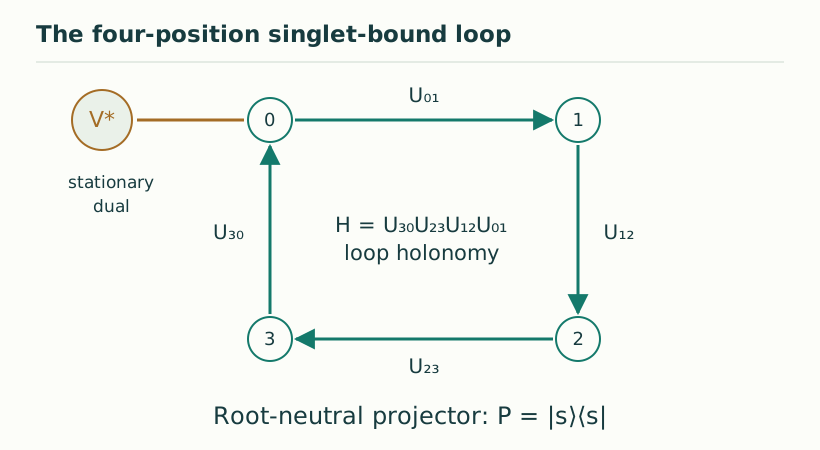
The singlet-loop Hamiltonian is a rank-one attractive perturbation of a free hopping operator after an energy shift. Its secular root z lies strictly above the largest free eigenvalue λ*. Consequently H has a unique lowest eigenvalue Δ−z. Other eigenvalues are constrained by rank-one interlacing. This is a finite-dimensional statement valid for every positive Δ and real hopping amplitude t, not merely in a small-hopping series.
E₀=Δ−z, z>λ*
Figure 1. The four-position singlet-bound loop. A mobile carrier hops around four supplied positions while its stationary dual remains at the root. The root singlet penalty and the link holonomy determine the finite model response. This construction presupposes the lattice and carrier data. View full size ↗
03Derive the uniform gap bound
Let w* be the singlet’s spectral weight in the top free eigenspace. In the secular sum, the top contribution alone gives 1≥Δw*/(z−λ*), hence z−λ*≥Δw*. Each maximizing mobile mode carries weight 1/(4m), so w*≥1/(4m). Interlacing then gives gap(H)≥Δ/(4m). For m≥2 a vector in the repeated top free eigenspace can be chosen orthogonal to the singlet, making the first inequality exact: the gap equals z−λ*.
gap(H)≥z−λ*≥Δw*≥Δ/(4m)
04A rank-dependent example
For m=2 the uniform lower bound is Δ/8; for m=3 it is Δ/12. At zero hopping the actual gap is Δ, so the uniform estimate is deliberately weaker. It must remain valid for all permitted holonomies and arbitrarily large hopping. At identity holonomy the manuscript obtains a stronger Δ/4 lower bound for these blocks. Comparing a general bound with a special-case gap prevents mistaking a worst-case guarantee for the exact spectrum at every parameter value.
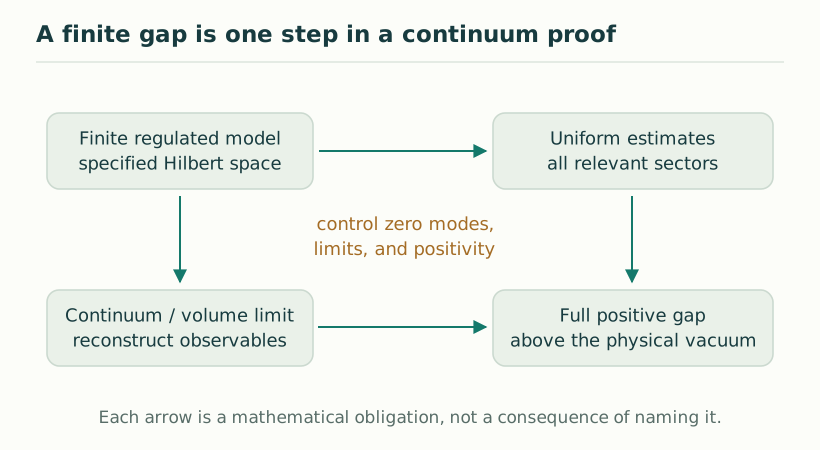
Figure 2. A finite gap is one step in a continuum proof. A finite-volume or charged-sector threshold does not by itself prove a full continuum mass gap. The diagram names distinct obligations: uniform control, physical-sector reconstruction, and a positive infinite-volume spectral threshold. View full size ↗
05Why this is not the Yang–Mills mass-gap problem
The auxiliary system has finitely many positions and a penalty Δ inserted directly into its Hamiltonian. A continuum gauge-field mass gap concerns a different Hilbert space, interacting field dynamics, volume and regulator limits, and physical normalization. The finite theorem supplies a protected auxiliary band useful for effective Hamiltonian constructions. It does not establish a positive gap uniform under all those additional limits. For SMM/DTT, the meaningful next step is to explain the singlet penalty and show controlled coupling to retained fields without losing the isolation needed for elimination.
06Gap protection and perturbative accuracy answer different questions
The static gap remains positive even when |t|/Δ is large, but a low-order expansion in that ratio is then unreliable. Conversely, a small hopping ratio supports a perturbative target whose error must be calculated separately from isolation. A protected band ensures that a spectral subspace is available; it does not guarantee that a particular fourth-order formula accurately describes its dynamics. This distinction is especially useful when building a DTT completion mechanism: one can first establish robust state separation, then choose a controlled parameter regime for an effective field interaction. Neither step should be inferred solely from the other.
07What a physical identification would require
A frame group, an invariant tensor and a loop response are mathematical structures. Identifying them with observed particle charges, interaction strengths and spacetime forces additionally requires matter statistics, chirality, dynamics, normalization and controlled scale matching. A connection can be flat even when its allowed structure group is large. A finite auxiliary gap can be positive without establishing a continuum Yang–Mills mass gap. The SMM/DTT programme becomes sharper when these distinctions are retained: a proposed temporal source law can then be asked to reproduce specific carriers and coefficients rather than receiving credit for empirical physics merely because familiar group labels appear.
Gauge-invariant density matrices and neutral amplitudes are different notions. Averaging a density matrix over frames can leave a maximally mixed state in a nontrivial charged representation. Averaging amplitudes coherently projects onto invariant vectors and can instead select a singlet sector. A completion mechanism must specify which operation it implements and where its reference carrier resides. This distinction matters when interpreting a static singlet calculation as a physically generated neutral sector: symmetry of the Hamiltonian preserves a chosen sector but does not automatically prepare it.
KEEP THE CONNECTION
Key ideas
The finite ground state is unique for all positive penalties.
The uniform bound is Δ/(4m), with stronger special cases.
A protected auxiliary gap is distinct from a continuum gauge-field mass gap.
Scope of the argument. Exact finite auxiliary gap; no continuum or thermodynamic-limit mass-gap claim.
Sources & further reading
Gauge_Structure_Temporal_Completion_v20(2).pdf — working draftpp. 9–10, Theorem 2.1
Source editions and catalogue entries
Working manuscript
Gauge Structure from Temporal Completion in SMM/DTT — Version 20
Working manuscript. Article-level references identify the consulted sections and the scope of the interpretation. No public URL was supplied for this exact manuscript version.