What the holonomy Hessian does and does not contain
Explore the exact trace structure of the response near identity holonomy. Explain why the absence of an independent squared-trace term matters for the model’s coefficient relations.
The gauge manuscript deliberately separates exact mathematics for a supplied singlet-binding Hamiltonian from a conditional SMM/DTT reconstruction of carriers, comparison rules and retained tensors. The static loop theorems use ordinary complex carrier spaces, positive penalties, hoppings and link matrices as inputs. The temporal interpretation asks whether one generative source and its completion records can select those inputs. Six nested inner stages are generative roles, not six separate clock axes or a pre-existing gauge multiplet. Exact solvability at the first layer is valuable, but it does not automatically close the selection problem at the second.
02Expand near identity holonomy
Write W=e^(iX) with X small and Hermitian. The exact ground energy is invariant under conjugating X, so a general quadratic response could involve both tr(X²) and [tr X]². The singlet-loop model is more restrictive: its exact secular expression averages independent one-angle ring resolvents. Reversing any individual eigenangle leaves that expression unchanged. Mixed quadratic products of different eigenangles are therefore absent.
E(e^(iX))−E(I)=(κ̂_m/2)tr(X²)+O(||X||⁴)
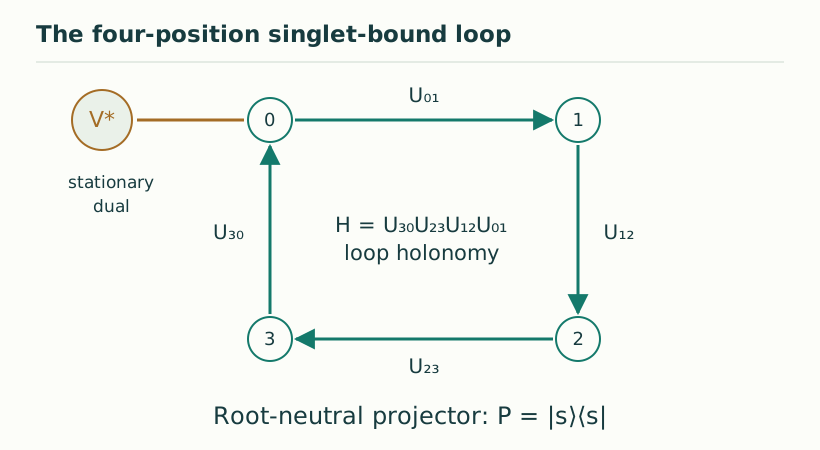
Figure 1. The four-position singlet-bound loop. A mobile carrier hops around four supplied positions while its stationary dual remains at the root. The root singlet penalty and the link holonomy determine the finite model response. This construction presupposes the lattice and carrier data. View full size ↗
03Why the squared-trace term is excluded
Let x_a be the eigenvalues of X. A squared-trace contribution contains cross terms 2x_ax_b for a≠b. Such terms change sign under reversing only one eigenangle, contradicting the independent angle-reversal symmetry of this specific resolvent. The conclusion is stronger than conjugation invariance alone. At rank one the two invariants coincide, so their distinction requires m≥2. Higher-order multi-trace terms are not excluded by this quadratic argument.
04Two blocks and a central coefficient
For rank-three and rank-two blocks write X₃=X₃⁰−2fI₃ and X₂=X₂⁰+3fI₂, with traceless X_m⁰. Then tr X₃²=tr(X₃⁰)²+12f² and tr X₂²=tr(X₂⁰)²+18f². Adding independent responses gives κ̂₁=12κ̂₃+18κ̂₂ in this integral central normalization. If both blocks share t and Δ, the exact stiffness is proportional to 1/m, so κ̂₂/κ̂₃=3/2.
κ̂₁=12κ̂₃+18κ̂₂
equal t,Δ ⇒ κ̂₂/κ̂₃=3/2
05What “all orders” means here
The stiffness is computed from the exact static resolvent, so its small-curvature Hessian includes all hopping orders for this Hamiltonian. It does not mean that the full holonomy potential is exactly quadratic or a Wilson trace action. Additional representations, electric dressing, interactions or quantum running may alter the relation. In SMM/DTT the result provides a conditional coefficient identity linked to a specific completion apparatus. Turning it into a coupling prediction requires independently justified carrier content, matching scales and normalization, rather than identifying the coefficients with measured forces by name.
06The normalization of the Abelian generator is essential
The numbers twelve and eighteen arise from the particular central weights −2 and +3 and the carrier ranks. Rescaling the Abelian generator rescales its coefficient, so a coupling comparison must state the convention used for charges and kinetic terms. A numerical relation between bare Hessian coefficients is not yet a relation between laboratory couplings at a specified energy. Matter normalization and running can intervene. The exact identity is still useful: once a physical matching convention is established, it becomes a nontrivial constraint on that model. Without the convention, familiar-looking numbers can create a false impression of a parameter-free prediction.
A useful next calculation would add one explicitly specified extra carrier representation and recompute the Hessian. This would test which coefficient relations depend on the original singlet apparatus and which survive a controlled extension, instead of assuming that gauge symmetry alone protects them.
07What a physical identification would require
A frame group, an invariant tensor and a loop response are mathematical structures. Identifying them with observed particle charges, interaction strengths and spacetime forces additionally requires matter statistics, chirality, dynamics, normalization and controlled scale matching. A connection can be flat even when its allowed structure group is large. A finite auxiliary gap can be positive without establishing a continuum Yang–Mills mass gap. The SMM/DTT programme becomes sharper when these distinctions are retained: a proposed temporal source law can then be asked to reproduce specific carriers and coefficients rather than receiving credit for empirical physics merely because familiar group labels appear.
Gauge-invariant density matrices and neutral amplitudes are different notions. Averaging a density matrix over frames can leave a maximally mixed state in a nontrivial charged representation. Averaging amplitudes coherently projects onto invariant vectors and can instead select a singlet sector. A completion mechanism must specify which operation it implements and where its reference carrier resides. This distinction matters when interpreting a static singlet calculation as a physically generated neutral sector: symmetry of the Hamiltonian preserves a chosen sector but does not automatically prepare it.
KEEP THE CONNECTION
Key ideas
Independent eigenangle reversal excludes a quadratic squared-trace term.
The two-block central relation follows from explicit trace algebra.
Exact static hopping dependence does not imply protection under new dynamics or renormalization.
Scope of the argument. Exact static Hessian for the supplied model; empirical coupling identification and robustness under added dynamics remain open.
Sources & further reading
Gauge_Structure_Temporal_Completion_v20(2).pdf — working draftpp. 10–12, Theorem 2.3 and Corollary 2.4
Source editions and catalogue entries
Working manuscript
Gauge Structure from Temporal Completion in SMM/DTT — Version 20
Working manuscript. Article-level references identify the consulted sections and the scope of the interpretation. No public URL was supplied for this exact manuscript version.