
Unity counts sources; multiplicity counts distinguishable outcomes. A model connects them through explicit state, update, memory and readout rules.
What you will learn
- Distinguish a source from its states and histories.
- Count histories and identify which differences a detector retains.
- Write the ingredients of a minimal source model.
Before you begin: None. Familiarity with counting and the meaning of a rule is sufficient.
What does one source mean?
The Single Monad Model, abbreviated SMM, proposes a common generative origin for observable multiplicity. Start by separating two questions: how many sources are fundamental, and how many distinguishable results their activity can produce. A single musician can perform many sequences; the number of performers does not count the possible sequences. This analogy clarifies the logical distinction without supplying a physical explanation of the universe.
The proposed source is pre-spatial in the explanatory sense. Calling it a tiny point already presupposes a surrounding space, distance and position. A constructive account instead begins with allowed states and operations, then asks whether relationships among their outcomes can acquire spatial meaning. Nothing in this first step assigns a location to the source.
Keep four objects separate
A state contains the information used by a model to determine its next permitted changes. An operation changes that state. A history lists operations or states over an episode. A record is information retained when that episode finishes. An observation can reveal only part of the record, just as a counter display reveals less than all the circuitry maintaining it.
These distinctions prevent a common counting error. Many histories may end with the same displayed value, and one history may leave several correlated records. Neither number is automatically the number of active sources. The relevant physical question is how the declared mechanism creates, preserves and reads those distinctions. Memory therefore belongs among the resources of the model.
Worked example: eight histories, two labels
Suppose one source performs three successive operations, each labelled A or B. Assume every sequence is allowed. The histories are AAA, AAB, ABA, ABB, BAA, BAB, BBA and BBB: two choices at each of three positions give 2³=8 possibilities. Now let completion retain only whether the number of B operations is even or odd.
The even class contains AAA, ABB, BAB and BBA. The odd class contains AAB, ABA, BAA and BBB. Thus one source supports eight histories but only two parity records. If each history is prepared with probability 1/8, each record has probability 4/8=1/2. Equal probabilities follow from the specified preparation and count; a different preparation can make the two records unequal without changing the available labels.
Writing the connection as a map
A map is a rule that assigns an output to each allowed input. Write C for completion and O for observation. Their composite Π=O∘C means first complete the history, then inspect its retained result. In the parity example, Π sends a three-letter history to one bit, zero for even parity and one for odd parity.
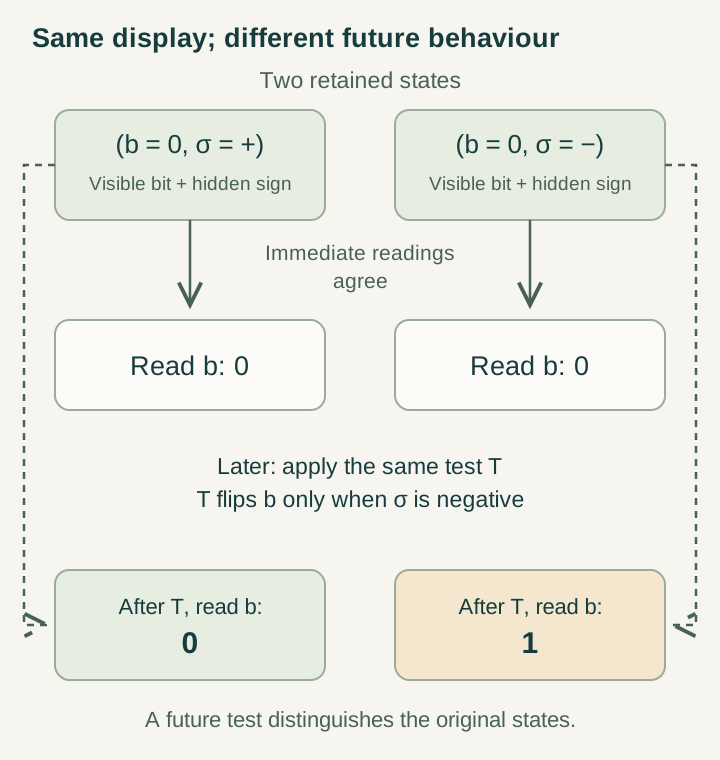
This notation makes information loss visible. The map has eight possible inputs and two outputs. Reading parity cannot recover the whole sequence. That is a precise statement about this detector, not a claim that the unused history never existed or can never matter. A later operation may expose a distinction which the present detector ignores.
Open the full-size diagram →
From a premise to a model
To make a source proposal calculable, specify the complete state z and an update rule U, written zn+1=U(zn). State which preparations are possible, which memory persists, how completion is certified and what a detector can read. The integer n counts applications of U; it becomes a physical duration only after a clock has been defined and calibrated.
Compare two implementations of the parity recorder. One stores the full sequence and computes parity at the end. Another flips a single memory bit whenever B occurs. They agree for the present parity task but use different memory resources. A later request to recover the first letter separates them. An explanation must therefore name both its target observations and the operations it admits.
The question carried into the next lesson
DTT, the Duality of Time Theory, develops a distinction between inner generation and outer completion. The parity construction already supplies a modest example: several internal updates prepare one available result. The next lesson makes this dependency explicit without treating every internal stage as a separate measurable clock.
During the course, keep a small ledger with columns for assumptions, calculated outputs and physical interpretations. Here the two available operations, three-step episode and parity detector are assumptions; eight histories and two labels are outputs. Interpreting such records as matter or spatial events remains a further task. The expanded SMM guide develops this programme, including persistence and the need to derive useful local relations among completed records.
Try the exercises
Work through each question, then open the answer to compare the steps.
Exercise 1
Repeat the example with two operations per history. List every history and its parity class.
Show the worked answer
The four histories are AA, AB, BA and BB because 2²=4. AA has zero B operations and BB has two, so both are even. AB and BA each have one B and are odd. Under uniform preparation each history has probability 1/4; each class therefore has probability 2/4=1/2. There remain two possible records even though the history count has fallen from eight to four.
Exercise 2
A detector retains only the last letter of a three-letter history. How many records exist, and can it distinguish AAB from BAB?
Show the worked answer
The records are A and B, so there are two. Four histories end in each letter. AAB and BAB both end in B, so this detector identifies them. A detector of the first letter separates them, reporting A and B respectively. The distinction is therefore relative to the chosen observation rule; it is not determined by the fact that there is one source.
Continue with the articles
- The Single Monad Model of the Cosmos
Introduce the Single Monad Model as a proposal connecting one generative source with the many events of experience. Set out its vocabulary before approaching its physical interpretations.
- One action, two temporal roles
Explain the draft’s same-cycle foundation: inner action is primitive, while outer record order comes from completed observable returns. Neither role automatically supplies a second readable laboratory clock.
- When two histories count as the same observation
Introduce completion and observational equivalence as distinct ways of identifying histories. Explain why the tests available to an observer determine which differences survive.