
What is established?
A short guide connects the published mathematics, conditional constructions, and open physical questions to the detailed research already on this site.
Read the research status →

SINGLE MONAD MODEL · DUALITY OF TIME THEORY
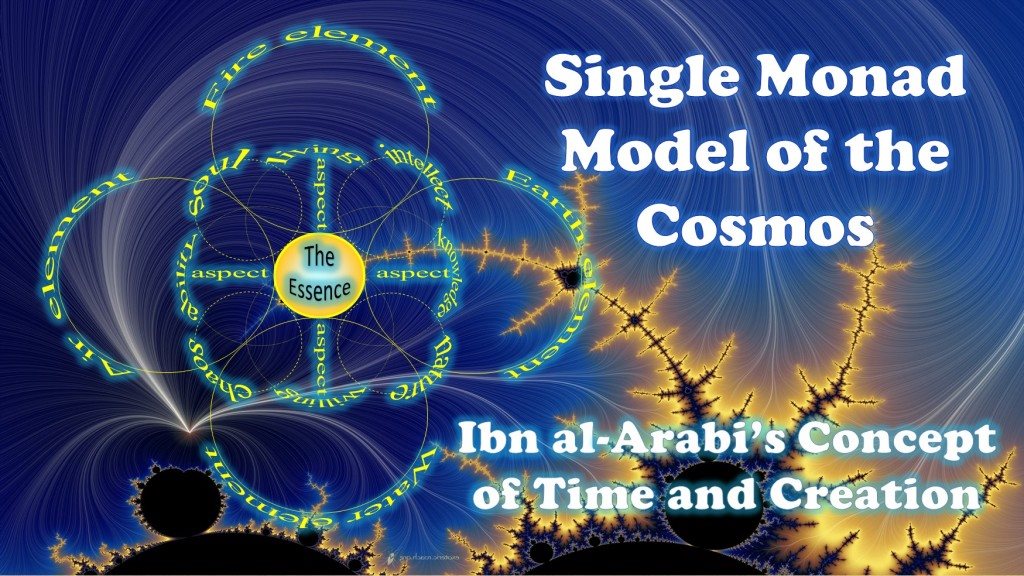
Explore the research behind the Single Monad Model of the Cosmos and Duality of Time Theory. Developed by Mohamed Haj Yousef from his study of Ibn al-Arabi’s account of time and creation, the programme explores how the multiplicity of the world can arise from one generative source.
EXPLORE THE RESEARCH
A short guide connects the published mathematics, conditional constructions, and open physical questions to the detailed research already on this site.
Read the research status →Inspect a finite source update and refine its recorded states until their future behaviour becomes predictable. Follow every transition and export the calculation.
Try the memory lab →Vary phase and coherence in a two-path interference model, then examine the additional prediction needed to test a dual-time interpretation.
Try the interference lab →PUBLISHED RESEARCH
Completion, compatible complex structures, and the conditions behind positive-frequency geometry.
How real representations and their commutants constrain the selection of quantum phase.
A dual-time geometric approach to temporal asymmetry and reduced dynamics.
RESEARCH AREAS · ENGLISH AND ARABIC
Signal limits, Lorentz symmetry, mass and gravitational response.
اقرأ بالعربيةStructural counts, response normalization and the missing physical matching.
اقرأ بالعربيةConsistency checks, observable comparisons and predictions after calibration.
اقرأ بالعربيةGenerated vacuum, expansion, horizons and linked perturbation targets.
اقرأ بالعربيةGround states, spectra, scales and reproducible numerical examples.
اقرأ بالعربيةFrames, transport, retained records and conditional symmetry groups.
اقرأ بالعربيةRESEARCH REFERENCE · ENGLISH AND ARABIC
The programme distinguishes proved statements under explicit assumptions from physical identifications and independent tests. Explore the open problems and the joint-dynamics target, then follow a focused collaboration topic:
THE DUALITY-OF-TIME POSTULATE
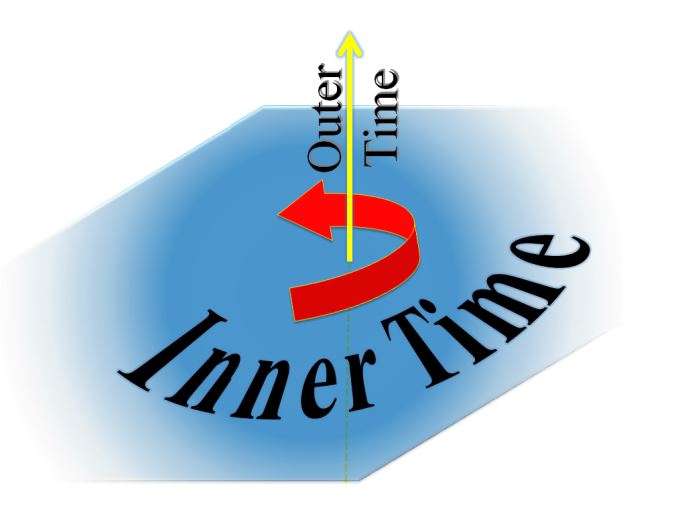
At each outward moment, the model proposes that space and matter are generated anew through a single chronological process, with inner levels of time nested within the formation of spatial dimensions.
This is the central proposal linking the Single Monad Model (SMM) to Duality of Time Theory (DTT). Inner activity constructs the spatial configuration; outward time orders the completed configurations that become available to observation. Motion is then studied through the succession of these renewed states.
The books develop this distinction through complex-time geometry. The research pages follow its mathematical construction and investigate connections with relativity, quantum phenomena, matter, and the direction of time.
THE SINGLE MONAD MODEL
The model draws on Ibn al-Arabi’s account of renewed creation and the divine week. Its six inner stages and seventh, outward role connect the formation of space with the observable succession of events.
Understand the frameworkThe Single Monad is the proposed common origin of observable multiplicity, prior to the emergence of spatial positions and relations.
Six functional roles organize the formation of spatial relations. These are nested stages within the proposed process, rather than six independently measured time axes.
The seventh role is the completed configuration available to observation. Successive records provide the starting point for studying clocks, motion, and retained information.
THE SINGLE MONAD MODEL BOOK SERIES
Ibn al-Arabi’s Concept of Time and Creation. The philosophical and cosmological foundations: unity, multiplicity, renewed creation, and the divine week.
Book details and guide
Complex-Time Geometry and Perpetual Creation of Space. Inner generation and outward evolution, with proposed connections to relativity and quantum theory.
Book details and guide
Fractal Complex-Time, the Incorporeal World and Quantum Gravity. Symmetry and the physical, psychical, and spiritual domains within the author’s cosmological interpretation.
Book details and guide
Particle-Wave Duality from Time Confinement to Space Transcendence. A more accessible introduction drawn from the first three volumes.
Book details and guideFor a concise statement of the proposal and its intended physical consequences, see DoT: The Duality of Time Postulate and Its Consequences on General Relativity and Quantum Mechanics.
AUTHOR AND ORIGINS
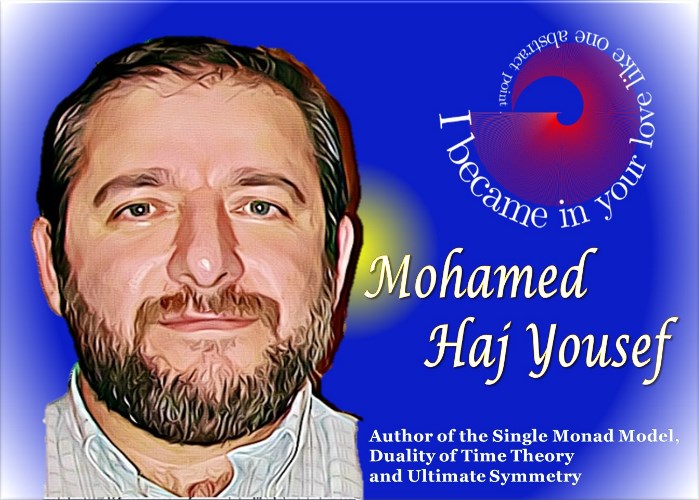
The investigation began during his Cambridge years in the early 1990s, and grew through a sustained study of time, creation, and the relation between unity and multiplicity in Ibn al-Arabi’s cosmology.
A PhD examined Ibn al-Arabi’s concept of time and its relationship to questions in modern physics.
The Routledge study, Ibn ‘Arabî — Time and Cosmology, provided the foundation for the revised Single Monad Model edition of 2014.
Duality of Time appeared in 2017, followed by Ultimate Symmetry and Time Chest in 2019.
TIME, PRESENCE, AND CREATION
The time of anything is its presence.
Ibn al-Arabi, as translated by Mohamed Haj Yousef. Explore the texts and reflections that inform the project’s philosophical background.
CHOOSE YOUR WAY IN
Meet the common source, inner generation, and outward completion. The introductory guides, glossary, and questions build the vocabulary for the rest of the site.
A guided introductionWork through spatial emergence, complex phase, clocks, matter, and constants. Trace the assumptions and results in each model, then explore the remaining research questions.
Explore the researchExplore other accounts of time, space, and cosmology alongside SMM and DTT. Follow the philosophical background, historical perspectives, and detailed comparisons.
Browse the comparisonsFROM THE ARTICLE ATLAS
Inner generation and outer record order can be roles of one process. A completed return becomes an observable advance only when its action respects the retained records and their tests.
Read articleA quaternionic readout, ten-mode pair memory, and a selected stopping grammar produce 137 distinguishable records. The construction makes its retention assumptions explicit and leaves physical coupling as a separate problem.
Read articleSquare completion gives the exact normalized ground state of the supplied nonrelativistic Coulomb Hamiltonian. Its spectrum and relative root-mean-square speed provide precise atomic benchmarks without selecting the coupling itself.
Read articleAN INTERACTIVE RESEARCH WORKBENCH
Trace the assumptions, equations, and physical matching behind six constants. Explore the distinction between structural counting, measured response, and the choice of physical scales.
WATCH, STUDY, AND EXPLORE
Watch the author’s presentations and the explanatory films, then explore the figure catalogue and interactive demonstrations of clocks, geometry, and response.
Follow the twelve-lesson course, work through the mathematical derivations, and use the claim map to connect assumptions, results, publications, and open questions.
اقرأ الأسس الفكرية والرياضية لنموذج الجوهر الفرد ونظرية ثنائية الزمن، وتابع الدورة العربية والاشتقاقات والأمثلة المشروحة وقاموس المصطلحات.
EXPLORE SMONAD
The Arabic–English directory connects matching articles, lessons, derivations and research guides. The memory lab and interference lab are now available in Arabic, with the same calculations and downloadable results.
SMONAD
Share this page with its own title, summary and preview image.