A026Public article topicExpanded article4 min read
The Two Cycles of Life
A proposed guide to the two cycles of life in the source framework. Develop their meanings through the text before making any connection with physical recurrence.
The source article describes two cycles associated with the hidden and manifest aspects of the Muhammadan reality in Ibn al-Arabi’s cosmology. It reports a numerical chronology but explicitly notes that the numbers do not agree with modern cosmology and geology. The discussion should therefore be approached as a theological and symbolic account, not as a competing astronomical age estimate.
The central contrast is between an order understood as hidden and its manifestation in an articulated history. The word cycle organizes this relation, but it does not automatically describe a measured periodic orbit or a physical recurrence of the entire universe.
02Hidden and manifest are relational descriptions
A pattern can be present in one description while not yet available in another. A musical score contains relations that become audible through performance; a mathematical specification can be articulated through particular examples. These analogies illustrate a difference between determination and manifestation without suggesting that the two are identical in every respect.
In a metaphysical account, the hidden–manifest relation can concern how creation depends on an intelligible order. In a physical account, hidden means inaccessible to specified measurements. The terms overlap linguistically but have different commitments. A rigorous comparison states which relation is intended.
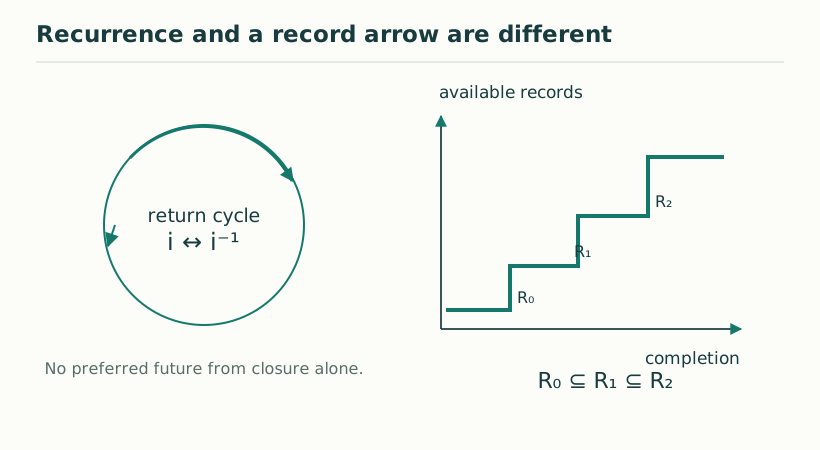
Figure 1. Recurrence and a record arrow are different. A reversible cycle admits both orientations. A record arrow requires an ordered availability relation, such as inclusion of retained records. Recurrence alone does not select a future. View full size ↗
03Why numerical correspondence is not enough
A symbolic chronology may use a number to organize relationships, express completeness or connect textual motifs. A measured chronology requires a unit, a procedure and a relation to observations. Without those ingredients, converting the symbolic number into years of physical evolution creates a new claim that the source itself does not establish.
The same principle applies to modern DTT numerology. A count in a mathematical construction becomes physically significant only through a justified map to an observable. Whether the count concerns stages, branches or retained records, the map must explain what is counted and how the count is measured.
04The DTT connection: generation and appearance
DTT also distinguishes inner generation from outer completion. This offers a conceptual parallel to hidden and manifest organization, but it is not a literal identification of the two cosmic cycles with two physical time axes. The current nested construction uses one source process with dependent inner roles and a completed record order.
The distinction becomes mathematically useful when a state can undergo internal organization without yet producing a new public record. Completion then marks the availability of a result. A model must specify that condition and demonstrate what information the completed record retains.
05A worked analogy with a prepared pattern
Consider a device that first prepares a coherent internal pattern and then emits a readable signal. The preparation stage and the emission stage belong to one process but support different observations. A receiver observing only the emitted signal may know little about the preparation history.
If different preparation histories lead to different later signals, they must remain distinguishable in the model’s predictive state. If every future observation agrees, they can be identified operationally. This turns the broad hidden–manifest distinction into a precise question about information and dynamics, without claiming that a laboratory device realizes the spiritual cosmology.
06What the comparison contributes
The two-cycle image encourages a layered account of manifestation: what is outwardly accessible need not exhaust the organization that sustains it. For SMM, that organization belongs to one source; for DTT, its relation to completion becomes a target for formal reconstruction.
The scientific value comes from restrictions on possible histories and records. A physical theory must show why particular outputs occur and what would distinguish its explanation from alternatives. The symbolic chronology remains meaningful within its own interpretive context, while the modern programme develops independently defined units, state spaces and observable tests. Preserving this separation makes the conceptual connection informative rather than misleading.
KEEP THE CONNECTION
Key ideas
The two cycles are interpreted within a theological cosmology, not as measured cosmic ages.
Hidden and manifest do not automatically mean two laboratory time coordinates.
DTT can formalize preparation and completion while keeping its physical dictionary explicit.
Scope of the argument. Historical-symbolic interpretation; the cited chronology is not adopted as physical cosmology.
Original public topic. This edition provides an independently written explanation; article-level references identify the passages and additional sources used.