
In this article
- Circular structure and repeated events
- Phase and winding
- Recurrence depends on the state description
- A circle does not automatically produce an arrow
- Periods need not be commensurable
- What SMM/DTT can build from the distinction
Distinguish circular temporal structure from repeated events in a cycle. Use that distinction to prevent recurrence, periodicity, and return from being treated as interchangeable.
Circular time and cyclical time can describe different things. A circular variable has a topology: moving around it returns to the same phase. A cyclical process repeats some pattern of behaviour. Neither statement alone says that every detail of the universe returns to an identical state.
The source article makes this distinction within Ibn al-Arabi’s account. It contrasts a circle used to represent temporal wholeness with recurring days, weeks and other periods, while emphasizing that similar manifestations need not be identical. This distinction is valuable for a modern temporal-generation model.
A phase θ is naturally defined modulo 2π. After a full turn, θ has the same value. A separate winding count n can record how many turns have occurred. The pair (n,θ) therefore contains more information than θ alone. A cyclic internal variable can coexist with an unbounded record of completed cycles.
This provides a simple mathematical language for DTT. Inner recurrence may concern phase, while outer completion increments a retained record. The relation must be built into the dynamics, but it is not logically contradictory. Circular internal organization does not force the observer’s complete history to repeat.
A clock face returns to noon every cycle, but the clock’s calendar can show a different date. The face alone is recurrent; the combined state is not. If the calendar is ignored, an observer loses the distinction. Thus the claim that a system has returned depends on which variables count as part of the system.
The same issue matters in quantum and generative models. A visible arrangement may recur while an unobserved phase or memory changes. Those hidden changes can affect later outcomes. A recurrence claim should specify whether it concerns appearance, full state, probability distribution or some selected observable.
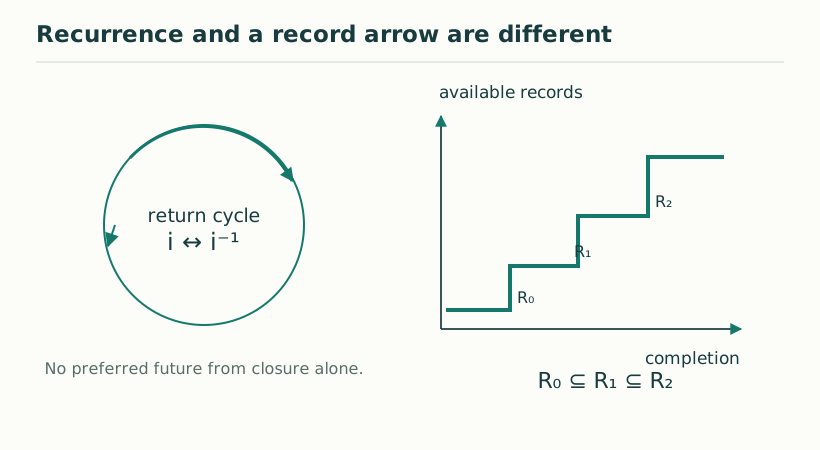
A symmetric circle permits either orientation. Choosing clockwise labels does not explain why physical records accumulate in one direction. A directed history needs an additional structure, such as an oriented dynamics, a boundary condition or an order of record availability.
In the current SMM/DTT axiomatic approach, recurrent returns and an observer’s positive record order are distinguished. This is conceptually important: an arrow can belong to how completed information is retained even when a more primitive recurrence remains reversible. The relation is model dependent and must not be inferred solely from drawing a circular arrow.
Two cycles can have periods whose ratio is not a rational number. Their phases may come arbitrarily close to an earlier joint configuration without ever repeating it exactly. Even when the ratio is rational, a return of both phases does not ensure that every other state variable has returned.
This elementary observation helps distinguish ideal periodic models from the broad philosophical claim of ever-new manifestation. An exact mathematical period is a strong property. A recognizable seasonal or daily pattern can remain useful even when the larger physical state changes from one occurrence to the next.
A useful model would specify an inner phase, a completion section, retained memory and the observable rule for comparing successive returns. It could then calculate which quantities repeat, which accumulate and which affect the next completion. The circle becomes a defined component of a larger construction.
The conceptual connection with SMM is the coexistence of unity of process and multiplicity of manifestations. DTT gives this a possible temporal architecture. Its success depends on deriving the relation between recurrence and records, not on assuming that a circle is either a complete universe or merely a decorative metaphor for time.
KEEP THE CONNECTION
Scope of the argument. Elementary mathematical explanation linked to a conditional DTT interpretation.
Original public topic. This edition provides an independently written explanation; article-level references identify the passages and additional sources used.
Source register →