
In this article
- Why the vocabulary matters
- Questions and answers encode relations
- A compact reading glossary
- Translating into model language
- A worked example of a category mistake
- A vocabulary for constructive work
Build a concise glossary of temporal expressions used across the historical articles. Explain how each term marks a different relation rather than assuming every word denotes the same clock variable.
Translating several temporal expressions as time can hide differences between duration, occasion, present condition, recurring cycle and eternity. The source article closes its discussion by identifying less common terms such as sarmad, mata and hin alongside the better-known vocabulary. Its purpose is lexical clarification within Ibn al-Arabi’s broader system.
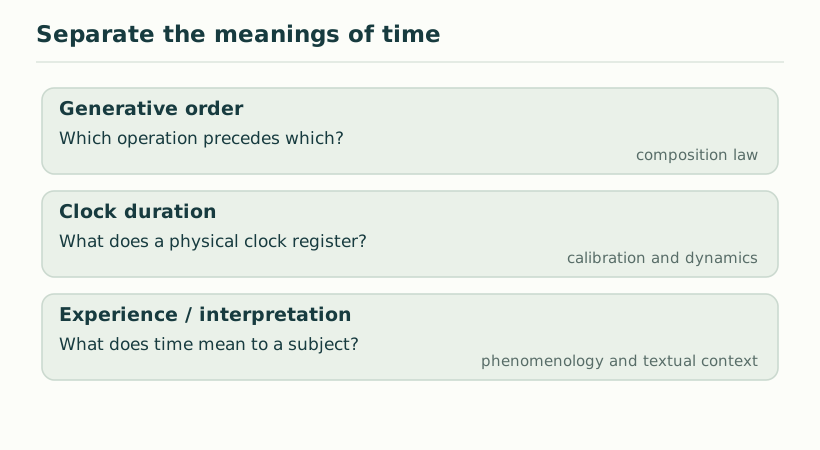
For SMM/DTT, careful terminology is a practical necessity. A proof can fail because one word changes meaning midway through the argument. A duration measured by a clock, an internal order of operations and a metaphysical dependence should not be substituted for one another without an explicit bridge.
The question when asks for a relation between an event and some temporal reference. An answer such as at sunrise identifies another recognizable event. It does not necessarily provide a numerical duration from an absolute origin. The language itself therefore contains an operational element: it connects an occurrence to a reference that a community can recognize.
A model can formalize this by attaching event labels to clock readings or by defining coincidence relations. The choice depends on the task. Asking when completion occurs may mean which internal condition closes the process, or which external clock reading is recorded. Those are different questions.
The following distinctions are a guide to reading, not rigid replacements for every historical occurrence. Context remains decisive, and the same word can carry ordinary and technical meanings. The table gives enough structure to prevent the most common conflations while leaving detailed philological questions to the relevant text and edition.
| Term | Working reading |
|---|---|
| zaman | Temporal ordering or time in context |
| waqt | Present condition or occasion |
| yawm | Day or completed cycle |
| nahar / layl | Daytime / night |
| azal / abad | Without beginning / without end |
| dahr | The encompassing Age in the cited interpretation |
| sarmad | Everlasting or absolute eternity |
| mata | The question when |
| hin | A duration or occasion identified by context |
A mathematical DTT model needs its own symbols, with their roles distinguished from the historical vocabulary. For example, n can count completed events, θ can denote an internal phase, and τ can represent a physically calibrated clock. These symbols answer different questions even if ordinary prose calls all of them time.
One should also state whether a variable is observable, a gauge choice or an internal state parameter. A change in notation is harmless only when it preserves the defined relations. Identifying two differently motivated variables requires a theorem, a constitutive assumption or an explicitly stated calibration.
Suppose a text describes the moment as the state presently received, and a later argument treats that phrase as proof of a fixed microscopic interval. The conclusion does not follow. A description of a condition has been converted into a numerical measure without supplying a clock or a unit.
Likewise, beginninglessness does not determine an infinite elapsed age, and a recurring day does not prove exact repetition of the entire physical state. These errors can be avoided by writing the intended relation in plain language before introducing symbols. Doing so often reveals which missing premise is needed.
For the modern programme, the most useful set of distinctions is generative order, phase, completion, record order, clock duration and causal order. Generative order organizes operations; phase describes recurrence; completion selects a public result; records retain distinctions; clock duration compares intervals; causal order constrains influence.
SMM proposes their common dependence on one source. DTT seeks a construction relating them. Historical vocabulary can illuminate why these questions matter, while modern definitions make them calculable. Maintaining both levels gives the articles a coherent conceptual language and helps readers recognize when a statement is interpretive, mathematical or physical.
KEEP THE CONNECTION
Scope of the argument. Lexical and conceptual guide; the table is contextual rather than a substitute for detailed textual scholarship.
Original public topic. This edition provides an independently written explanation; article-level references identify the passages and additional sources used.
Source register →