A036Public article topicExpanded article4 min read
The Significance of the Week in Theology and Astronomy
Compare the week as an astronomical, cultural, and theological organization of time. Explain how its role changes when it becomes part of a cosmological argument.
The day, lunar month and year have recognizable astronomical reference processes. The seven-day week has a different status: it is a historically established social and religious cycle rather than a simple exact orbital period. The source article discusses its symbolic associations with seven celestial bodies, divine Names and the ordering of sacred time.
This distinction matters for SMM/DTT. The cultural importance of seven can motivate a sevenfold model, but it does not demonstrate that physical generation contains exactly seven fundamental operations. The model must supply its own structural reason.
02A historical ordering rule can be calculated
The planetary-hour scheme cycles through a fixed order of seven traditional celestial rulers. If successive hours advance one place in that order, then the ruler of the next day’s first hour lies 24 places later. Since 24 leaves remainder 3 on division by 7, the daily assignment advances by three positions.
The rule is arithmetic. Starting from an appropriate member of the traditional sequence produces the familiar weekday associations. It explains how two different orders can be related within the scheme. It does not establish that those celestial bodies physically govern the corresponding hours.
24 ≡ 3 (mod 7)
Daily ruler index: jₙ₊₁ = jₙ + 3 (mod 7)
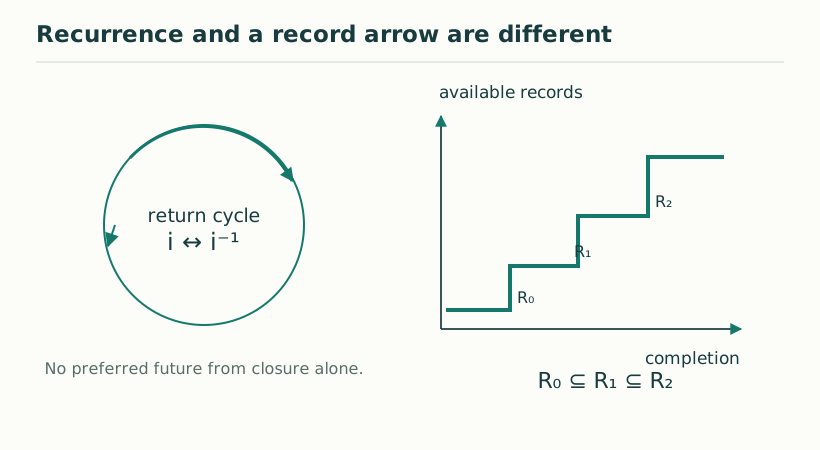
Figure 1. Recurrence and a record arrow are different. A reversible cycle admits both orientations. A record arrow requires an ordered availability relation, such as inclusion of retained records. Recurrence alone does not select a future. View full size ↗
03What modular arithmetic does and does not prove
For a cyclic list with m entries, advancing k places repeatedly visits every entry exactly when k and m have no common divisor greater than one. With m=7 and k=3, all seven positions are visited before returning. This is why the daily sequence is a permutation of the whole seven-member list.
The mathematical result is exact under the chosen list and step rule. The choice of seven rulers and twenty-four hours is an input to the calculation. A numerical pattern can therefore be rigorously derived within a convention without proving that the convention itself is a fundamental law of nature.
04A symbolic cycle can organize different functions
In a theological reading, the days can express distinct modes within an ordered whole. The unity belongs to the source and the complete cycle; the differences belong to the roles assigned to its phases. This is more informative than treating seven as a mysterious number that independently explains every occurrence of seven elsewhere.
A similar organizational idea can motivate DTT: several generative roles may be needed before a completed record is available. The substantive question is which roles are irreducible and how their dependency is established. A cycle diagram alone cannot answer it.
05The nested DTT distinction
The six inner stages and the outer completion role form a hierarchy in the current DTT formulation. They are not seven ordinary weekdays accelerated to microscopic speed, nor seven independently measurable time coordinates. Their connection to the cosmic week is conceptual and historical, while their physical meaning depends on explicit operations.
A proper model should show what fails if a stage is omitted, merged or reordered. If nothing observable changes under arbitrary redesign, the sevenfold organization may be a representation choice rather than a physical necessity. If a theorem establishes an invariant dependency, the claim becomes stronger.
06How to use the week comparison
The week provides an accessible example of a cycle whose phases have different roles and whose total structure matters. It also teaches caution: astronomical observation, arithmetic construction and theological meaning are distinct sources of significance. Their agreement cannot be assumed from a shared number.
For SMM/DTT, the productive route is to identify the function of each stage and derive the structure of its completed output. The historical scheme can guide questions and figures, while mathematical analysis establishes what follows from the selected rules. That division allows the sevenfold idea to be explored rigorously without turning calendar practice into evidence for an unproved physical mechanism.
KEEP THE CONNECTION
Key ideas
The week differs from an exact astronomical period.
The planetary-hour ordering follows a precise modular rule within its chosen convention.
DTT must justify sevenfold organization through functional dependencies, not shared numerals alone.
Scope of the argument. Historical-symbolic account with an exact arithmetic example; no planetary influence is asserted.
Original public topic. This edition provides an independently written explanation; article-level references identify the passages and additional sources used.