A038Public article topicExpanded article4 min read
The Week as the Primary Time Cycle
Explain the proposal that the week has a primary organizing role in temporal cosmology. Identify the premises behind that proposal and the limits of a physical interpretation.
01Why a whole cycle can be more fundamental than a phase
The source article argues that the cosmic week is primary because its days are qualitatively different, each associated with a distinct attribute. A single day therefore does not represent the full organization. The repeated week is also not an exact repetition of every manifestation; similarity of role is distinguished from identity of event.
This suggests a precise modern question: when does a complete sequence of different operations form the natural unit of a process, even though its parts can be individually named?
02A minimal period is a property of a pattern
Consider the repeating symbolic sequence ABCABC. Its shortest repeating block is ABC. Calling one letter a full cycle would miss the difference among the three roles. If the sequence were AAAAAA, a one-letter block would suffice. The period therefore depends on the distinctions that the description retains.
For a physical process, the analogous question is whether successive stages are operationally distinguishable. If every allowed measurement treats several stages identically, the effective cycle may be shorter. If their order affects the result, the whole ordered sequence can be indispensable.
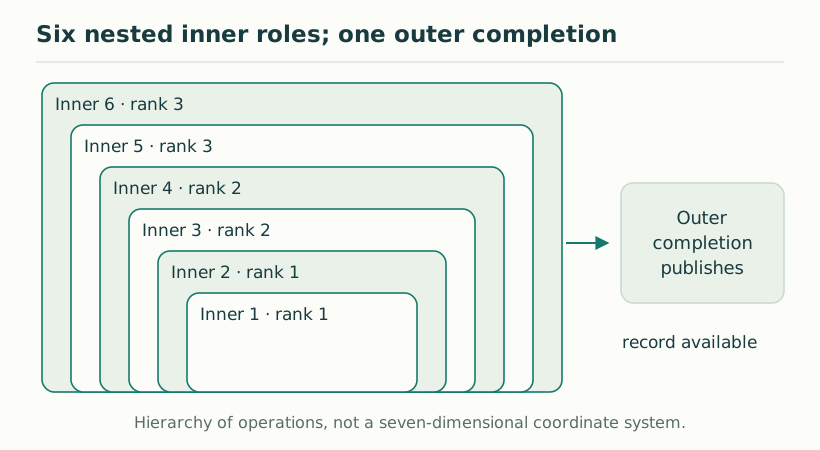
Figure 1. Six nested inner roles; one outer completion. The six inner roles are nested functional stages with readout ranks 1, 1, 2, 2, 3, 3. The outer completion publishes the resulting record. These are not seven independent time axes. View full size ↗
03Order can matter even when the same operations appear
Two operations need not commute. Preparing a state and then measuring it can differ from measuring first and preparing afterward. More abstractly, F∘G can differ from G∘F. A complete cycle is therefore not just a bag of named stages; it can contain an essential dependency structure.
DTT’s claim of nested inner roles should be expressed through such dependencies. Earlier stages constrain what later stages can meaningfully do. This differs from seven independent clocks ticking side by side. The hierarchy has content only when the maps and their domains are specified.
04Repeated organization with new records
A process can repeat its operating sequence while acting on a changed memory state. The instruction pattern remains the same, but the result differs. For example, a counter repeatedly performs read, increment and store, producing a new value each time. The cycle of roles repeats; the full state does not.
This provides a concrete bridge between a primary cycle and ever-new manifestation. In SMM/DTT, inner recurrence can preserve an organizational pattern while outer completion adds a distinct record. The model must include the memory that makes successive results different and explain its physical persistence.
05Why six plus one requires a demonstration
The current nested DTT account assigns six inner roles to the construction of spatial readout and a seventh to outer completion. Some explicit draft models organize readout ranks as 1, 1, 2, 2, 3, 3 before publication. This is a defined model architecture, not a result obtained simply from the conventional seven-day week.
To establish necessity, one would need to prove that the target properties cannot be realized with a smaller or differently organized admissible construction. A successful seven-stage example establishes possibility under its assumptions. A minimality theorem would establish a stronger claim. The distinction prevents an illustrative model from being mistaken for uniqueness.
06The productive interpretation
The primary-week idea is useful as a model of functional completeness: a meaningful unit may consist of several different roles whose joint action yields a result. It asks the reader to look at composition rather than isolated steps. This is closely aligned with DTT’s emphasis on completion.
The physical programme must then identify the invariant content of the cycle. Which roles are essential, which can be combined, and which are observer-dependent descriptions? Answering these questions would explain why a particular temporal architecture is selected. The historical image supplies a coherent starting intuition, while mathematics determines whether the proposed architecture is merely workable or genuinely necessary.
KEEP THE CONNECTION
Key ideas
A complete cycle can be the natural unit when its phases have different roles.
Repeated instructions can produce a nonrepeating history through retained memory.
A seven-stage construction demonstrates possibility; necessity requires a minimality argument.
Scope of the argument. Conceptual comparison with a stated model architecture; sevenfold physical necessity is not asserted.
Entropy Barriers to Geometric SelectionWorking draft temporal_locality_v8(1).pdf, page 1 abstract, nested ranks and conditional construction; no public link supplied
Original public topic. This edition provides an independently written explanation; article-level references identify the passages and additional sources used.