A037Public article topicExpanded article4 min read
The Four Main Time Cycles
A guide to the four principal cycles discussed in the source framework. Organize their roles and relations so later articles can use the vocabulary consistently.
The source article groups day, week, month and year as four principal cycles and interprets their organization through a fourfold cosmological symbolism. It relates that symbolism to the attributes Life, Knowledge, Ability and Will, while distinguishing a wider sevenfold structure associated with creation. These are relations within Ibn al-Arabi’s account, not a derivation of astronomical periods from four measured parameters.
The modern question is how different cyclic descriptions are coordinated and what kind of unity their coordination expresses.
02The cycles are not exact integer copies
A calendar organizes several physical and conventional cycles whose periods do not generally fit into one exact integer hierarchy. A month need not contain an exact number of weeks, and a year need not contain an exact number of days. Practical systems use conventions and corrections to keep their labels related to the desired reference processes.
This matters whenever a symbolic scheme uses neat ratios. An idealized four-week month can be useful for organizing a diagram, but it should not be presented as an exact measurement of a lunar return. A model must distinguish its ideal cycle from the astronomical quantity it approximates.
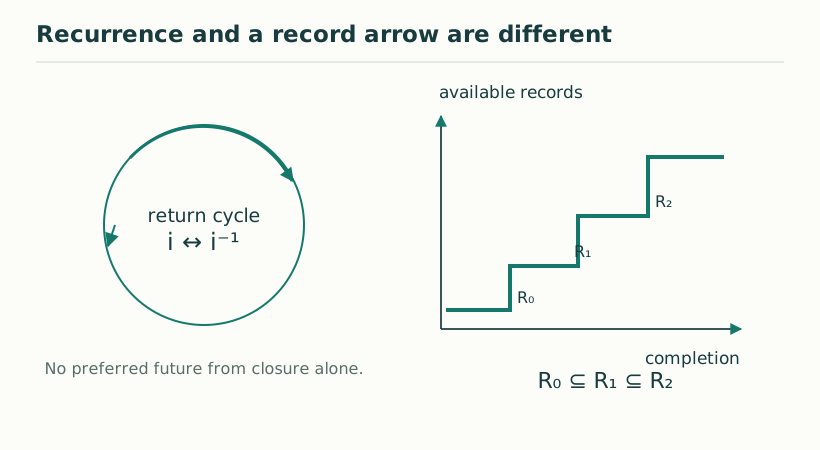
Figure 1. Recurrence and a record arrow are different. A reversible cycle admits both orientations. A record arrow requires an ordered availability relation, such as inclusion of retained records. Recurrence alone does not select a future. View full size ↗
03A hierarchy of scales can be operational
A laboratory instrument may sample rapidly, average over a longer window, summarize results over a still longer interval and periodically recalibrate. These are four useful scales of one operation, even if their ratios are chosen rather than fundamental. The hierarchy is defined by what each scale does.
DTT can use a similar functional distinction among inner operations and completed records. A scale becomes explanatory when its role and coupling are specified. Merely listing several periods does not explain why the system needs them or why their ratios take particular values.
04Fourfold symbolism and physical dimensionality
A fourfold symbolic structure can connect different domains by analogy. It does not imply that every four-element list refers to the same physical object. Four seasons, four selected functions and four spacetime coordinates have different definitions and evidential roles.
The SMM/DTT programme should therefore ask what relation is preserved by a proposed correspondence. Does each element play a complementary role? Does their composition close a cycle? Is there a symmetry that can be defined mathematically? These questions are more informative than simply matching the cardinality of two lists.
05A worked example of a drifting alignment
Suppose a simplified calendar defines a month as exactly twenty-eight days, while the process it tracks returns after a different period P. After n months, the difference between the calendar prediction and the accumulated physical duration is n(28−P) days, under the idealization that P is constant.
The example shows how a small mismatch accumulates. It is not a proposal to identify an actual lunar period with a particular number here. Its purpose is to explain why an exact symbolic subdivision cannot substitute for a measured period or a correction rule. The same issue arises when a generative model identifies internal cycles with external clock intervals.
Accumulated offset after n idealized months: Δ = n(28 − P) days
06The conceptual connection with SMM/DTT
SMM seeks unity behind differentiated manifestations, while DTT seeks a coordinated temporal architecture for their production. The four-cycle discussion can motivate attention to several levels of description: local recurrence, organized sequence, larger return and long-term history. Those levels need not correspond one-to-one to the source’s four symbolic terms.
A rigorous model would define its cycles through return conditions and readout functions, then calculate their relations. If it recovers a hierarchy, the result should explain whether the hierarchy is selected dynamically, imposed by observation or chosen for convenience. This turns a broad cosmological analogy into a clear investigation of timescales and their physical meaning.
KEEP THE CONNECTION
Key ideas
Calendar cycles combine physical reference periods and conventions.
Matching the number of elements in two schemes does not establish a physical correspondence.
DTT cycle ratios require defined return conditions and clock comparisons.
Scope of the argument. Interpretive account with a toy calendar calculation; symbolic ratios are not used as astronomical measurements.
Original public topic. This edition provides an independently written explanation; article-level references identify the passages and additional sources used.