A039Public article topicExpanded article4 min read
The Divine Origin of the Seven Days of the Week
Present the theological account of the seven days as a source-based study. Explain the relation between Divine Names, cosmic ordering, and the symbolic structure of a week.
The source article associates each day of the cosmic week with one of seven fundamental divine attributes. The ordering begins with Hearing and ends with Speaking, while the intervening days articulate other capacities. It interprets the sequence as a structure of manifestation rather than a mere repetition of identical intervals.
The exact correspondence is useful to preserve because it is a specific textual scheme. Its interpretation should remain distinct from a physical claim that laboratory processes possess these attributes in the theological sense.
02The correspondence in the cited account
The table records the mapping used by the source. It is an interpretive map of the cosmic week. It should not be confused with a proposed measurement protocol, a set of seven independent time dimensions, or a claim about the order in which biological capacities develop. Each of those would require a separate argument and appropriate evidence.
The correspondence in the cited account
Day
Attribute in the source
Sunday
Hearing
Monday
Life
Tuesday
Seeing
Wednesday
Will
Thursday
Ability
Friday
Knowledge
Saturday
Speaking
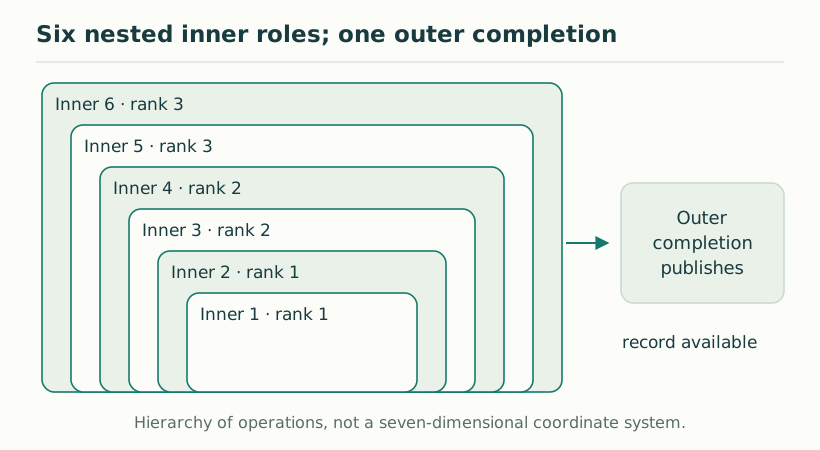
Figure 1. Six nested inner roles; one outer completion. The six inner roles are nested functional stages with readout ranks 1, 1, 2, 2, 3, 3. The outer completion publishes the resulting record. These are not seven independent time axes. View full size ↗
03Why hearing can precede manifestation in the symbolism
The scheme gives priority to receptivity to a creative command and culminates in articulated expression. At the conceptual level, this suggests a distinction between a possibility being addressed or selected and its becoming available as an expressed result. The sequence organizes dependence rather than merely counting elapsed units.
A modern analogy is an interface that accepts a specification, develops a structured state and finally publishes an output. The analogy can clarify roles without identifying a divine command with software or treating a spiritual attribute as a physical operator. Its value lies in the relational pattern.
04The DTT bridge is structural
DTT distinguishes inner generation and outer completion. The historical six-plus-one scheme can therefore inspire a distinction between construction and the availability of a completed world. In the current nested formulation, the six inner stages are dependent roles contributing to spatial readout, while the outer role records a completed event.
The connection is not an automatic one-to-one dictionary assigning a specific matrix to each divine attribute. Such a dictionary would be a new model and would need explicit definitions. Without it, the honest claim is that the cosmological structure motivates the architecture rather than proves its physical realization.
05What a necessity argument would require
Suppose a model contains seven labelled stages. To show that seven are necessary, one must define the allowed class of models and the property being achieved. It is then necessary to rule out admissible alternatives with fewer stages or a different decomposition. Relabelling one operation as several suboperations cannot establish a fundamental count.
A meaningful proof might show that certain independent compatibility conditions must be satisfied before a record is complete. Their dependency could force a minimum architecture. The result would concern those mathematical conditions. Identifying them with the historical attributes would remain an interpretive comparison unless further physical and textual justification were supplied.
06How to retain the conceptual depth
The seven-day scheme expresses a whole whose distinctions are meaningful and whose unity is not mere sameness. This is central to SMM’s aim of explaining multiplicity through one source. DTT gives the idea a possible generative organization: differentiated inner work and completed outward manifestation.
The strongest development preserves both the specific historical correspondence and the demands of modern reconstruction. The reader can see the source of the intuition, the exact structure proposed in a model, and the point at which a physical claim would require proof or measurement. That transparency makes the connection more informative than a numerical analogy alone.
KEEP THE CONNECTION
Key ideas
The source supplies a specific day–attribute correspondence.
The connection to DTT concerns differentiated construction and completion.
A fundamental stage count requires a defined admissible model class and a necessity proof.
Scope of the argument. Theological correspondence and structural interpretation; no biological or physical law is inferred from the table.
Original public topic. This edition provides an independently written explanation; article-level references identify the passages and additional sources used.