
In this article
- Why a cycle needs a reference
- Symmetry and the absence of a pointer
- Relational phase
- A constructive SMM interpretation
- DTT and the first readable tick
- A reference can be relational rather than absolute
- References make time readable
A proposed guide to the motion of the seven days through the zodiac in the historical framework. Explain its symbolic and cosmological setting without turning it into a contemporary prediction.
The source distinguishes an undifferentiated orb, whose motion has no visible landmark, from a star-marked orb in which a cycle can be identified. It uses this contrast to discuss the definition of days and assigns a starting position within its historical zodiacal scheme. The durable conceptual insight is the role of a reference: a perfectly uniform pattern does not itself provide a readable indication of how far it has rotated.
Imagine an ideal, uniformly colored circle. Rotating it through any angle gives the same visible image. A marked point breaks that observational ambiguity. The mark does not create rotation; it creates a way to distinguish rotational states relative to an observer.
Mathematically, a uniform circle is invariant under a continuous rotation group. A marked circle has fewer transformations that leave the complete marked configuration unchanged. This is a clear example of the difference between the symmetry of a background and the distinguishability supplied by a record.
A phase can be measured only relative to a reference phase. If θ₁ and θ₂ both increase by the same arbitrary constant, the difference θ₁−θ₂ remains unchanged. That invariant difference can carry measurable information even when the individual phase origins are conventional.
For a clock, the reference may be a detector position, another oscillator or a stored event. The period and the zero point answer different questions: the period specifies recurrence, while the zero point specifies where counting begins. A historical choice of starting constellation should therefore not be confused with a measured fundamental constant.
SMM asks how differentiation can arise from a unified origin. The reference-marker example gives that question a manageable form: what makes two otherwise equivalent source configurations operationally distinct? A candidate answer requires a stable relation that survives completion and can be read more than once.
This also explains why a homogeneous source cannot be converted into a richly structured cosmos simply by drawing coordinates on it. Coordinate labels distinguish descriptions; physical records distinguish states through operations. The theory needs a mechanism that produces the latter.
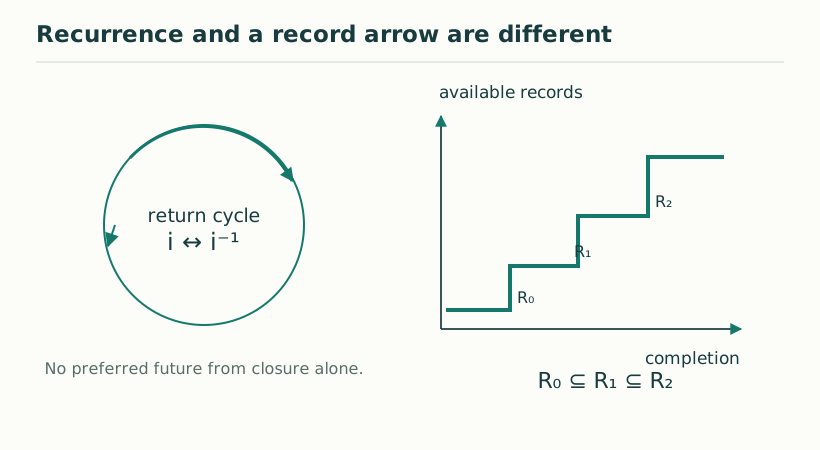
In DTT terms, an inner recurrence becomes an outer clock only when completion produces distinguishable records. The first readable tick is not merely the first traversal of an abstract circle. It is a traversal registered by a physical readout with an appropriate memory or comparison operation.
One can express this by assigning a record rₙ to each completed cycle. If every rₙ is indistinguishable and no counter exists, elapsed cycles cannot be recovered from the record. Adding a retained count changes the observable information. Explaining that retention belongs to the dynamics of the clock.
Place two marks on an otherwise uniform circle. Their angular separation is unchanged if the whole circle is rotated. That separation is a relational observable, while either mark’s absolute angle depends on a chosen origin. The example distinguishes breaking a description’s ambiguity from asserting an absolute background direction. A DTT clock could similarly compare two recurring structures without assigning either an external universal phase zero. This is useful for a theory that aims to generate its own observable references. The required physical content is the stability of the comparison and the dynamics that preserves or changes it. An arbitrary label written beside the circle supplies neither of those properties.
An unmarked ring and a marked ring differ in their ability to support phase comparisons. The mark supplies a distinguishable relation; a retained count supplies accumulated duration. Zodiacal imagery belongs to the source’s historical cosmology, while this reference problem is a general feature of measurement. The connection to DTT is precise: observable time requires distinguishability, a comparison procedure and records of completion.
KEEP THE CONNECTION
Scope of the argument. Historical interpretation and original explanatory analysis; formal examples are illustrative models, not claimed deductions from scripture.
Original public topic. This edition provides an independently written explanation; article-level references identify the passages and additional sources used.
Source register →