
In this article
- Generalizing the meaning of a day
- Every period needs a reference
- Nested periods are not nested universes
- The symbolic days of divine Names
- A model with several return scales
- What the generalization teaches
A proposed study of days associated with orbs and Divine Names. Focus on how distinct temporal measures express different relations within the cosmological account.
The source article extends day from an earthly cycle to the characteristic return associated with other celestial or symbolic spheres. It also discusses days attributed to divine Names. These uses share the idea of a completed scope of activity, but they belong to different descriptive domains. An orbital period is measurable astronomy; a divine day is part of a theological account of manifestation.
The generalization is conceptually useful when it is read as a question about the appropriate reference process. It becomes misleading if all the periods are treated as numerical instances of one laboratory clock without a defined comparison.
A rotating body can be compared with distant directions or with another moving body. An orbiting object can return to the same phase relative to one reference before or after it does so relative to another. The word period therefore requires a statement of what is repeating and relative to what.
A simple example is two pointers turning at different angular rates. Their relative phase advances at the difference of those rates. The time between alignments is determined by that difference, not by either pointer’s individual period alone. This is the basic logic behind many apparent or synodic cycles.
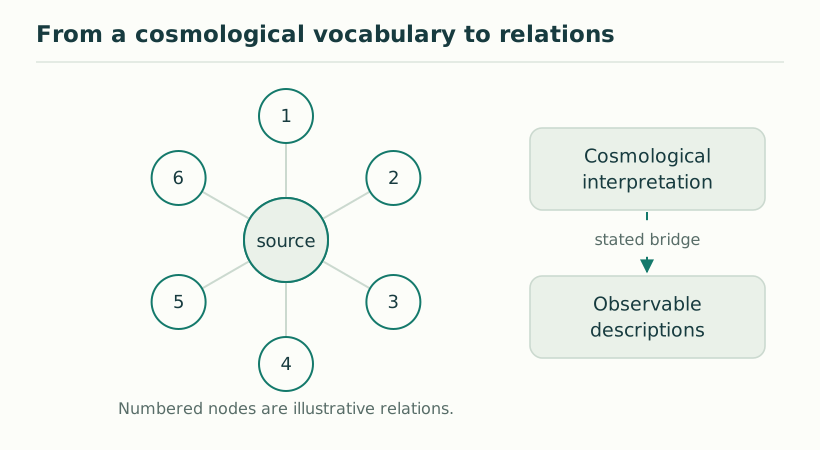
One process can complete many cycles while another completes one. This produces a hierarchy of counts, but it does not require one physical time to be literally contained inside another. A watch’s second hand, minute hand and hour hand are coupled readouts of a common mechanism, with different return periods.
DTT uses a more ambitious hierarchy of inner roles and outer completion. The clock analogy helps separate dependency from independent coordinates. A nested stage can organize the output of earlier stages without becoming a separate world in which a conventional clock runs at a different speed.
Within Ibn al-Arabi’s cosmology, a divine Name organizes a distinctive mode of manifestation. Its day concerns that mode’s scope or predominance. Such language relates unity of source to differentiated effects. It is not a physical claim that a named celestial body causes a specific moral or psychological state through an undiscovered force.
A modern reader can preserve the conceptual pattern: different aspects of one generative order can have different characteristic modes. To use the pattern in physics, however, one must define the modes mathematically and identify observables that distinguish them. Names alone do not select a dynamical spectrum.
Imagine an inner process with phase θ and a receiver that accepts a record only after several compatible subcycles close. One observable may respond to each subcycle, while another responds only to full completion. Their measured recurrence periods can differ even though they arise from one process.
This is a possible DTT mechanism for multiple temporal scales. Its content depends on the acceptance rule and couplings. If those are independently adjustable, many period ratios can be produced. A predictive theory would derive or constrain the ratios and explain why the relevant receiver has that structure.
The most useful lesson is that temporal units are tied to processes and observational access. There is no need to treat every use of day as a small copy of an earthly calendar day. Equally, there is no need to collapse symbolic meaning into astronomical measurement.
SMM/DTT can use this distinction to organize its vocabulary. Inner phase, subcycle, completed event and clock duration should be defined separately, then related through the source model. The resulting account can explain a hierarchy of observable timescales if the dynamics supplies one, while remaining clear about which older cosmological associations are interpretive motivations rather than measured laws.
KEEP THE CONNECTION
Scope of the argument. Conceptual astronomy and symbolic interpretation; no astrological force or universal numerical ratio is asserted.
Original public topic. This edition provides an independently written explanation; article-level references identify the passages and additional sources used.
Source register →