
In this article
- Light, darkness and the relation to an observer
- Visibility is a relation, not the whole state
- Alternation does not imply annihilation
- Active and receptive roles
- A gated-detector example
- The SMM/DTT conceptual connection
Examine daytime and nighttime as complementary temporal descriptions in the source tradition. Develop their astronomical and interpretive roles without assuming they are identical.
Daytime and nighttime provide a familiar example of how one persistent source can appear and disappear from a particular viewpoint. The Sun does not cease to exist when it passes below a local horizon. What changes is the geometrical relation between source, observer and intervening body.
The source article extends this pattern symbolically through the divine Name Light and the active and receptive aspects of the Universal Soul. Its conceptual emphasis is the relation between manifestation and concealment. This should be distinguished from a physical claim that ordinary light and darkness are produced by spiritual states.
A lamp behind a screen can remain on while a detector receives no direct signal. Moving the screen or detector changes what is accessible without necessarily changing the lamp. This elementary example helps separate the source’s state from the observer’s information about it.
For SMM, the distinction is important because a single source can be represented differently through different receiving conditions. The variety of appearances need not imply a variety of independent sources. A physical model must nevertheless specify the interaction and geometry that produce those appearances.
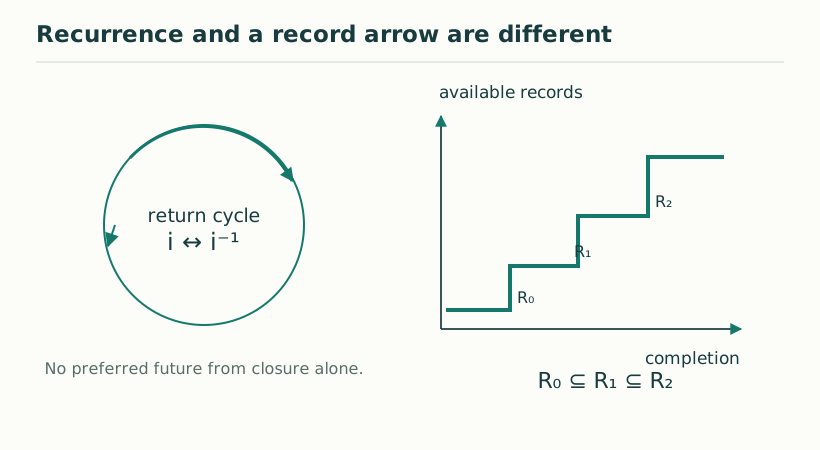
An observation channel can alternate between active and inactive intervals. During an inactive interval, relevant dynamics may continue and leave effects on later records. Therefore a lack of current observation does not by itself establish that a system has ceased to exist.
This is a useful discipline for a renewed-creation account. If a DTT model asserts a stronger ontological discontinuity, the assertion must be part of its defined dynamics rather than inferred from an observer’s temporary lack of access. The relation between unseen generation and visible completion should be demonstrated, not supplied by the day–night analogy alone.
The symbolic distinction between activity and reception can be interpreted as two roles in a single process. A system produces a change; another aspect retains or interprets the result. In an actual detector, interaction and recording may overlap continuously. The existence of these roles does not prove that all physical movement and all perception occur in mutually exclusive universal intervals.
DTT can use nested operations to separate generation from the publication of a record. Whether that separation is sharp, approximate or observer-dependent is a mathematical question for the model. It cannot be decided merely by assigning the words day and night to the two roles.
Suppose a detector samples a periodic signal only during a short open interval of each cycle. Depending on the gate’s phase, it may report a large value, a small value or no change at all. The underlying signal can be the same in every case. What differs is the temporal observation map.
This provides a concrete model of appearance and concealment. It also reveals a potential ambiguity: a receiver can miss dynamics because of its sampling pattern. If DTT uses completion gates, it should show what information is lost and whether later observations recover it. A gated output is not automatically a complete state description.
The enduring connection is the distinction between a generative source and its mode of appearance to a receiver. DTT gives this distinction a temporal organization: inner activity, completion conditions and outer records. The day–night image makes the relational aspect intuitive while leaving the actual physics to the specified maps and dynamics.
A clear article can therefore use the symbolism without claiming that it establishes a laboratory law. The analogy asks a productive question: does the absence of an observed event reflect absence of source activity, an incomplete process, or a limitation of the receiver? Those alternatives lead to different models and potentially different predictions.
KEEP THE CONNECTION
Scope of the argument. Symbolic interpretation and a detector analogy, without identifying spiritual activity with electromagnetic light.
Original public topic. This edition provides an independently written explanation; article-level references identify the passages and additional sources used.
Source register →