A030Public article topicExpanded article4 min read
The Single Day
A proposed introduction to the Single Day and its role in organizing temporal multiplicity. Explain the term through its source context before using it in the language of completion.
The source article interprets the single day as an indivisible unit of divine action whose effects differ among recipients. The unity concerns the act’s source and organization, while the multiplicity concerns how different capacities receive it. The article also offers a scanning picture to connect the cosmic unit with the small temporal portion available to an observer.
The central SMM question is therefore not how one event becomes many independent sources. It is how one generative action supports many distinguishable effects while preserving a coherent observable world.
02A common input does not produce identical outputs
Apply the same temperature change to different materials and they respond differently. Send one mathematical operation into different states and its outputs differ. These examples show why unity of operation does not imply uniformity of result. The receiving state and coupling matter.
In a monadic model, this suggests a precise division: the source action can be common, while the observable response depends on retained structure. A complete theory must explain that retained structure as well. Otherwise the multiplicity is merely moved into an unexplained list of receiver properties.
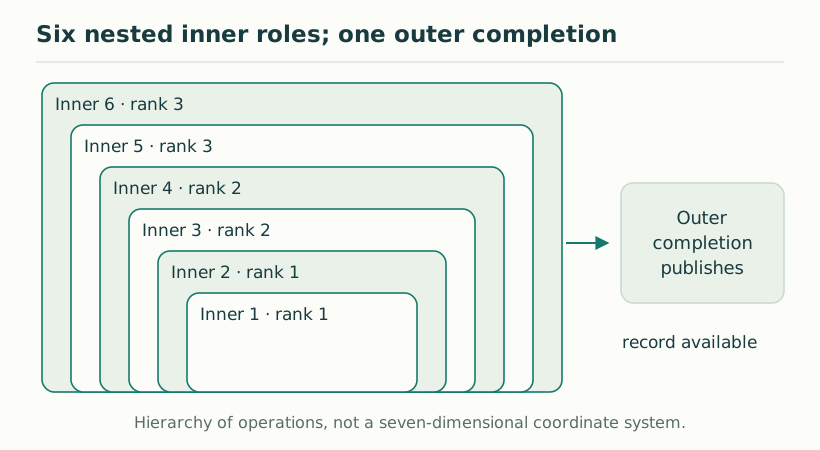
Figure 1. Six nested inner roles; one outer completion. The six inner roles are nested functional stages with readout ranks 1, 1, 2, 2, 3, 3. The outer completion publishes the resulting record. These are not seven independent time axes. View full size ↗
03Indivisibility can mean operational indivisibility
A transaction may consist of several internal operations but count as one committed result to its user. The result is indivisible at the interface even though its construction has internal organization. This is one useful way to understand completion without assuming that every hidden substep is another public event.
DTT’s nested inner stages can fit such a picture. The outer completion marks the availability of a coherent record. The analogy does not decide whether the process has a minimum physical duration; it distinguishes a unit of observation from the operations that prepare it.
04The scanning formula and its assumptions
If a total cycle of duration T visits N states serially for equal dwell intervals, then each dwell interval is T/N. The arithmetic is elementary. Its physical interpretation is not: one must establish serial rather than parallel operation, equal dwell times, the relevant state count and the meaning of the total duration.
The source’s scanning image should therefore be read as a model-dependent bridge, not a measured elementary tick. If observers themselves exist only through the process, their clocks must also be constructed within it. An external stopwatch that fixes T would otherwise supply the temporal scale the theory claims to explain.
Equal serial dwell assumption: δ = T/N
Changing the scheduling or dwell distribution changes the relation
05A completion condition must preserve consistency
Imagine a generated record containing several mutually dependent parts. Publishing the parts before they are compatible could expose contradictory observations. A completion rule can require their joint consistency before the record becomes available. This makes completion a substantive constraint rather than simply the last item on a list.
The same logic applies to a physical model. The spatial readout, matter state and clock record must agree at completion. If each is constructed by an unrelated rule, a single publication step does not explain their agreement. The source dynamics must enforce the compatibility.
06From a cosmic unit to a research target
The single-day concept offers a way to think about one generative act with distributed manifestations. DTT can make that picture precise through a state space, a nested update and a completion instrument. The resulting object may have many internal degrees of freedom while representing one publicly completed event.
The strongest claim would show how observers embedded in these events recover stable durations and causal relations. That requires more than selecting a cosmic cycle or dividing it by a large number. The useful conceptual advance is to identify completion as the bridge between generative unity and observable multiplicity, then investigate the bridge’s exact mathematical and physical conditions.
KEEP THE CONNECTION
Key ideas
A common action can have different effects through different receiving structures.
Operational indivisibility does not rule out internal construction.
The formula T/N requires explicit scheduling and clock assumptions.
Scope of the argument. Interpretation of a single creative act and a conditional scheduling model; no elementary tick is numerically determined.
Original public topic. This edition provides an independently written explanation; article-level references identify the passages and additional sources used.