
In this article
- Reading each day through its role
- A compact correspondence table
- Gathering and the difference between assembly and activity
- What the SMM perspective adds
- The nested DTT interpretation
- From a rich scheme to a precise question
Develop a day-by-day reading guide to the Divine Week. Give each day’s conceptual role and explain how those roles contribute to the larger account of creation.
The source article develops the cosmic week through correspondences among days, attributes, celestial symbols and prophetic figures. Its detailed account distinguishes the original days of manifestation from ordinary calendar days. The following table preserves a limited subset of that scheme so that its structure can be read clearly without reproducing its extensive symbolic catalogue.
The associations are historical and theological. Sun and Moon belong to the traditional seven-member celestial scheme, even though modern astronomy distinguishes them from planets. The table is not an assertion of causal astrological influence.
The purpose of the mapping is to show differentiation within one ordered whole. The roles are not interchangeable in the source’s interpretation. At the same time, a table records an association rather than proving it. Its meaning depends on the surrounding account of manifestation, knowledge and the relation between macrocosm and human experience.
| Day | Attribute | Traditional celestial association |
|---|---|---|
| Sunday | Hearing | Sun |
| Monday | Life | Moon |
| Tuesday | Seeing | Mars |
| Wednesday | Will | Mercury |
| Thursday | Ability | Jupiter |
| Friday | Knowledge | Venus |
| Saturday | Speaking | Saturn |
The source gives Friday a special meaning of gathering and completion, while Saturday concerns the ongoing transformations of the manifested world. A useful modern distinction is between assembling the conditions for a process and the continuing evolution that those conditions support.
For example, constructing a network and letting signals propagate through it are different operations. A theory might generate the network anew at each cycle, but it must then explain how signal identities and correlations persist. The analogy makes the construction–manifestation distinction concrete without turning a sacred weekday into a physical network update.
SMM asks how the differentiated roles and their effects remain dependent on one source. The source is not one additional member of the table. It is the proposed ground of the whole relational organization. This distinction prevents the unity claim from becoming merely an eighth item added to seven others.
A formal realization would define how one action can support several compatible readouts. The readouts may differ because their receiver structures differ. A genuine common-source explanation must then account for those structures and their agreement, instead of simply assigning an independent mechanism to every symbolic role.
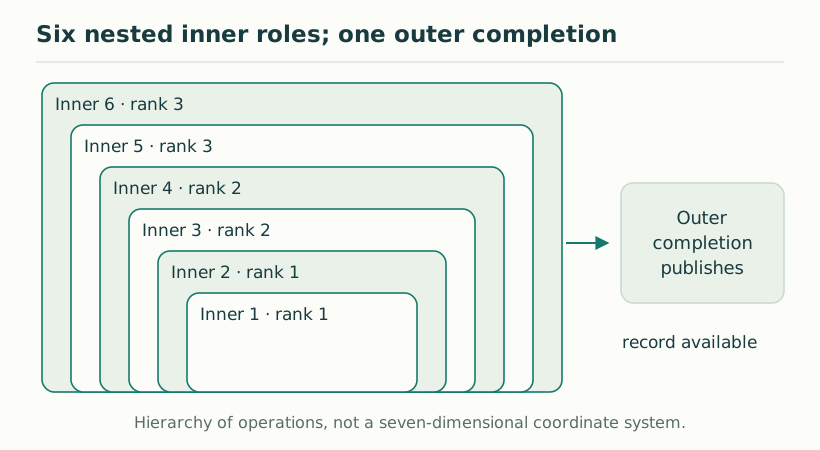
DTT can use the contrast between preparation and manifested activity to explain why inner construction is distinguished from outer completion. Six inner roles contribute to the generated spatial organization, and the outer role makes a completed result available. This is a hierarchy of dependent operations, not a timetable of seven ordinary days at a smaller scale.
The nested-stage diagram presents six inner functional roles and an outer completion. The nesting expresses dependency among operations, not seven parallel measured time coordinates. Within a specified model, each role needs its own operation or map. Historical names provide interpretive context; they do not, on their own, determine those maps.
A symbolic system can be rich because it connects many domains of meaning. A physical model gains strength differently: it reduces independent choices and derives consequences. The two strengths can support one another, but they are not interchangeable. More correspondences do not automatically produce more predictive power.
The constructive question is whether a selected generative hierarchy yields stable dimensional readout, compatible clocks and lawful matter propagation. If it does, the historical scheme remains part of the intellectual motivation while the result stands on its explicit assumptions. If it does not yet do so, the articles can still explain the conceptual architecture clearly and identify the precise mathematical relation that a future model must supply.
KEEP THE CONNECTION
Scope of the argument. Detailed symbolic guide with a modern structural comparison; no astrological causation or fixed physical stage mapping is asserted.
Original public topic. This edition provides an independently written explanation; article-level references identify the passages and additional sources used.
Source register →