A047Public article topicExpanded article4 min read
The Kinds of Events
Organize the kinds of events discussed in the temporal cosmology. Explain how classification of events supports the larger distinction between an underlying order and its manifestations.
The source explains that one creative event can have different effects according to the capacities of its recipients. It illustrates this through heating: different materials respond differently to the same influence. Its historical table associates kinds of events with the days and explicitly acknowledges uncertain or missing entries. The central explanatory idea is response dependence, rather than a requirement that a common source produce identical visible effects everywhere.
02An elementary response calculation
Suppose equal amounts of energy Q are transferred to two thermally isolated samples. In a regime where heat capacities are approximately constant and no phase transition occurs, their temperature changes are ΔT₁ = Q/C₁ and ΔT₂ = Q/C₂. If C₂ is twice C₁, the second sample warms half as much. One input does not imply one output because the recipients have different response properties.
This example is an elementary physical illustration, not a derivation of the source's event table. It makes the underlying logic explicit: input, receiver state and coupling together determine an outcome.
ΔT₁ = Q/C₁, ΔT₂ = Q/C₂
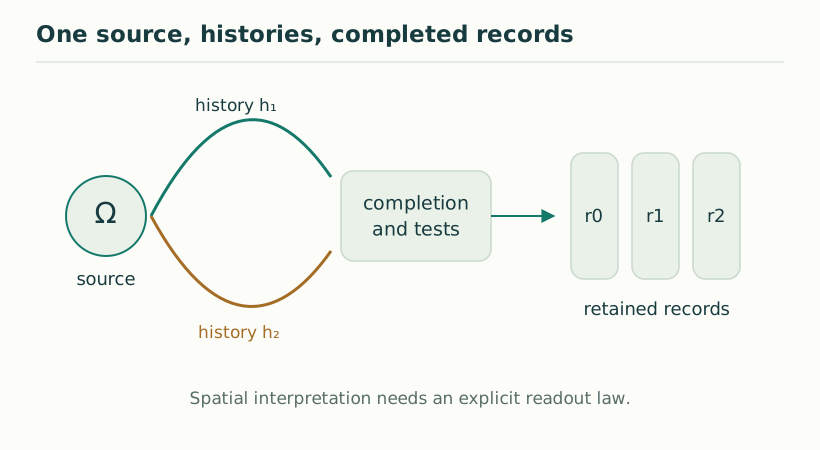
Figure 1. One source, histories, completed records. Conceptual reconstruction: composable source histories are tested and completed before a retained record becomes available. The source is not depicted as a point already located in space. View full size ↗
03Distinguishing kinds from instances
A kind of event is a class, such as a transition or an exchange, while an instance is a particular occurrence. Two instances can belong to one class yet differ in magnitude, location or participants. A classification is useful only when its categories are defined by properties that can actually be checked.
For a generative model, one may classify updates by which invariant they preserve, which records they modify or which coupling they activate. This is more informative than assigning a name after observing the result, because it allows the classification to constrain future calculations.
04SMM and differentiated receptivity
A single-source ontology can accommodate diversity if its states or relations carry different receptive capacities. In mathematical terms, outputs rₐ = Rₐ(F(s)) can differ because the readouts Rₐ access different aspects of a common updated state. The commonality lies in the source dynamics F, while the plurality lies in accessible relations and responses.
For this to explain rather than rename multiplicity, the family of readouts cannot be chosen arbitrarily to fit any desired result. Their structure must follow from specified operations, symmetries or constraints of the model.
05DTT and completed event types
Inner generation concerns the formation of possibilities and relations; outer completion concerns what is registered as an event. Event types can therefore be defined through completion instruments: a successful detection, a retained phase comparison, an energy-transfer record or a change in spatial relation. Different outcomes need not correspond to different independent sources.
A useful formal object is a set of outcome maps Iₐ, each associated with a completed record. In a probabilistic model, these maps must provide normalized outcome probabilities. In a quantum model, additional consistency requirements ensure that the maps preserve physically valid states. Naming an outcome does not replace these requirements.
06A shared law with different initial conditions
Consider two variables obeying the same decay law, xₙ₊₁ = axₙ, with 0<a<1, but starting from different initial values. Their histories differ while the ratio xₙ₊₁/xₙ is the same whenever xₙ is nonzero. That ratio is evidence of the common law, whereas equal initial values would be an additional assumption. This illustrates a useful SMM principle: unity should appear through shared relations, not through forced sameness of all states. A physical reconstruction can seek invariant ratios, common transformation behavior or linked responses across distinct systems. DTT then adds the task of showing how those laws operate through the same completion structure while allowing different realized histories.
07Diversity governed by one law
Different recipients can respond differently to one specified influence. What makes this a unified explanation is a common response law with independently defined recipient properties. The historical event table documents a classification, including acknowledged uncertainties; its missing entries should not be filled by numerical aesthetics. The constructive SMM question is how a common source constrains diverse responses while preserving their genuine differences.
KEEP THE CONNECTION
Key ideas
A common input can generate different responses.
Event kinds need explicit classification criteria.
A single-source model must constrain its readouts, not merely name them.
Scope of the argument. Historical interpretation and original explanatory analysis; formal examples are illustrative models, not claimed deductions from scripture.
Original public topic. This edition provides an independently written explanation; article-level references identify the passages and additional sources used.