A048Public article topicExpanded article4 min read
Hours, Minutes and Seconds
Hours, minutes and seconds divide temporal measurements without determining a fundamental temporal structure. Unit conversion and clock calibration clarify the distinction between counted events, defined units and physically predicted ratios.
The source distinguishes creative events from the conventional subdivisions used to describe observed time. It discusses the day, hour, minute and second, then asks whether indefinitely dividing a numerical interval implies indefinitely dividing what exists physically. That distinction remains useful: the mathematical precision of a number and the resolution of a clock are not the same thing. The historical page calls the base-sixty division hexadecimal; the correct term is sexagesimal.
02A transparent unit calculation
By ordinary civil-time convention, one hour contains 60 minutes and one minute contains 60 seconds. Thus 24 hours contain 24 × 60 × 60 = 86,400 seconds. This conversion is a relation among units. It does not establish that a physical day has an exactly unvarying astronomical duration, nor does it show that a generative process is composed of 86,400 fundamental events.
A measurement might instead report 1.234 seconds. The extra decimal places express the chosen numerical description and, when justified, measurement precision. They do not by themselves establish microscopic temporal constituents.
24 × 60 × 60 = 86,400
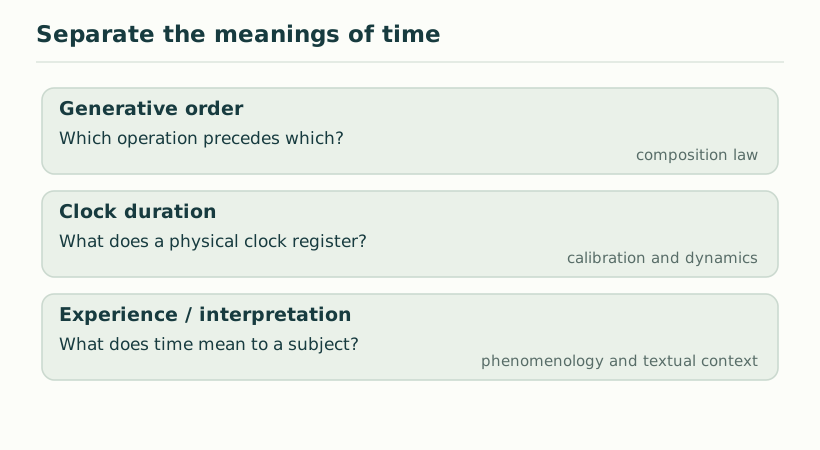
Figure 1. Separate the meanings of time. An interpretive map separates generative order, measured duration, and experienced or theological meanings. A relation between them is a question to formulate, not an automatic identification. View full size ↗
03How the second is defined
The modern SI fixes the caesium hyperfine transition frequency at 9,192,631,770 hertz. This connects the unit second to a specified physical frequency. Other clocks realize or compare time through different systems, and practical measurements retain uncertainties even though the defining number is exact.
This gives a useful separation: definition fixes what a unit means; realization concerns how an apparatus approximates it; theory explains the physical system used. A proposed temporal ontology must engage the third question while remaining consistent with the first two.
How the second is defined
Level
Question
Example
Definition
What does the unit mean?
Fixed caesium reference frequency
Realization
How does an apparatus implement it?
A calibrated clock with uncertainty
Theory
Why does the system behave this way?
A dynamical account of the transition
04Counts require calibration
Suppose an inner process completes N cycles. A count is dimensionless. To express its duration in seconds, a model needs a scale τ₀ or an independently defined comparison with a reference clock, so that τ = Nτ₀ in the simplest uniform case. Merely writing a large number of cycles does not determine τ₀.
If the duration per completion varies with state, then τ is a sum of calibrated increments rather than a constant multiple of N. That distinction becomes relevant when discussing clock rates, gravitational time dilation or the relation between a generative ordering and physical proper time.
05The SMM/DTT connection
SMM motivates an underlying sequence of manifestations, while DTT distinguishes generative stages from observable records. These principles make counting and completion central, but they do not choose a human unit system. A successful physical model would derive relations among actual clock readings, preferably including dimensionless ratios that do not depend on whether seconds or another unit is used.
For example, if two clock readouts satisfy Δτ_A/Δτ_B = f(state), the ratio is meaningful without a choice of unit. Deriving f from one source dynamics is a stronger result than attaching a conventional unit to an inner label.
06Changing units leaves a physical ratio unchanged
Suppose clock A advances by two calibrated seconds while clock B advances by three in the same comparison protocol. Their ratio is 2/3. Expressing both durations in milliseconds gives 2000/3000, the same ratio. A change in notation cannot alter this physical comparison. By contrast, the numerical value of an individual duration changes with the unit. This distinction explains why dimensionless ratios are particularly useful in evaluating a constants or clock program. A model that derives such a ratio has supplied content independent of human unit conventions. A model that only reproduces a familiar number of seconds must show how its scale was calibrated before the numerical match can be assessed.
07Three levels of temporal description
Event count, calibrated duration and displayed units answer different questions. Their separation prevents a familiar numerical subdivision from being mistaken for evidence about the world’s deepest structure. Sexagesimal and decimal notation are useful representational systems. Any deeper physical significance proposed for them must come from an independent structural argument and a defined measurement connection, not from the convenience of a conversion factor.
KEEP THE CONNECTION
Key ideas
Unit conversion does not determine fundamental temporal structure.
A dimensionless count needs a physical calibration.
Clock ratios are useful targets for DTT derivations.
Scope of the argument. Historical interpretation and original explanatory analysis; formal examples are illustrative models, not claimed deductions from scripture.
Historical public topic address, redirected to this edition’s revised explanation. It identifies the topic’s provenance; the revised page supplies its own reading locators and claim scope.