A049Public article topicExpanded article4 min read
The Contrasting Approaches of Sufism and Philosophy
Compare the methods of Sufism and philosophy as presented in the source discussion. Explain how experience, interpretation, and argument support different kinds of claim.
The source introduces the contrast through Ibn al-Arabi's account of meeting Ibn Rushd. It presents an encounter between spiritual unveiling and rational inquiry, emphasizing both possible agreement and a difference in the route to understanding. The story is most useful here as a reflection on methods of knowing. It does not establish that one person's reported experience automatically proves a physical theory, nor that formal reasoning exhausts every kind of human understanding.
02Discovery and justification
An idea can originate in a dream, a contemplative practice, a mathematical puzzle or an unexpected experiment. Its origin does not decide whether it is correct. Justification depends on the kind of claim being made. A theological interpretation may be assessed through textual coherence and a religious tradition; a mathematical theorem requires a valid argument from explicit premises; a physical prediction requires a defined relation to observations.
Keeping these tasks distinct allows creative sources of insight to remain valuable without asking them to perform work they do not perform. An inspiration can motivate a model while the model earns its scientific standing through its consequences.
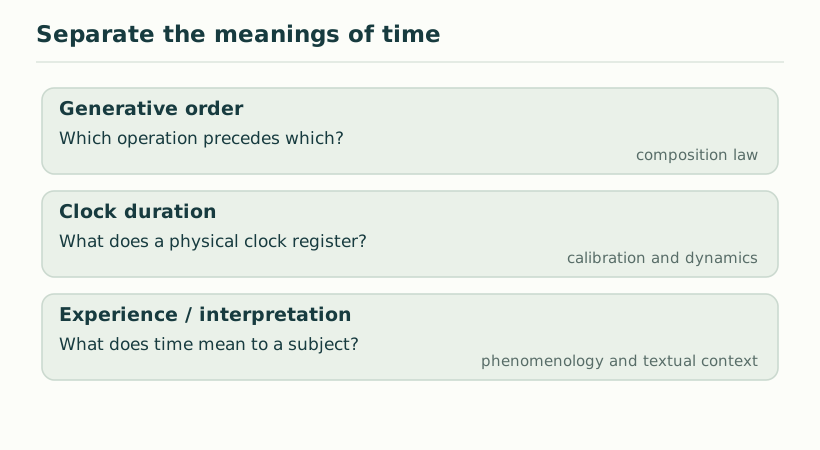
Figure 1. Separate the meanings of time. An interpretive map separates generative order, measured duration, and experienced or theological meanings. A relation between them is a question to formulate, not an automatic identification. View full size ↗
03What conceptual insight can contribute
A powerful conceptual picture can reorganize a problem. Thinking of space as generated rather than pre-given changes the questions one asks about locality. Thinking of duration as a relation between completed records encourages attention to clocks and memory. These are substantive contributions even before a detailed calculation exists, because they can identify hidden assumptions in familiar descriptions.
The next step is to make the insight resistant to ambiguity. What is generated? What counts as a record? Which relations are preserved? Which alternatives would violate the proposal? Answering these questions turns a suggestive perspective into a tractable research program.
04SMM as an ontological proposal
SMM begins with a unifying conception of origin and manifestation. Its philosophical strength depends partly on whether it clarifies the relationship between unity and experienced plurality. Its physical strength depends on whether an explicit model produces nontrivial constraints on observable states. These are related aims but not interchangeable evaluations.
A universal statement compatible with every possible observation can remain meaningful as metaphysics, yet it does not distinguish physical predictions. Conversely, a narrow theorem may be scientifically useful while leaving large metaphysical questions untouched.
05DTT as a translation task
DTT proposes a distinction between generative inner order and completed outer time. The translation into mathematics needs a state space, a dynamics, accessible operations and a clock readout. An illustrative diagram may help communicate the distinction, but the equations must determine how the two levels relate.
Consider two models sharing the same verbal description but predicting different clock ratios. The disagreement cannot be resolved by repeating the common description. It is resolved by examining their additional assumptions and, where possible, the observations that discriminate them. This is how formal work sharpens the original insight.
06A claim can be strong in one domain and incomplete in another
An argument may establish that a proposed ontology is internally coherent without establishing that nature realizes it. A mathematical construction may prove the existence of a state space and update rule without showing that its parameters are uniquely selected. An experiment may support a specific prediction while leaving several ontological interpretations open. These are not defects caused by using different methods; they are distinctions among conclusions. For SMM/DTT, stating the conclusion at the right level helps preserve genuine achievements. A rigorous conditional theorem is more valuable when its conditions remain visible, because it tells later work exactly what must be derived or measured to strengthen the claim.
07A productive dialogue
The constructive relation between Sufi interpretation and scientific inquiry is a dialogue between questions. The historical tradition supplies a rich vocabulary of dependence, manifestation and unity. Mathematics can reveal which formulations are coherent; physics can identify their measurable consequences. Respecting each enterprise includes asking what a particular argument has established and how its conclusion follows from the kind of evidence supplied.
KEEP THE CONNECTION
Key ideas
The origin of an idea differs from its justification.
Different claims require different forms of evidence.
DTT formalization can sharpen a metaphysical insight into a testable question.
Scope of the argument. Historical interpretation and original explanatory analysis; formal examples are illustrative models, not claimed deductions from scripture.
Original public topic. This edition provides an independently written explanation; article-level references identify the passages and additional sources used.