A034Public article topicExpanded article4 min read
The Age: a guide to the term
A glossary article on the Age and its place among the source’s expressions for time. Explain how its encompassing role differs from the repeated cycles described as days.
The source article uses al-dahr, the Age, for an encompassing order in which the differentiated days and modes of manifestation are understood. It discusses the term as a divine Name in Ibn al-Arabi’s interpretation, rather than simply as a very large number of years. The ordinary question about the age of an object and this technical use of the Age therefore have different meanings.
The conceptual issue is how many temporal perspectives can belong to one whole without requiring a further physical clock that stands outside all of them.
02A whole is not always another member
A library catalogue organizes books, but it is not simply the next volume in every series it describes. A map of relationships among clocks is not automatically another clock with a longer period. These analogies help explain why an encompassing description can have a different logical role from the items it organizes.
For SMM, the source is intended to ground the multiplicity of manifested relations. It should not be treated as the largest object among those relations. The same caution applies to the Age: its interpretive role cannot be captured merely by increasing the scale on an ordinary timeline.
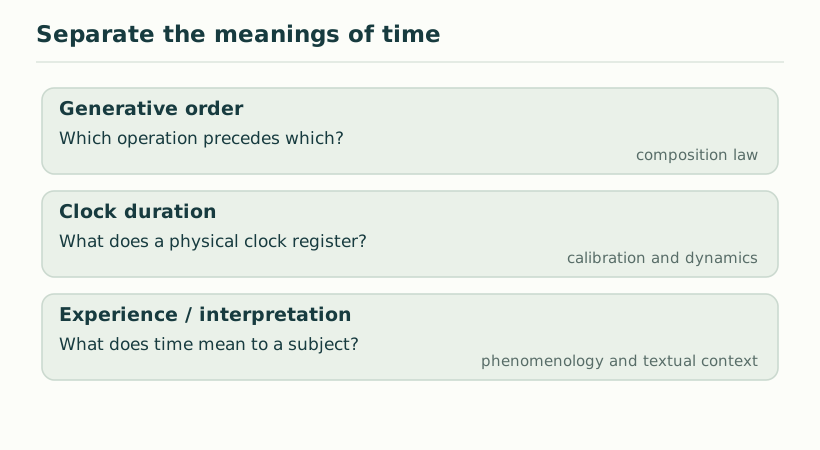
Figure 1. Separate the meanings of time. An interpretive map separates generative order, measured duration, and experienced or theological meanings. A relation between them is a question to formulate, not an automatic identification. View full size ↗
03Many clocks and one comparison structure
A physical system can contain several clocks with different periods and couplings. Their readings become mutually meaningful through comparison procedures. One can represent the relations among them without assuming that any single clock gives an absolute view from nowhere.
DTT’s common-source aim is stronger than gathering these clocks into one diagram. It seeks to explain why their comparisons obey compatible laws. A shared source could constrain their response, but the constraint must be demonstrated. Otherwise the encompassing language adds no calculation beyond the separate clock models.
04Why another container does not finish the explanation
If time is imagined as a container of events, one can ask what contains that container. Adding another larger container repeats the question. The source article criticizes this tendency through its account of the Age. A relational reconstruction offers a different approach: specify events and the relations that make their order meaningful.
This does not imply that all coordinates are useless. Coordinates are effective labels once the relevant structure exists. The point is that a coordinate range, even an infinite one, does not explain why events possess the measured temporal relations they do.
05The DTT link to an observable totality
A DTT model can distinguish the full generative description from the record algebra accessible to an observer. Different observers may access different subsets while remaining part of one source-generated structure. The relation among those views is then a mathematical problem of consistency and transformation.
The encompassing description should not be assumed to be directly observable as a whole. A physical observer is embedded in the model and has finite access. This limitation matters when discussing global simultaneity, the entire cosmic state or a universal completion count. Each requires a defined operational meaning.
06A useful way to read the term
The Age can be read as a reminder that the whole order of manifestation is not exhausted by any one local temporal measure. Within Ibn al-Arabi’s theology it has a specific relation to divine naming; within an SMM/DTT discussion it can motivate attention to the common dependence of many observable orders.
The modern physical translation remains selective. One can investigate a total history space and its observable quotients without claiming that the mathematical space is al-dahr itself. The value of the connection lies in clarifying whole and part, source and manifestation, and local measurement and global description. These distinctions make the research vocabulary more precise while respecting the original term’s broader meaning.
KEEP THE CONNECTION
Key ideas
Al-dahr in the source is not simply a large measured age.
An encompassing description is not necessarily another clock.
DTT must relate local observable times through a defined common structure.
Scope of the argument. Interpretive guide to a technical term; the theological Age is not identified with a measurable cosmological parameter.
Sources & further reading
The Age ↗Main article text, accessed 16 October 2026
Original public topic. This edition provides an independently written explanation; article-level references identify the passages and additional sources used.