A042Public article topicExpanded article4 min read
The Original Days of Event
Introduce the Original Days of Event and their role in organizing occurrence. A focused glossary entry will help readers distinguish this term from the other kinds of days.
01The difference between an event and a calendar day
The original article distinguishes an indivisible creative Day of event from a familiar local day. Its geographical illustration compares the different phases of daylight occurring around Earth at one moment, emphasizing the contrast between a comprehensive event and a local temporal experience. The article also notes that dividing a circle into 360 degrees is mathematically conventional. The conceptual question is therefore about how a global description relates to locally encountered succession, rather than about proving a privileged numerical clock unit.
02One event, several descriptions
Consider a single update to a database containing many fields. The update is one operation in the system specification, but a reader can inspect the changed fields separately. Likewise, one mathematical state transition can induce many changes in its component observables. There is no contradiction between counting one transition and counting several outcomes if the counts refer to different levels of description.
This example must not be silently converted into a universal instantaneous physical update. A database has an implementation and an external clock; a cosmological theory must explain its own physical clocks and communication constraints. The analogy resolves a counting ambiguity, not the dynamics of the universe.
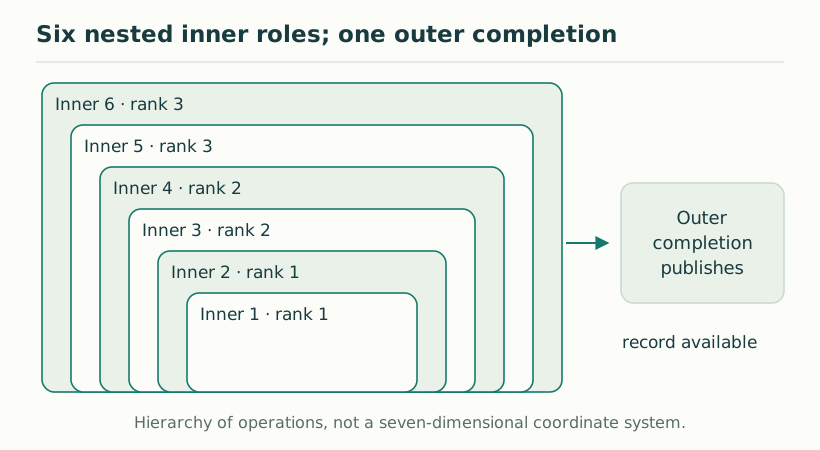
Figure 1. Six nested inner roles; one outer completion. The six inner roles are nested functional stages with readout ranks 1, 1, 2, 2, 3, 3. The outer completion publishes the resulting record. These are not seven independent time axes. View full size ↗
03A precise distinction of indices
Let n label a source-level transition and let a label a local observable. The record rₐ(n) describes what observable a reports after transition n. A complete record family is {rₐ(n)}. The number of available local records can be large even when the generating transition has a single index. Counting records and counting transitions answer different questions.
A local observer may access only some records, and the relation between that observer's proper time and n requires a clock model. The observer cannot infer that n is a universal measured time merely because the theorist uses it to order a calculation.
rₐ(n): local record a after source transition n
04SMM and the unity of production
The SMM motivation is to account for multiplicity through a common origin. The Day of event provides a vocabulary for one act considered comprehensively. The contemporary formal problem is to replace that vocabulary with a rule that generates distinguishable outcomes and their mutual relations. A shared label is insufficient: the rule must constrain those outcomes in ways that would not follow from unrelated local prescriptions.
For instance, if two records are claimed to share a source, one may ask what invariant or compatibility relation ties them together. A conservation law, a correlation constraint or a common response to a transformation can give the statement mathematical content.
05DTT and local temporal access
DTT separates inner generation from completed outer records. This makes it possible to discuss a source transition without assuming that every sub-operation is separately visible. It also raises the central issue of access: which operations can an observer perform, and which distinctions can those operations resolve? An operational equivalence relation groups source states that all permitted measurements treat alike.
If s and s′ give identical accessible records, writing s ~ s′ expresses that equivalence. The observable world is then organized by such equivalence classes, while the generating description may contain additional distinctions.
06A record-counting example
Suppose a transition produces three bits, r₁, r₂ and r₃, with the constraint r₃ = r₁ ⊕ r₂, where ⊕ denotes addition modulo two. There are three accessible bit records but only four allowed triples rather than all eight. The shared generating constraint makes their relation informative. An observer reading only r₃ sees less structure than an observer comparing the full triple. This example shows what a common event can contribute beyond a shared timestamp: it can impose a relation among outcomes. For SMM, the valuable unifying result would be an analogous independently derived compatibility condition among physical records. For DTT, completion determines which parts of the constrained triple become accessible together.
07Local and comprehensive descriptions
The geographical analogy concerns a local observer encountering one phase while a larger description includes many phases. The record model concerns several accessible variables associated with one generating transition. These comparisons clarify different levels of organization; neither establishes relativistic simultaneity. The lasting insight is that the word day can identify a level of description, and a theory of time must specify the observer’s relation to that level.
KEEP THE CONNECTION
Key ideas
A creative event and a calendar interval are different concepts.
One update can support many local records.
The relation between source order and measured time must be defined.
Scope of the argument. Historical interpretation and original explanatory analysis; formal examples are illustrative models, not claimed deductions from scripture.
Original public topic. This edition provides an independently written explanation; article-level references identify the passages and additional sources used.