Explain the conditions under which the projected structural functional becomes monotone. Distinguish this model-level result from a universal derivation of thermodynamic entropy production.
The dual-time gauge draft distinguishes retained observable fields q from hidden generative variables r. Observation projects the larger state onto q, while couplings to r can still influence future observations. This is a concrete version of the SMM/DTT distinction between inner generation and outer realization. The mathematical reduction studied here starts from specified equations, coupling matrices and relaxation assumptions. It does not derive them from the six nested inner stages, nor identify those stages with independent time coordinates. The purpose is to show exactly how a chosen hidden sector can produce memory and, under stronger assumptions, monotone reduced dynamics.
02Separate reversible motion from descent
In the local reduced regime let q̇=J∇H−M∇Ψ, where J is antisymmetric and M is positive semidefinite. The first term is a reversible candidate flow; the second follows the negative structural gradient. Antisymmetry of J alone does not ensure that Ψ is preserved by J∇H. The additional condition is ∇Ψ·J∇H=0. It holds automatically for Ψ=H, but not for an arbitrary pair of functionals.
q̇=J∇H−M∇Ψ
{Ψ,H}_J=∇Ψ·J∇H=0
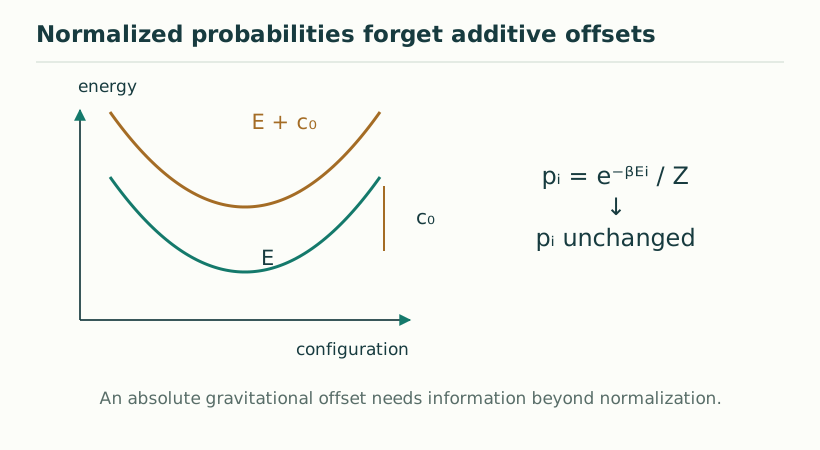
Figure 1. Normalized probabilities forget additive offsets. Adding an energy constant c₀ multiplies every Boltzmann weight by the same factor and leaves normalized probabilities unchanged. Such response alone cannot fix an absolute vacuum-energy offset. View full size ↗
03The monotonicity proof
Differentiate Ψ along the motion and substitute the evolution law. The reversible contribution vanishes only under the stated compatibility condition. The remaining quadratic form is nonpositive by positivity of M. Strict decrease requires the gradient to have a component in a direction actually coupled to hidden response. A nonzero gradient lying in ker M need not decay. This gives both the theorem and its equality conditions in one line.
dΨ/dt=−(∇Ψ)ᵀM∇Ψ≤0
M=KΛ⁻¹Kᵀ ⇒ strict decay if Kᵀ∇Ψ≠0
04A scalar decay example
Take Ψ=kq²/2 and M=m>0 with no reversible term. Then q̇=−mkq, so q(t)=q₀e^(−mkt) and Ψ(t)=Ψ₀e^(−2mkt). If instead M=0, Ψ stays constant. In two dimensions with M=diag(m,0), only the first gradient component is damped; the second can remain stationary or participate in reversible motion. This makes clear why a semidefinite metric yields a family of nondissipating directions rather than a guaranteed unique equilibrium.
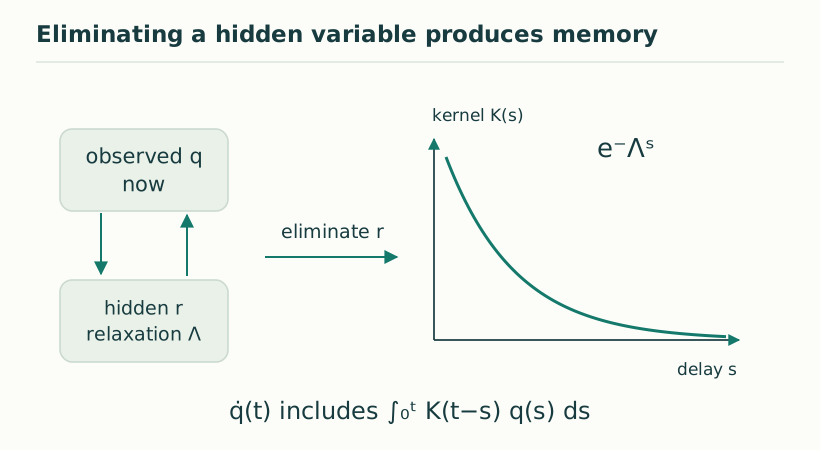
Figure 2. Eliminating a hidden variable produces memory. For a linear relaxing hidden sector, substitution produces a Volterra memory term. An exponentially decaying kernel is the simplest example; its fast limit can yield local effective dissipation under additional assumptions. View full size ↗
05From a structural decline to entropy language
The draft defines a recoverability defect Δ=Ψ(0)−Ψ(t). It is nondecreasing under the theorem. An effective entropy S_eff=S₀+aΔ+b logΓ is then nondecreasing only if the hidden-sector count Γ is constant or nondecreasing and a,b are positive. This is a chosen coarse-grained quantity, not a proof that every standard entropy obeys the same law. For DTT the constructive result is that a specified completion can produce an arrow in a reduced description. Its thermodynamic interpretation must be supplied and tested separately.
06An ordinary scalar drift is not automatically reversible
In a one-dimensional real toy equation a term ωq generally changes Ψ=kq²/2 by ωkq². It cannot simply be labelled Hamiltonian or reversible and then dropped from the monotonicity calculation. A nontrivial antisymmetric generator requires at least a suitable multidimensional space; alternatively set the scalar drift to zero or prove separately that it preserves Ψ. This small issue illustrates a broader discipline for SMM/DTT: interpretive labels do not replace the algebraic condition used in a theorem. Every retained reversible sector must be checked against the actual structural functional before a reduced second-law statement is made.
07Interpretation of an irreversible reduced law
A reduced equation can lose predictive information because several larger states share one observed state. That does not make projection alone a universal source of thermodynamic entropy. Positive hidden relaxation, a chosen initial condition or reservoir, and a condition on the reversible flow do essential work in this model. The structural functional Ψ is not automatically Boltzmann, Gibbs or von Neumann entropy. Connecting its decay to a laboratory second law requires an operational coarse-graining, thermodynamic variables and calibrated coefficients. This qualification preserves the useful mechanism while preventing a model-level monotonicity theorem from being mistaken for an unconditional derivation of time’s arrow.
A finite closed Hamiltonian system preserves information globally and can display recurrences. Replacing some of its degrees of freedom by a permanently relaxing operator requires a specified approximation, reservoir or limiting regime. The exactness claimed for hidden-variable elimination is exactness relative to the supplied coupled equations, including their positive relaxation operator. It is not an independent proof that those equations follow from a conservative temporal action. A source-based derivation should track where the discarded information resides and over which interval the reduced dissipative description remains accurate.
KEEP THE CONNECTION
Key ideas
The reversible flow must preserve Ψ for the theorem to apply.
Strict decay depends on coupling to the gradient, not merely K≠0.
A structural functional requires further identification before it becomes thermodynamic entropy.
Scope of the argument. Conditional Lyapunov monotonicity in the local regime; no universal thermodynamic entropy theorem.
Sources & further reading
dual_time_entropy_v4.pdf — working draftpp. 18–21 and 23, Propositions 6.11–6.15
Source editions and catalogue entries
Working manuscript
A Dual-Time Gauge Model for Projection-Induced Memory and Irreversibility
Draft file: dual_time_entropy_v4.pdf
Working manuscript. Article-level references identify the consulted sections and the scope of the interpretation. No public URL was supplied for this exact manuscript version.