Introduce the signed order parameter used to represent temporal interchange symmetry breaking. Explain why genuinely degenerate choices matter for the model’s symmetry argument.
The dual-time gauge draft distinguishes retained observable fields q from hidden generative variables r. Observation projects the larger state onto q, while couplings to r can still influence future observations. This is a concrete version of the SMM/DTT distinction between inner generation and outer realization. The mathematical reduction studied here starts from specified equations, coupling matrices and relaxation assumptions. It does not derive them from the six nested inner stages, nor identify those stages with independent time coordinates. The purpose is to show exactly how a chosen hidden sector can produce memory and, under stronger assumptions, monotone reduced dynamics.
02A symmetry needs two genuinely related alternatives
The model contains two temporal sectors and an interchange operation exchanging them. A useful order parameter must change sign under this exchange. The draft defines Φ from the difference of gauge-covariant phase-gradient norms in the two sectors. This distinguishes which sector dominates the alignment. An even quantity measuring their sum cannot by itself identify which of two exchanged configurations has been chosen, although it can measure total alignment strength.
I: +↔−, I²=id
I(Φ)=−Φ
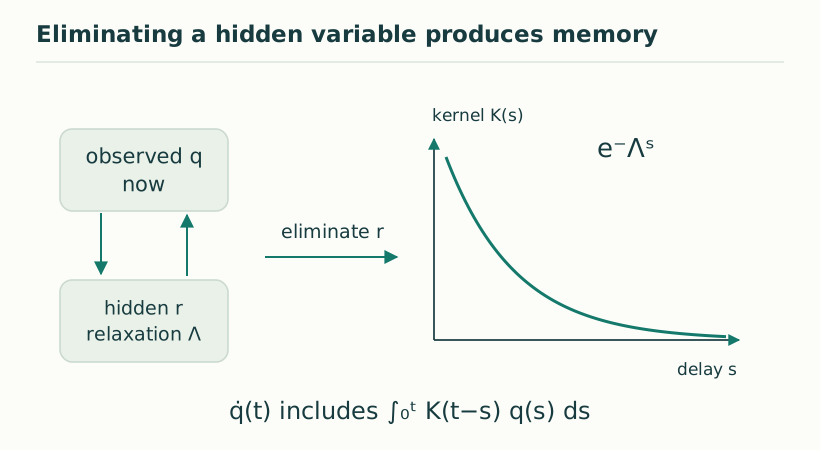
Figure 1. Eliminating a hidden variable produces memory. For a linear relaxing hidden sector, substitution produces a Volterra memory term. An exponentially decaying kernel is the simplest example; its fast limit can yield local effective dissipation under additional assumptions. View full size ↗
03The double-well mechanism
Choose V(Φ)=a(Φ²−v²)² with a>0. Its two minima lie at ±v and have equal energy. The interchange sends one minimum to the other, while Φ=0 is a stationary maximum when v is nonzero. Differentiating gives V′=4aΦ(Φ²−v²) and V″(±v)=8av²>0. The choice of potential and the order parameter’s dynamics are supplied model assumptions; the existence of two minima does not explain which one a particular history occupies.
V′(Φ)=4aΦ(Φ²−v²)
V″(±v)=8av²>0
04An explicit bias changes the question
Add a small term −hΦ. For h≠0 the two wells no longer have equal depths: one is energetically preferred. This is explicit symmetry breaking, whereas choosing a branch of an exactly symmetric model is the spontaneous-breaking idealization. In a finite system, fluctuations can restore a symmetric ensemble even when individual configurations spend long intervals near one well. The thermodynamic or dynamical limit, boundary conditions and observation times must therefore be stated before claiming a permanently selected temporal orientation.
05Why orientation is not yet irreversibility
Selecting the sign of Φ distinguishes temporal alignments, but it does not by itself prove entropy growth or a one-way observable history. The draft separately assumes an observation projection, hidden relaxation and compatibility conditions producing reduced monotonicity. These are distinct logical steps. For SMM/DTT a complete account should connect branch selection with actual completion records and explain why their order is stable. A sign choice in a potential is a tractable model of symmetry breaking; the emergence of a universal physical arrow remains a larger dynamical problem.
06The order parameter must be gauge meaningful
The phase gradients entering Φ are covariant derivatives, so a local phase-frame change does not arbitrarily alter the claimed temporal alignment. A raw phase difference without an appropriate comparison rule could depend on gauge choices and fail to define a physical order parameter. Even with gauge covariance, the relation between Φ and recorded time orientation needs an observable: for example a signed response or a sector-sensitive completion statistic. The draft’s double well supplies a mathematical branch structure, but a physical arrow requires a reproducible way for completed records to distinguish those branches while respecting the retained gauge symmetries.
07Interpretation of an irreversible reduced law
A reduced equation can lose predictive information because several larger states share one observed state. That does not make projection alone a universal source of thermodynamic entropy. Positive hidden relaxation, a chosen initial condition or reservoir, and a condition on the reversible flow do essential work in this model. The structural functional Ψ is not automatically Boltzmann, Gibbs or von Neumann entropy. Connecting its decay to a laboratory second law requires an operational coarse-graining, thermodynamic variables and calibrated coefficients. This qualification preserves the useful mechanism while preventing a model-level monotonicity theorem from being mistaken for an unconditional derivation of time’s arrow.
A finite closed Hamiltonian system preserves information globally and can display recurrences. Replacing some of its degrees of freedom by a permanently relaxing operator requires a specified approximation, reservoir or limiting regime. The exactness claimed for hidden-variable elimination is exactness relative to the supplied coupled equations, including their positive relaxation operator. It is not an independent proof that those equations follow from a conservative temporal action. A source-based derivation should track where the discarded information resides and over which interval the reduced dissipative description remains accurate.
KEEP THE CONNECTION
Key ideas
The order parameter must be odd under temporal interchange.
Degenerate minima differ from an externally biased potential.
Selecting an orientation does not alone derive irreversibility.
Scope of the argument. Landau-type model of temporal interchange; its potential, limits and relation to the observed arrow are conditional.
Sources & further reading
dual_time_entropy_v4.pdf — working draftpp. 8–10, §4; pp. 18–20 for the separate monotonicity mechanism
Source editions and catalogue entries
Working manuscript
A Dual-Time Gauge Model for Projection-Induced Memory and Irreversibility
Draft file: dual_time_entropy_v4.pdf
Working manuscript. Article-level references identify the consulted sections and the scope of the interpretation. No public URL was supplied for this exact manuscript version.