Hydrogen fine structure and its temporal interpretation
Examine how relativistic, spin, and angular-momentum structure split the Coulomb spectrum. The standard baseline gives precise requirements for a temporal source model and shows which additional quantities could become independent predictions.
01Why fine structure is the next consistency layer
The minimal atom provides a scalar nonrelativistic Coulomb spectrum. Fine structure asks whether the material carrier has the spin and relativistic dynamics required to split those idealized levels. This is a natural next step for SMM/DTT because an internal phase carrier and a generated causal geometry should constrain the same particle. The supplied Paper 13 is a skeleton defining this research task, not a completed derivation. A useful expansion therefore starts from a clear standard benchmark, identifies which coefficients are inherited, and states what a genuinely source-derived correction would have to calculate.
02The baseline operator and its assumptions
For a point nucleus treated as infinitely heavy, take a spin-half particle with mass m, action scale ħ and potential V(r)=−αħc/r. Expanding the relativistic one-particle theory yields a kinetic correction, spin–orbit interaction and Darwin contact term. Their relative coefficients are fixed by the standard Dirac/Pauli construction; they are not independent fit parameters. Replacing m by a reduced mass is useful at leading order but does not reproduce all recoil corrections. Nuclear spin, finite size, radiative effects and external fields require further terms.
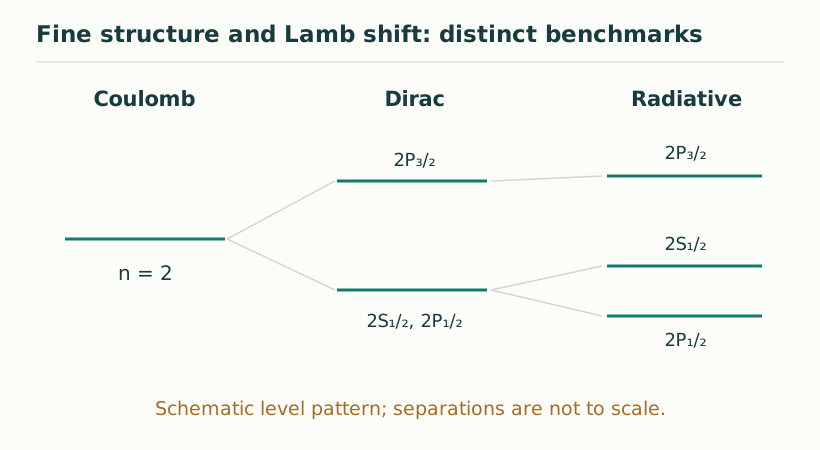
Figure 1. Fine structure and Lamb shift: distinct benchmarks. Schematic only, with deliberately exaggerated separations. For hydrogen n = 2, Dirac fine structure separates j = 1/2 from j = 3/2; radiative corrections further separate 2S₁/₂ and 2P₁/₂. No measured scale is plotted. View full size ↗
03A summary derivation of the order
A Coulombic bound state has typical momentum p∼mcα and binding energy of order mc²α². Inserting that momentum into p⁴/(m³c²) gives an energy of order mc²α⁴, two powers smaller than the leading binding scale. Spin–orbit and Darwin terms occur at the same order in the standard expansion. This power counting explains the hierarchy but not the coefficients or state dependence. Matrix elements must be evaluated on normalized eigenstates, and a degenerate subspace must be diagonalized before assigning individual level shifts.
04A transparent spectral benchmark
For the point-nucleus, infinite-mass Dirac–Coulomb problem, the leading fine-structure correction depends on n and j. Its form is a useful target because separate kinetic, spin and contact contributions combine into one relation. For n=2, the j=1/2 states share the same Dirac energy even though they have different orbital angular momentum. Their radiative separation is a later Lamb-shift question. A source model should first reproduce this organized pattern rather than adjust one transition at a time.
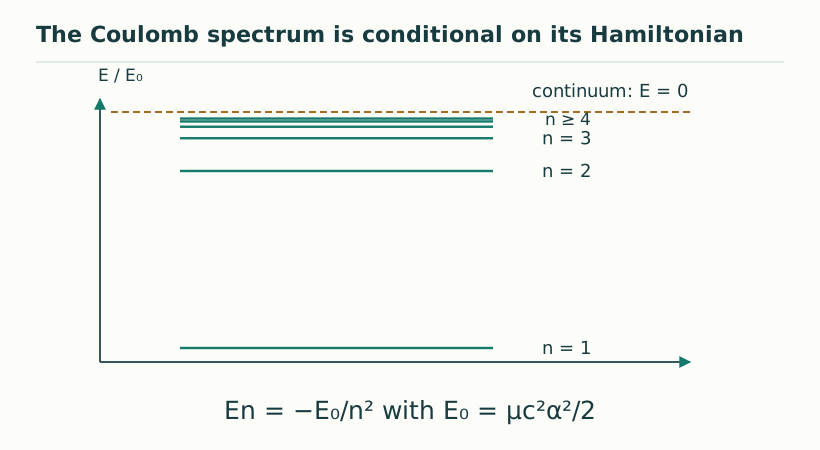
Figure 2. The Coulomb spectrum is conditional on its Hamiltonian. For the nonrelativistic Coulomb Hamiltonian, bound levels follow En = −E₀/n² and approach the continuum threshold. The diagram uses dimensionless E/E₀ and does not derive the coupling or supply radiative corrections. View full size ↗
05What a DTT construction must add
An SMM/DTT account would specify how the same inner history carrier produces spatial transport, spin response and the relevant action scale. A quaternionic or spinorial representation can supply kinematics, but the correct spin–orbit coefficient requires dynamics. Likewise, a temporal orientation label is not yet an extra Hamiltonian term: its transformation law, Hermiticity and coefficient must be stated. A proposed correction δHDTT must be computed from the source and then evaluated on the same level basis. If it merely reproduces the standard terms, that is a reconstruction result rather than a new spectral anomaly.
06A definite fine-structure splitting to reproduce
In the infinite-nuclear-mass benchmark, compare the two n=2 levels with j=1/2 and j=3/2. The bracket in the displayed fine-structure formula is respectively 5/4 and 1/4. Their correction difference is therefore mc²α⁴/32, with the j=3/2 level higher at this order. This is an explicit coefficient and angular pattern that a proposed source-derived spin Hamiltonian can be checked against. It is not the full measured interval: recoil, radiative, nuclear and environmental contributions may enter at the required accuracy. A successful reconstruction must obtain the same result by combining kinetic, spin–orbit and contact terms with common coefficients, rather than insert the final splitting as a separate phenomenological rule.
07A practical calculation sequence
Freeze the upstream coupling and masses, define the spin carrier, derive the effective Hamiltonian to a declared order and compare its coefficients with the standard baseline. Next compute shared level shifts and form transition differences. Record separately the approximation error from omitted powers, nuclear inputs and numerical integration. Only after this baseline passes should a new residual be tested. The article’s figures can show a single Coulomb level splitting into fine-structure components and then receiving radiative and nuclear corrections, with the scale hierarchy labeled schematically rather than using uncomputed DTT numerical values.
KEEP THE CONNECTION
Key ideas
Fine structure tests joint spin, transport and normalization.
The supplied paper is a research skeleton rather than a completed calculation.
Derived common coefficients must precede new spectroscopic claims.
Scope of the argument. Standard fine-structure formulas are benchmarks under explicit point-nucleus assumptions; no new DTT splitting has been calculated here.
Sources & further reading
Temporal Reconstruction of Hydrogen III, skeleton research outlinepaper13_hydrogen_fine_structure_lamb_shift.pdf, §§2–7, pp.3–9
Minimal hydrogen note: transition consistency and contact correctionsmm_dtt_minimal_hydrogen.pdf, §8.1, p.7
Working manuscript. Article-level references identify the consulted sections and the scope of the interpretation. No public URL was supplied for this exact manuscript version.