Develop the skeleton draft’s temporal-loop language into a precise construction. Specify the states, interactions, and regulator before claiming a connection with radiative corrections.
A recurrent source history, a closed path in parameter space and a loop in a quantum-field perturbation expansion are different objects. The first concerns composition of operations; the second concerns transport and holonomy; the third involves a specified amplitude calculation with internal propagators and vertices. SMM/DTT can investigate connections among them, but shared circular imagery is not a derivation. The Paper 13 skeleton asks for radiative inner-time loops. The first task is to define which kind of loop is meant and how it enters a measurable atomic energy shift.
02Start with an explicit retained-and-eliminated model
Let P project onto the retained atomic sector and Q=I−P onto mediator or excited auxiliary states. Write one self-adjoint Hamiltonian on the combined space. Solving the Q component of a stationary equation and substituting it into the P component produces an energy-dependent effective operator. This elementary elimination is a clean template for a temporal-loop proposal because it displays the intermediate states and denominators. The interpretation as inner generation may motivate the Q sector, but cannot replace its specified dynamics or the physical meaning of the projection.
Heff(E) = PHP + PHQ(E−QHQ)⁻¹QHP, when the resolvent exists.
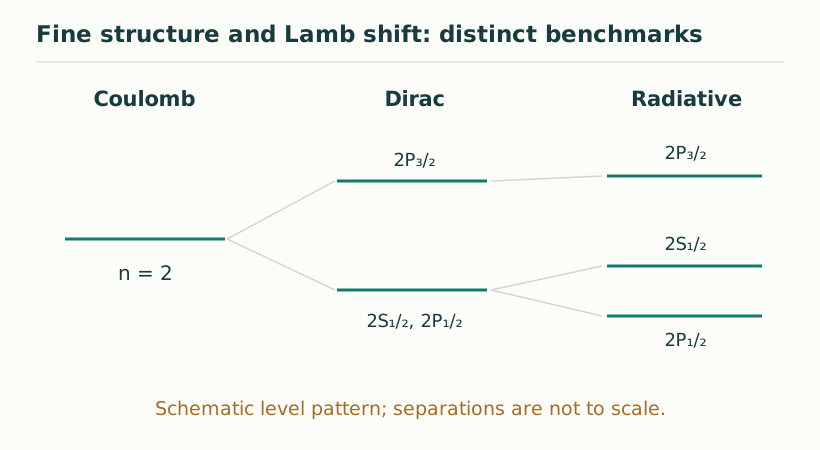
Figure 1. Fine structure and Lamb shift: distinct benchmarks. Schematic only, with deliberately exaggerated separations. For hydrogen n = 2, Dirac fine structure separates j = 1/2 from j = 3/2; radiative corrections further separate 2S₁/₂ and 2P₁/₂. No measured scale is plotted. View full size ↗
03A worked two-level calculation
Take one retained state with energy E₀, one auxiliary state with energy E₀+Δ and a real coupling v. Eliminating the auxiliary gives a correction v²/(E−E₀−Δ). When |v|≪|Δ| and E is close to E₀, the leading shift is −v²/Δ. This is a genuine calculable response, including its sign and regime of validity. It is not yet a radiative field loop: a field generally supplies a continuum of intermediate states, momentum integrals and symmetry constraints. The toy calculation clarifies what must be specified before a named temporal cycle can carry predictive content.
04Regulation and matching cannot be omitted
If infinitely many auxiliary modes contribute, the sum may diverge or depend on a cutoff. A complete model must explain how source resolution regulates the calculation, which observables define the renormalized parameters and how cutoff dependence cancels in predicted transitions. Calling a microscopic tick the cutoff does not determine its value or guarantee a consistent limit. The same regulator must be used in self-energy, vertex and field-response calculations where their identities are linked. Otherwise a finite number may reflect incompatible conventions rather than a physical correction.
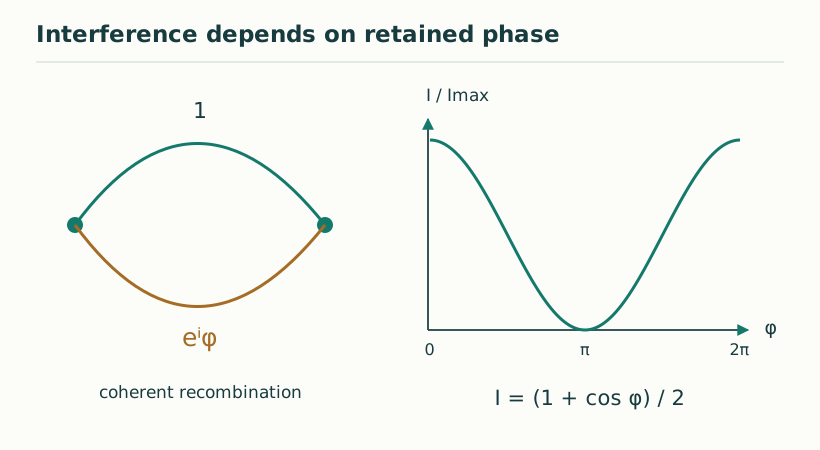
Figure 2. Interference depends on retained phase. The ideal two-path law I(φ) = |1 + eⁱφ|²/4 = (1 + cos φ)/2 is an illustrative quantum baseline. A temporal interpretation must specify which histories retain coherence and how the phase is controlled. View full size ↗
05The conceptual DTT connection
DTT treats inner generative histories as richer than the completed outer record. Eliminating unresolved variables is therefore a natural mathematical operation in the program. The effective outer Hamiltonian can retain signatures of those histories through energy shifts, memory or nonlocal response. This connection is structural: it shows where hidden generative information could affect accessible levels. It does not establish that the eliminated variables are a second laboratory time. An equivalent one-time theory with auxiliary states may reproduce the same response, so a distinctive temporal claim must identify an additional observable restriction or source-derived relation.
06The toy resolvent can be checked exactly
For the two-state matrix with diagonal entries E₀ and E₀+Δ and off-diagonal coupling v, the exact eigenvalues are E₀+Δ/2±√(Δ²/4+v²). For Δ>0, expanding the lower eigenvalue gives E₀−v²/Δ+v⁴/Δ³ plus higher terms. This reproduces the leading resolvent shift and exposes its error scale. Close to Δ=0 the expansion fails: the exact levels split by 2|v| and both states must be retained. A temporal-loop model needs an analogous separation criterion before eliminating inner modes. If the eliminated sector becomes resonant with the atomic sector, a small radiative correction description may cease to be valid even though the full coupled system remains mathematically well-defined.
07What would complete the proposal
A useful manuscript would give the joint state space, source update, coupling operators, conserved quantities, regulator and completion map. It would derive an effective atomic operator and show its order in the independently fixed coupling. It would then recover known radiative terms or predict a new, limited family of corrections with shared coefficients. The six nested inner stages should appear as actual maps or subspaces in this construction. Their hierarchy cannot be replaced by counting six pictorial loops. The calculational path is precise: a retained state leaves through a specified coupling, traverses the auxiliary resolvent and returns, with each coefficient fixed by the model.
KEEP THE CONNECTION
Key ideas
Recurrence, holonomy and perturbative loops must be defined separately.
Resolvent elimination gives a concrete model of hidden-state corrections.
A source-derived operator and matching prescription are needed for radiative claims.
Scope of the argument. The resolvent example is an explicitly defined mathematical illustration; the skeleton supplies no completed radiative inner-time model.
Sources & further reading
Temporal Reconstruction of Hydrogen III, skeleton research outlinepaper13_hydrogen_fine_structure_lamb_shift.pdf, §§2–7, pp.3–9
Minimal hydrogen note: transition consistency and contact correctionsmm_dtt_minimal_hydrogen.pdf, §8.1, p.7
Working manuscript. Article-level references identify the consulted sections and the scope of the interpretation. No public URL was supplied for this exact manuscript version.