A proposed guide to using the Lamb shift as a precision benchmark for the program. Explain why naming a temporal-loop mechanism is weaker than reproducing a quantitative shift.
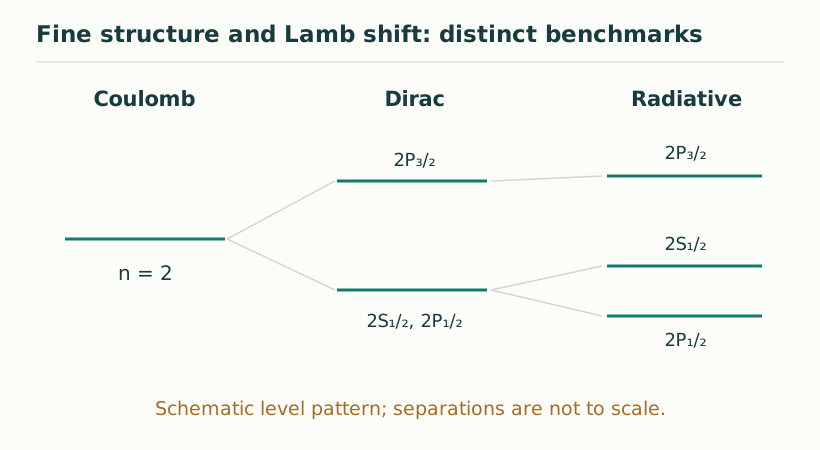
The Lamb shift is an exacting test because the leading Coulomb problem and the point-nucleus Dirac problem leave degeneracies that radiative and nuclear effects lift. A prominent example compares 2S1/2 and 2P1/2. Explaining that separation requires more than explaining why an atom binds or why it has spin. The Paper 13 skeleton correctly places the problem after the constants and leading atomic structure are fixed. Its temporal-loop language identifies a possible direction of research but does not supply a computed shift. This article turns that direction into a quantitative standard of success.
02What is actually compared
A theoretical transition is a difference of physical levels divided by h. Each level receives contributions from the chosen relativistic baseline, electron self-energy, vacuum polarization, recoil, nuclear size and additional higher-order effects. Hyperfine or field-dependent measurements require their own conventions. The word “Lamb shift” can refer to a residual relative to a specified baseline or to a particular experimentally extracted interval; the convention must be stated. Otherwise two calculations can appear to disagree simply because they subtract different reference energies.
νab = (Eb−Ea)/h; δνab = (δEb−δEa)/h.
Figure 1. Fine structure and Lamb shift: distinct benchmarks. Schematic only, with deliberately exaggerated separations. For hydrogen n = 2, Dirac fine structure separates j = 1/2 from j = 3/2; radiative corrections further separate 2S₁/₂ and 2P₁/₂. No measured scale is plotted. View full size ↗
03Why an order estimate is not a derivation
Radiative bound-state shifts involve small powers of α, state-dependent matrix elements and logarithms of scale ratios. An expression such as “order α⁵mc² times a logarithm” describes size, not a complete prediction. It does not determine the finite coefficient, the dependence on n and angular momentum or the treatment of ultraviolet contributions. The skeleton’s schematic equation should therefore be read as a power-counting placeholder. A completed calculation needs a specified interaction, regulator and matching prescription, together with the cancellation or absorption of regulator dependence into quantities already fixed elsewhere.
04A simple contact model illustrates both promise and ambiguity
As an educational perturbative example, add δH=λδ³(r) to Coulomb matrix elements. For an nS state, the first-order shift is λ/(πrB³n³); for ℓ>0 it vanishes at this order. Thus the example separates S and P levels and gives a correlated state pattern. It does not reproduce the full Lamb shift, whose contributions are more diverse. The delta expression is used only as a first-order effective contact insertion, not as an unregularized three-dimensional Hamiltonian definition. The coefficient λ has units energy times volume and remains to be derived.
δEnS = λ/(πrB³n³); δEnℓ = 0 for ℓ>0 at this order.
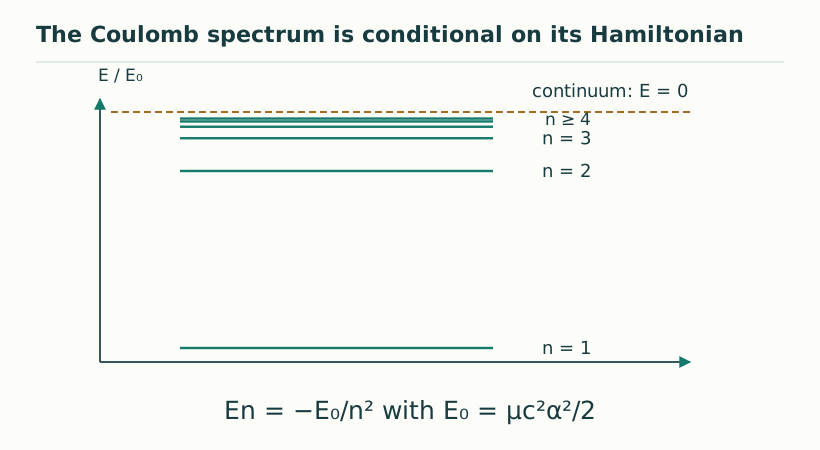
Figure 2. The Coulomb spectrum is conditional on its Hamiltonian. For the nonrelativistic Coulomb Hamiltonian, bound levels follow En = −E₀/n² and approach the continuum threshold. The diagram uses dimensionless E/E₀ and does not derive the coupling or supply radiative corrections. View full size ↗
05Where SMM/DTT could make a difference
A temporal source might generate a short-distance operator whose coefficient and state dependence survive outer completion. To make that proposal meaningful, identify the retained matter states, the mediator states that have been eliminated and the map from their virtual response to an effective operator. A closed inner sequence is not automatically a radiative loop: it must contribute the correct amplitude, statistics and normalization. If the result is equivalent to ordinary QED after matching, it may explain a representation choice but does not predict an extra Lamb shift. A new contribution must be stated as a separate operator.
06The benchmark should use several levels
Fit-free prediction of one interval would be valuable; a consistent pattern across several independent intervals is stronger. Use the same constants and coefficients for all levels, propagate shared uncertainties and compare both S-sensitive and high-angular-momentum channels. Do not absorb every disagreement into a new line-specific parameter. A failure in one channel can reveal missing nuclear structure, a mistaken baseline or a wrong temporal operator. The predicted baseline, its uncertainty and any candidate correlated residual must be reported separately so that the physical origin of a discrepancy can be assessed.
KEEP THE CONNECTION
Key ideas
A Lamb-shift calculation requires coefficients, state dependence and regulator control.
A contact pattern is an instructive example, not the full radiative answer.
A temporal mechanism must produce a shared effective operator.
Scope of the argument. The supplied manuscript is a skeleton. This article develops a benchmark and an illustrative perturbative operator, not a completed Lamb-shift prediction.
Sources & further reading
Temporal Reconstruction of Hydrogen III, skeleton research outlinepaper13_hydrogen_fine_structure_lamb_shift.pdf, §§2–7, pp.3–9
Minimal hydrogen note: transition consistency and contact correctionsmm_dtt_minimal_hydrogen.pdf, §8.1, p.7
Working manuscript. Article-level references identify the consulted sections and the scope of the interpretation. No public URL was supplied for this exact manuscript version.