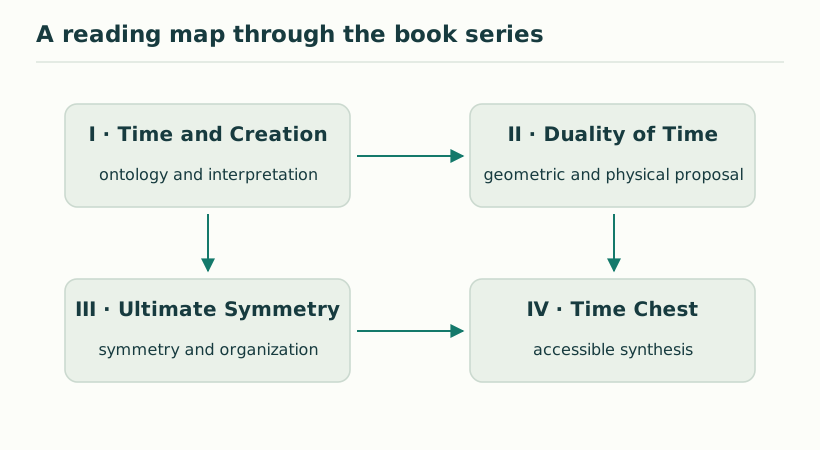
Volume I places Ibn al-Arabi’s treatment of time and creation at the center of the Single Monad Model. Its public introduction emphasizes that the relevant ideas must be assembled from passages distributed across several works and contexts. The volume therefore has two related roles: an interpretation of historical cosmology and the motivation for a new model.
Those roles should be distinguished when reading. A convincing textual interpretation establishes what a concept means in the source tradition. A physical model must additionally define observables, equations, and a way to compare its consequences with experience. The second project can be inspired by the first without inheriting a physical proof from it.
02Begin with dependence before asking for a mechanism
The central conceptual question is how a differentiated world relates to a unified source. Unity here need not mean that a small object sits at one spatial location while creating other objects elsewhere. That picture already assumes the space whose origin is under discussion. A pre-spatial source is instead an explanatory starting point for the existence of relations.
Consider the difference between a sentence and the rule that generates grammatical sentences. The rule is not another word occupying a position in every sentence. This analogy helps separate a source from its manifestations, although it does not establish that cosmic generation is linguistic or computational. Its limited purpose is to clarify the level of explanation.
Figure 1. A reading map through the book series. A thematic map, not a claim that the later mathematical results follow automatically from the earlier texts. Readers can move from the ontology of time to physical constructions, then return to the interpretive questions. View full size ↗
03Time as a relation and time as a container
A container picture imagines time as an independently flowing medium into which events are placed. A relational picture begins with ordered changes and comparisons between them. The latter makes the question of a temporal origin more subtle: asking what happened before time can presuppose the ordering relation one is trying to explain.
An operational clock illustrates the distinction. A pendulum does not collect a substance called time; a chosen sequence of its states is compared with other processes. This does not decide every metaphysical question, but it shows why measured duration should be separated from an independent temporal container.
04Renewal and the problem of persistence
Ever-renewed creation raises a constructive question: if states are renewed, what makes an object count as the same object across observations? Similar appearance is not enough. A model needs relations that preserve identity, memory, and predictable interaction across the sequence.
The world-as-a-movie analogy is useful at this point. Frames can represent distinct configurations, but a film’s apparent motion depends on ordered presentation and stable correspondences between features. The analogy explains a possible description of continuity; the full SMM/DTT task is to derive the corresponding order and retention rules rather than leave them to an external projector.
05From cosmological days to nested temporal roles
The historical discussions of days, cycles, and the week provide a vocabulary for relating differentiated manifestation to a unified order. The later DTT program interprets six inner roles and one outer completion role as a hierarchy of spatial formation and observation. This is a modern reconstruction of a conceptual pattern, not a literal identification of theological days with laboratory seconds.
The most useful reading keeps a three-column notebook: the original term, the meaning established in its textual context, and the proposed mathematical counterpart. A blank third column is acceptable. It is better than silently equating different notions merely because their names or numbers resemble one another.
06How Volume I connects to the technical articles
The completion articles translate persistence into retained distinctions under future tests. The locality articles ask which relations can support a stable spatial readout. The clock articles ask what a material device actually measures. Together they make concrete several questions raised by the historical account.
Read Volume I as the conceptual foundation for those questions. Its lasting value in the research program is to challenge the assumption that space, objects, and their temporal order must all be primitive. The later mathematics earns its conclusions by supplying the structures that turn that challenge into explicit models and by showing where the proposed explanation remains incomplete.
KEEP THE CONNECTION
Key ideas
A source of spatial relations need not be an object inside pre-existing space.
Renewal requires an account of persistent identity and memory.
Historical terms and mathematical counterparts should be connected explicitly.
Scope of the argument. An original conceptual reading guide based on the public introduction, not a substitute for the complete historical volume.
Thematic reading guide based on the public introduction, available preview or catalogue material identified in the article references. It does not claim to summarize every chapter.