Volume II develops the proposed temporal geometry of the program. Its public introduction presents spatial formation through inner levels and an outer observational role, with split-complex numbers used to express a hyperbolic relation. This is the move from cosmological motivation toward a mathematical language.
The key reading question is whether each mathematical structure represents an assumption, a derived consequence, or an independently calibrated observation. The same formula can be useful in all three roles, but an argument becomes circular if it treats an assumed target geometry as though the notation alone had derived it.
For SMM, the unity of the source is the starting premise. DTT develops the temporal distinction through which that one source could generate many completed spatial records. The volume therefore asks how multiplicity can be organized by a common process, before an observer assigns independent positions and clock readings to its results.
02Split-complex algebra in a concrete calculation
Let j satisfy j²=+1 and let z=u+jv, with real u and v. Conjugation sends j to -j, so z times its conjugate is u²-v². Unlike ordinary complex numbers, nonzero split-complex numbers can have zero norm: u=v is a simple example. This algebra naturally organizes a quadratic form with one positive and one negative direction.
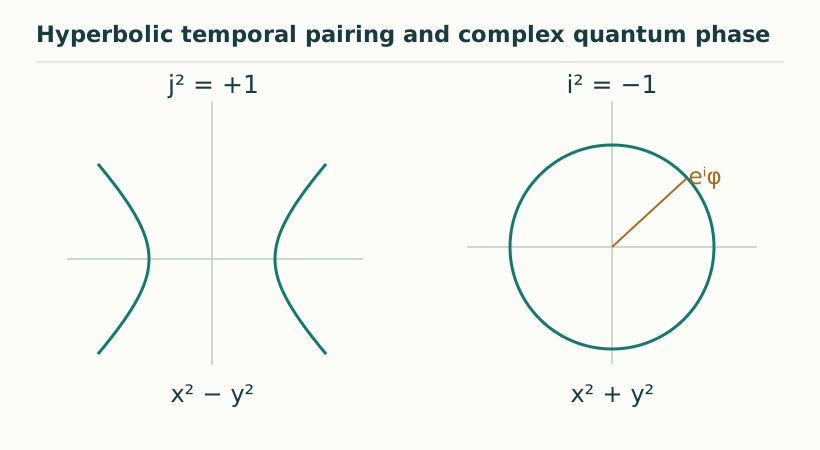
Its exponential is exp(jη)=coshη+j sinhη. Multiplying by this unit-norm element preserves the quadratic form. This is why the algebra is well suited to representing hyperbolic rotations and Lorentz-type transformations once a physical readout is specified.
j²=+1, z̄=u-jv, zz̄=u²-v².
e^(jη)=coshη+j sinhη, e^(jη)e^(-jη)=1.
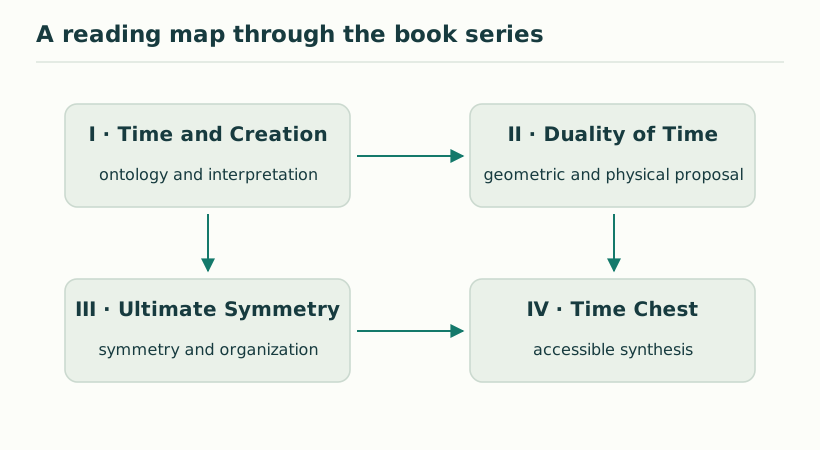
Figure 1. A reading map through the book series. A thematic map, not a claim that the later mathematical results follow automatically from the earlier texts. Readers can move from the ontology of time to physical constructions, then return to the interpretive questions. View full size ↗
03Ordinary quantum phase is a different structure
For the usual imaginary unit i²=-1, exp(iθ) describes a circular phase and preserves u²+v². The circular and hyperbolic algebras have different geometry. Reusing the word imaginary must not erase that distinction.
The newer phase-selection papers ask how an ordinary complex structure J²=-I arises from an oriented real Hilbert flow. That is a separate mathematical question from representing a split-complex temporal pairing. A coherent theory may contain both structures, but it must state which acts on source states, which organizes temporal roles, and how the observation map connects them.
04Nested generation is not seven external coordinates
The DTT hierarchy is best read as a sequence of dependencies: two inner roles at each stage of three-dimensional formation, followed by completed observation. A construction can use several internal parameters without presenting observers with that many independent clocks.
An algorithm supplies a simple analogy. Preparing data, resolving an address, and committing a result are different stages even if a single processor executes them. The analogy does not explain why nature follows a particular algorithm; it clarifies why a list of stages should not be drawn as a list of mutually perpendicular time axes.
Figure 2. Hyperbolic temporal pairing and complex quantum phase. The split-complex unit j² = +1 supports a hyperbolic quadratic form. The ordinary complex unit i² = −1 supports circular phase rotations. A reconstruction must specify the bridge; the two units cannot simply be interchanged. View full size ↗
05From algebra to a physical limiting speed
A hyperbolic quadratic form has null directions. To identify them with the physical propagation of light, a model must link the algebraic variables with measured length and duration and show that the relevant matter and field dynamics share the same characteristic cone. The numerical speed depends on the calibration between those quantities.
Thus c can be expressed as an update scale divided by a completion time in a specified model, but a universally shared ratio must be explained. If two independently chosen clocks or channels measure different ratios, the common source label alone does not remove the disagreement. The current operational-clock work examines that missing selection step.
06A disciplined route through the volume
First learn the algebra and the generative interpretation separately. Then follow each proposed physical consequence back to the assumptions that make it possible. Where the book uses an intuitive identification, compare it with the later explicit source, record, clock, and cone constructions in this atlas.
This approach preserves the volume’s central ambition: to explain spatial and physical structure through temporal generation. It also reveals a concrete standard of progress. A stronger theory is one that derives a relation previously supplied independently, not merely one that rewrites more familiar equations in temporal notation.
KEEP THE CONNECTION
Key ideas
Split-complex and ordinary complex structures have different mathematical roles.
Nested temporal stages are functional dependencies rather than independent axes.
A physical cone needs a readout and common calibration, beyond algebraic representation.
Scope of the argument. The algebraic examples are exact; their physical identification is a separate reconstruction problem.
Thematic reading guide based on the public introduction, available preview or catalogue material identified in the article references. It does not claim to summarize every chapter.