Volume III places symmetry, fractal complex time, and quantum-gravity questions into a broader cosmological interpretation. The public overview connects it with a hierarchy of ultimate, hyper, super, and ordinary symmetry. These terms belong to the author’s conceptual organization and should not automatically be equated with standard technical definitions bearing similar names.
A productive reading asks what remains unchanged, which transformations are allowed, and what object carries them. This turns the general word symmetry into a concrete question. A symmetry of equations, a symmetry of one state, and a correspondence between interpretive domains can have very different mathematical content.
02A simple model separates a law from a state
Consider a real variable φ with potential V(φ)=λ(φ²-v²)², where λ>0 and v>0. The potential is unchanged when φ changes sign. Its minima occur at φ=+v and φ=-v. Selecting one minimum produces a state that does not share the sign symmetry of the full law.
This is the elementary pattern of spontaneous symmetry breaking in a supplied model. The symmetry is present in the governing expression; the chosen state has a smaller stabilizer. The example does not establish a cosmic symmetry hierarchy, but it shows what a genuine breaking argument must identify: a symmetry group, a state space, and a selection or stability mechanism.
V(-φ)=V(φ), minima at φ=±v.
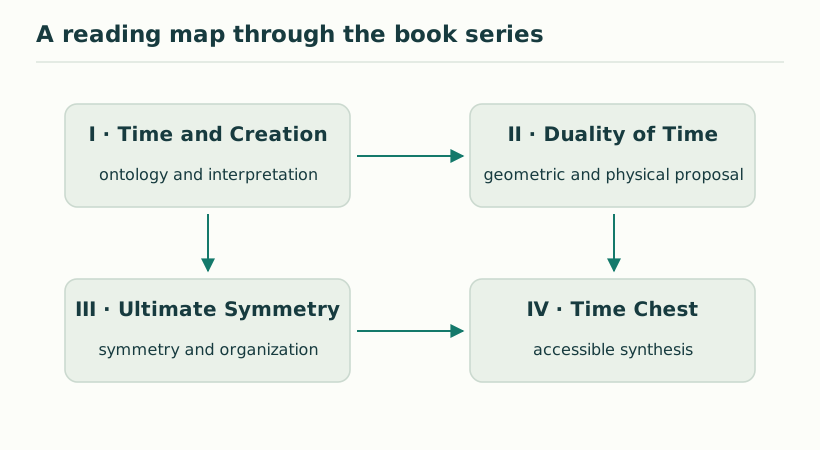
Figure 1. A reading map through the book series. A thematic map, not a claim that the later mathematical results follow automatically from the earlier texts. Readers can move from the ontology of time to physical constructions, then return to the interpretive questions. View full size ↗
03Representation and physical identity
A mathematical representation can describe transformations among components of a model. To interpret those components as physical particles or fields, one needs a Hamiltonian or action, admissible states, observables, and coupling rules. Identical dimensions of two representations do not prove that they describe the same physical sector.
The same caution applies to the term supersymmetry. In its technical physical meaning it requires specific algebraic relations linking bosonic and fermionic structures, with compatible dynamics. A broader metaphysical correspondence between domains can be discussed on its own terms without claiming that these technical requirements have already been met.
04Fractal time and scale-dependent observations
A temporal hierarchy may generate different effective descriptions at different resolutions. A measurable example would be a return-probability or correlation function whose scaling changes with the observation scale. The exponent must be defined from a specific observable and its regime of validity.
A fractal picture does not by itself determine that exponent, and a spectral dimension is not automatically the number of independent spatial coordinates. The newer renewal-clock and spectral-distance articles provide calculations that distinguish these questions. They also show why regularization and finite-size effects matter when interpreting an apparent dimensional flow.
05The relation to psychical and spiritual interpretations
The volume’s broader interpretive framework relates physical, psychical, and spiritual domains. Those are philosophical claims about the structure of experience and manifestation. A mathematical analogy can illuminate a proposed relation, but it does not independently show that a psychical domain contains experimentally identifiable copies of physical atoms.
The useful research task is to specify the bridge. Does a statement concern experienced duration, the algebra of observation, a proposed hidden physical sector, or a theological correspondence? Once the intended claim is clear, one can use the appropriate method: conceptual analysis, textual interpretation, mathematical modeling, or empirical comparison.
06How this volume can guide a functional theory
The strongest contribution of a symmetry-centered viewpoint is to constrain possibilities. A precise symmetry can rule out terms in an action, identify equivalent descriptions, protect a conserved quantity, or limit the form of an observable response. These are useful deductions even before a complete unification is available.
For SMM/DTT, the central target is to derive the relevant symmetry and its physical breaking from the same generative source that produces records and matter. The atlas’s gauge and completion articles show examples of conditional group selection and exact response constraints. They make the conceptual ambition of this volume more concrete while keeping the unresolved selection problems visible.
KEEP THE CONNECTION
Key ideas
A symmetry of a law need not be a symmetry of its selected state.
Technical supersymmetry requires specific algebra and dynamics.
A precise source symmetry can constrain responses without yet proving a full unification.
Scope of the argument. A thematic guide with an original symmetry-breaking example; metaphysical correspondences are distinguished from established physical sectors.
Thematic reading guide based on the public introduction, available preview or catalogue material identified in the article references. It does not claim to summarize every chapter.