
A localized detector event and an extended coherent state are different parts of an experiment. A temporal account must explain both the interference law and the effect of retaining path information.
An accessible route into the program
Time Chest: Particle-Wave Duality from Time Confinement to Space Transcendence is presented as an accessible synthesis of the longer series. Its public structure page moves from time and cosmology to SMM and the DTT postulate. This companion uses that overview and A217 rather than claiming to summarize the complete book.
The most useful reading method starts from an observable experiment, identifies its mathematical description, and only then asks what a temporal interpretation explains. This keeps an intuitive image connected to a result that a model must actually reproduce.
Two alternatives do not add like probabilities
Suppose two coherent path amplitudes reaching a detector are 1/2 and eiφ/2. Squaring their sum gives P+=(1+cosφ)/2. At a complementary output, the relative sign reverses, giving P−=(1−cosφ)/2. Their sum is one.
The relative phase changes the observed distribution even though the alternatives have the same individual magnitude. A temporal account must therefore preserve and recombine the relevant phase information; a sequence of ordinary exclusive probabilities is insufficient.
A path record changes the interference term
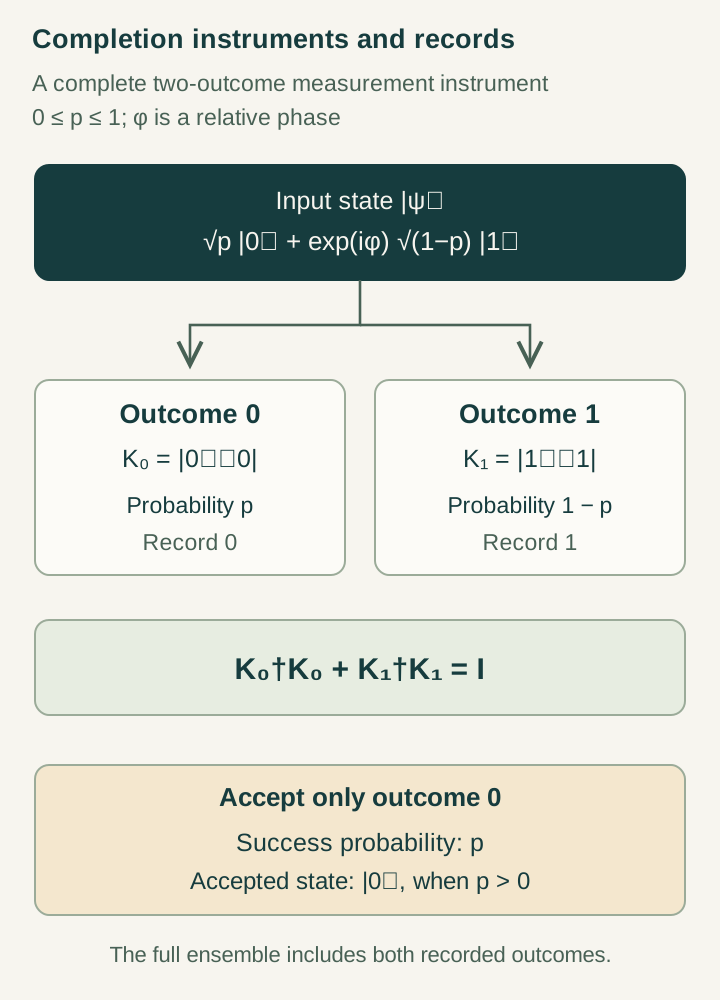
Let the two paths become correlated with normalized apparatus states r₁ and r₂. The cross term is weighted by their overlap ⟨r₁|r₂⟩. If the records coincide, the full interference is retained. If they are orthogonal and the record is ignored, the cross term vanishes in the detector marginal.
This calculation gives an operational meaning to the difference between an unrecorded alternative and an available path distinction. The apparatus need not be conscious. What matters is the physical correlation and the admitted future operations, including whether the records can be recombined coherently.
Open the full-size diagram →
What a click does and does not imply
A detector can register a localized event even when the predictive state before detection assigns amplitudes to extended alternatives. The location of the record and the support of the earlier state answer different questions. Treating them as the same object makes wave–particle language unnecessarily contradictory.
Nor does extended support alone imply controllable superluminal communication. A physical model must specify allowed operations and show how marginal probabilities respond. The temporal interpretation should recover both interference and the relevant causal restrictions, rather than infer one from a metaphor about spatial transcendence.
Inner generation and outer availability
SMM asks how a common source can generate multiple appearances. DTT distinguishes processes involved in formation from the completed record available to observation. An interferometer gives that distinction a demanding test: which internal distinctions carry phase, and which completed distinctions become stable memory?
The same source law should account for preparation, coherent transport, apparatus coupling, and retention. A picture of rapidly visiting alternatives can motivate an account, but its visit schedule must actually derive the complex amplitudes and observed statistics if it is to function as a physical explanation.
A short route with one question at each stage
Read A217 for orientation, A202 for phase selection, A112 and A116 for completion and phase-sensitive registration, and A117–A121 for stable records. Follow A129–A132 when asking how propagation relates to a shared causal cone.
At the end, write one prediction for the three phase settings above and one for fully distinguishable path records. Then ask whether a proposed DTT mechanism gives an additional result with its parameters fixed. This makes the accessible discussion useful to both new readers and researchers: intuition identifies the problem, while explicit preparation and readout determine whether the answer works.
Continue with the articles
- Reading Volume IV: Time Chest
A reading guide centered on the volume’s particle–wave and temporal-confinement themes, with questions for a later illustrated expansion.
- Real-commutant phase selection: a paper guide
Introduce the paper’s phase-selection question in real Hilbert representations. Prepare an accessible route from the commutant to compatible complex structures and their physical interpretation.
- Completion without biasing an unknown input
Explain the construction of a loaded completion channel with input-independent success probability. Clarify why this condition matters when the matter state is unknown.
- A phase-sensitive registration experiment
Outline the proposed protocol linking source coherence to later completion statistics. Compare its response matrix and energy diagnostic with a simpler qubit baseline.
- A record that carries its own completion certificate
Introduce autonomous generation of a record and a flag certifying completion. Explain why the certificate must arise from the specified dynamics rather than an external declaration.
- From a continuous pointer to a binary memory
Explain the transfer of a Gaussian pointer response into a binary record with a generated flag. Discuss the threshold approximation and what controls its error.
- Keeping an observed label stable
Study repeated interrogation of a stored label, including selective measurement backaction. Explain the transport assumptions that preserve the label and the errors they allow.
- Why light must share the same cone
Examine the additional assumption that electromagnetic dynamics inherit the constructed null geometry. A limiting cone in one sector does not automatically establish universal propagation across all fields.
Sources and reading
Read the original source for its exact formulation and edition. The examples on this page are explanatory reconstructions.